
Propaganda techniques are deliberate, systematic methods used to shape what people believe, feel, and do. They are not accidents of persuasion. Every technique, from emotional appeals to strategic omission, is chosen to produce a specific effect in a specific audience. To study propaganda techniques through history is to understand one of the most consequential forces in political life, one that has toppled governments, started wars, and manufactured consent on an industrial scale.
Harold D. Lasswell’s foundational work on WWI propaganda established the first rigorous classification of these methods, distinguishing between “value demands” such as war aims and war guilt, and “expectations” such as the illusion of inevitable victory. That framework still underpins how scholars approach propaganda methods analysis today. The psychological and rhetorical mechanisms he identified, emotional conditioning, loaded language, and the construction of an enemy image, recur across every era and every medium.
Before going deeper, here is a quick orientation to the main categories of propaganda techniques recognised across historical and modern scholarship:
- Emotional appeals: Fear, pride, outrage, and hope used to bypass rational evaluation.
- Transfer and association: Linking a cause or leader to respected symbols, institutions, or figures.
- Bandwagon: Creating the impression that everyone is already on board.
- Name-calling and glittering generalities: Attaching negative or positive labels without evidence.
- Card stacking: Presenting only the facts that support one side.
- Plain folks: Making leaders appear ordinary and relatable.
- Testimonial: Using authority figures or celebrities to endorse a position.
- Strategic omission: Excluding inconvenient truths rather than lying outright.
- Repetition: Repeating a message until it feels self-evidently true.
- Scapegoating: Blaming a group for complex social problems.
How scholars define and classify propaganda techniques
Propaganda is not simply lying. Garth S. Jowett and Victoria O’Donnell, whose textbook Propaganda and Persuasion remains a standard academic reference, define it as the deliberate, systematic attempt to shape perceptions, manipulate cognitions, and direct behaviour to achieve a response that furthers the desired intent of the propagandist. That definition separates propaganda from ordinary persuasion by emphasising intent, system, and the deliberate management of perception.
The word itself has a longer history than most people realise. The term originates from the 1622 Roman Catholic Congregation for the Propagation of the Faith, established to spread Christian doctrine to non-believers. Its meaning was neutral at that point, simply the organised spreading of a set of beliefs. The modern connotation of manipulation came later, accelerated by Lenin’s distinction between “propaganda,” which targeted the educated classes with complex ideological argument, and “agitation,” which used simple emotional triggers on mass audiences. That split, known as agitprop, reveals something important: even early theorists understood that technique must match audience.
Classic classification schemes tend to list seven to twelve core techniques. The Institute for Propaganda Analysis, founded in the United States in 1937, popularised a list of seven: name-calling, glittering generalities, transfer, testimonial, plain folks, card stacking, and bandwagon. These remain widely taught. More recent scholarship, including the work of Jowett and O’Donnell, argues that such lists are useful starting points but miss the structural complexity of real propaganda campaigns, which combine techniques, exploit media channels, and adapt to audience psychology simultaneously.
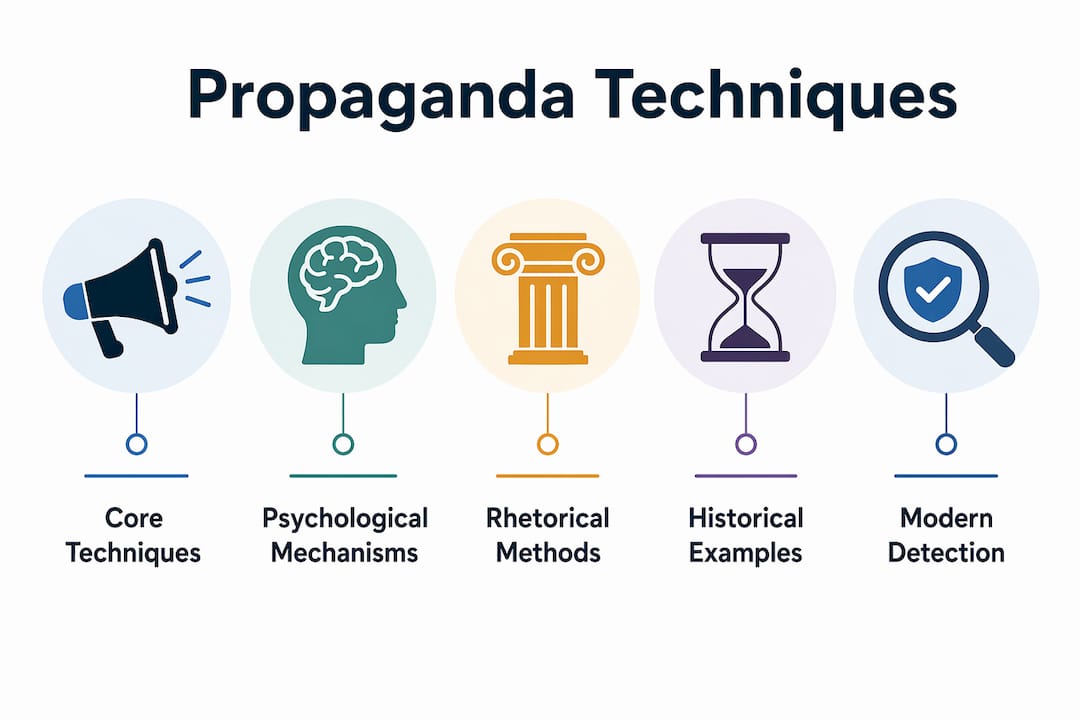
A more complete picture requires examining not just which technique is used, but who is using it, for what ideological purpose, through which medium, and against which audience. That is the shift from technique lists to structural analysis, and it defines how the field has developed over the past century. For a detailed breakdown of how these categories operate in practice, Whitebunnywabbit’s guide to types of propaganda techniques covers the classifications in depth.
Major propaganda techniques recognised in historical and modern scholarship:
- Fear appeals: Exaggerating threats to provoke anxiety and compliance.
- Euphemism: Replacing harsh realities with softer language (“collateral damage” for civilian deaths).
- Demonisation: Portraying opponents as subhuman or morally corrupt.
- False dilemma: Presenting only two options when more exist.
- Appeal to authority: Citing experts or institutions selectively to validate a claim.
- Repetition and sloganeering: Hammering a phrase until it becomes assumed truth.
- Selective truth: Stating accurate facts while omitting context that would change their meaning.
- Manufactured consensus: Creating the appearance of widespread agreement.
What psychological and rhetorical mechanisms make propaganda work?
Propaganda does not succeed because audiences are stupid. It succeeds because it exploits cognitive shortcuts that all humans rely on. Understanding those shortcuts is central to any serious study of media influence.
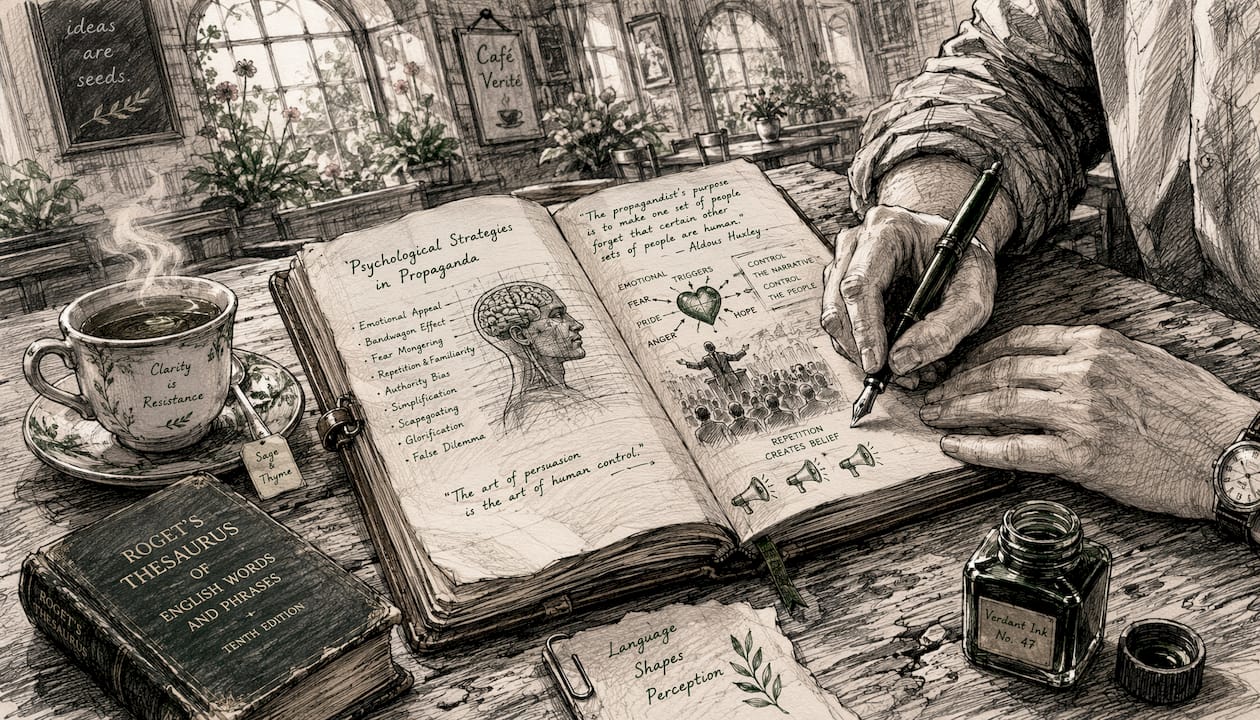
The most powerful mechanism is emotional arousal. When people feel fear, anger, or pride, their capacity for critical evaluation drops. Propagandists have understood this intuitively for centuries, and modern neuroscience confirms it. Fear appeals, in particular, work by activating threat-response systems that prioritise fast action over deliberate thought. Nazi propaganda under Joseph Goebbels weaponised this relentlessly, pairing images of physical threat with Jewish stereotypes to produce visceral disgust rather than rational assessment.
Aristotle’s three modes of persuasion, ethos (credibility), pathos (emotion), and logos (logic), provide the rhetorical skeleton that propagandists flesh out with specific techniques. Goebbels understood ethos: he controlled who was allowed to speak publicly in Germany, effectively monopolising credibility. Logos was deployed selectively through card stacking, presenting statistics and facts that supported the Nazi narrative while suppressing contradictory evidence. Pathos was the dominant mode, delivered through mass rallies, film, and music designed to produce collective emotional states. Visual symbolism and music amplify messaging in ways that purely verbal communication cannot match; flags, uniforms, and anthems all function as emotional anchors that reinforce ideological goals without requiring conscious processing.
Logical fallacies are the rhetorical tools that make weak arguments feel strong. The most common in propaganda include:
- Ad hominem: Attacking the person making an argument rather than the argument itself.
- Straw man: Misrepresenting an opponent’s position to make it easier to attack.
- Appeal to nature: Claiming something is good because it is “natural” or traditional.
- Slippery slope: Arguing that one small step will inevitably lead to catastrophic consequences.
- False equivalence: Treating two unequal things as if they are comparable.
Belief anchoring is another mechanism worth understanding. Once a person accepts an initial claim, subsequent information gets filtered through that anchor. Propagandists exploit this by establishing a simple, emotionally charged premise early, then building a more complex narrative on top of it. By the time the audience encounters contradictory evidence, the anchor is strong enough to make the new information feel wrong rather than the original claim. Recognising emotional manipulation signs in media messaging is one of the most practical skills that comes from studying these foundations.
| Psychological mechanism | Propaganda technique | Historical example |
|---|---|---|
| Fear arousal | Demonisation, threat exaggeration | Nazi anti-Jewish posters, Germany |
| Social proof | Bandwagon, manufactured consensus | Soviet election propaganda |
| Authority bias | Testimonial, appeal to authority | WWI British recruitment posters |
| Emotional conditioning | Repetition, music, symbolism | Nuremberg rallies |
| Cognitive anchoring | Sloganeering, false dilemma | “War on Terror” framing |
Historical examples of propaganda in action, with a focus on British cases
The history of British propaganda is longer and more sophisticated than the country’s self-image as a nation of plain-speaking pragmatists might suggest. From the Jacobite pamphlet wars of the early eighteenth century to the carefully managed information campaigns of both World Wars, Britain has produced some of the most technically accomplished propaganda in Western history.
The Lusitania medal: repurposing the enemy’s message
The sinking of the RMS Lusitania on 7 May 1915, which resulted in significant loss of life among passengers and crew, became one of the most effectively repurposed propaganda events of WWI. A German artist, Karl Goetz, produced a satirical medal depicting the ship going down, intending to criticise the Cunard Line for carrying munitions on a passenger vessel. Britain’s propagandists recognised immediately what they had. The British government reproduced the medal in large quantities and distributed copies alongside a document framing the medal as evidence of German celebration of civilian murder. What had been a German critique of British commercial recklessness became, in British hands, proof of German barbarism. The technique here is a classic boomerang: take an opponent’s message, reframe its context, and redirect it against them.
The Lusitania case also illustrates card stacking at the state level. The British government flatly denied that the ship carried munitions, a claim that shaped public opinion in both Britain and the United States for decades. The emotional impact of the medal campaign was significant in hardening American attitudes toward Germany in the years before the US entered the war in April 1917.
Paul Revere and the Boston Massacre engraving
Paul Revere’s 1770 engraving of the Boston Massacre is one of the earliest and most studied examples of visual propaganda in the English-speaking world. The image exaggerated the events of 5 March 1770, portraying British soldiers as a disciplined firing squad executing unarmed civilians, when the historical reality was considerably more chaotic and contested. Revere’s image was widely reproduced and distributed throughout the American colonies, and historians credit it with materially shifting colonial opinion against British rule. From a British perspective, it is a case study in how a single piece of visual propaganda, produced quickly and distributed through print networks, can define an event’s meaning for generations.

British WWI propaganda: the machinery of consent
Britain established the War Propaganda Bureau in August 1914, just weeks after the war began. The Bureau, operating from Wellington House in London, recruited leading writers including Arthur Conan Doyle, H.G. Wells, and Rudyard Kipling to produce material supporting the war effort. The operation was kept secret from the public; the writers’ work appeared as independent commentary rather than government output. This is a textbook example of what modern analysts call “black” or “grey” propaganda, where the true source is concealed or obscured.
Recruitment posters from this period deployed the plain folks and testimonial techniques alongside powerful shame appeals. The “Women of Britain Say Go!” poster and Alfred Leete’s iconic Kitchener recruitment image both used direct address and personal authority to create a sense of individual obligation. The Kitchener poster’s pointing finger and direct gaze were later adapted by the American “I Want You” Uncle Sam poster, illustrating how effective propaganda techniques migrate across national contexts.
Nazi propaganda and its reach into Britain
Joseph Goebbels, as Reich Minister of Propaganda from 1933, ran the most technically sophisticated state propaganda operation the world had seen to that point. His control extended across film, radio, print, and public spectacle. The 1934 Nuremberg rally, filmed by Leni Riefenstahl as Triumph of the Will, set a new standard for the use of cinema as ideological tool. The film’s techniques, including low-angle shots of Hitler to suggest power, vast crowd sequences to demonstrate mass support, and a carefully composed musical score, were studied by propagandists and filmmakers worldwide.
Nazi propaganda reached into Britain through radio broadcasts, most notably Lord Haw-Haw (William Joyce), whose English-language broadcasts from Germany were designed to undermine British morale by suggesting the war was unwinnable. The British government’s response was to counter with its own radio output through the BBC, which developed a reputation for factual accuracy precisely because it occasionally reported bad news. That credibility became a propaganda asset in itself.
| Period | Technique used | Medium | Effect on public opinion |
|---|---|---|---|
| WWI Britain | Boomerang reframing, card stacking | Print, medals, pamphlets | Hardened anti-German sentiment in UK and US |
| American Revolution (1770) | Visual exaggeration, emotional appeal | Engraving, print distribution | Shifted colonial opinion against British rule |
| WWII Britain | Credibility building, counter-broadcast | Radio, film, press | Maintained morale; undermined enemy broadcasts |
| Nazi Germany | Spectacle, demonisation, repetition | Film, radio, rallies | Manufactured mass ideological compliance |
| Jacobite pamphlet wars | Legitimacy claims, emotional appeals | Handbills, printed declarations | Attempted to shift loyalty from Hanoverian succession |
How propaganda theory evolved from Lasswell to the PropaInsight framework
The study of propaganda as a formal discipline began in earnest during and after WWI. Before Lasswell, propaganda was discussed in terms of its effects, but rarely analysed as a system with identifiable components. His 1927 work Propaganda Technique in the World War changed that. Lasswell proposed that propaganda could be classified by its content, specifically by the psychological materials it deployed, and by the organisational procedures used to produce and distribute it. His categories of war aims, war guilt attribution, and the illusion of enemy collapse gave researchers a vocabulary for analysis rather than just description.
The decades following WWII saw a shift toward understanding propaganda as a social and ideological process, not just a set of techniques. Jowett and O’Donnell’s 10-step analytical plan, developed across successive editions of their textbook, moved the field significantly further. Their framework asks analysts to identify: the ideology and purpose of the propaganda campaign; the context in which it operates; the organisational structure behind it; the propagandist’s identity; the target audience; the media techniques employed; the special techniques used to maximise effect; audience reactions; counter-propaganda efforts; and the long-term effects of the campaign. That is a structural analysis, not a technique checklist, and it demands that researchers understand the full social and political context of any propaganda campaign before drawing conclusions.
Discourse analysis entered the field as a complementary tool, particularly for understanding how propaganda constructs social reality rather than simply distorting it. Rather than asking “is this claim true or false?”, discourse analysis asks how language choices, framing decisions, and narrative structures produce particular ways of understanding the world. This approach is especially useful for studying news framing effects and the subtle ways that media coverage can function as propaganda without ever stating a demonstrably false claim.
The PropaInsight framework represents the current frontier of analytical thinking. It integrates three dimensions that earlier models treated separately: technique identification (what method is being used?), arousal appeals (what emotional state is the message designed to produce?), and intent analysis (what ideological or political goal does the message serve?). By combining all three, PropaInsight produces a richer picture of why a particular piece of propaganda succeeded or failed with its intended audience.
The evolution of analytical frameworks tracks closely with changes in media technology. Print propaganda required physical distribution networks and was relatively slow to spread. Radio collapsed that delay and allowed propaganda to reach mass audiences simultaneously, which is why both the British government and the Nazi regime invested so heavily in broadcast infrastructure during WWII. Film added emotional intensity through image and sound. Social media has since transformed the landscape again, enabling micro-targeted propaganda that can be tailored to individual psychological profiles at scale. Each technological shift has demanded new analytical tools, and the frameworks developed by Lasswell, Jowett and O’Donnell, and the PropaInsight team all reflect the media environments of their respective eras.
Key developments in propaganda theory:
- 1927: Lasswell establishes content classification and organisational analysis as core methods.
- 1937: The Institute for Propaganda Analysis publishes its seven-technique framework for public education.
- 1960s–1980s: Critical theory and discourse analysis enter the field, shifting focus from technique to ideology.
- 1992 onwards: Jowett and O’Donnell’s 10-step structural model becomes a standard academic reference.
- 2020s: Machine learning and natural language processing enable large-scale automated propaganda detection, as reflected in the PropaInsight framework.
What recent research reveals about detecting and analysing propaganda
Modern propaganda detection has moved well beyond reading a poster and identifying a technique. The PropaInsight framework addresses a genuine limitation in earlier approaches: expert-only annotation produces datasets that are too narrow to capture the full range of propaganda in complex real-world environments, particularly in political and military contexts where intent is deliberately obscured. By combining technique labels with emotional arousal scores and ideological intent markers, the framework allows analysts to ask not just “what technique is this?” but “what was this message designed to make its audience feel, and toward what end?”
Julian Richards’ work on discourse analysis highlights a related challenge. Extremist narratives and misinformation rarely announce themselves as propaganda. They work by constructing a particular social reality through accumulated framing choices, word selections, and narrative patterns. Detecting them requires understanding how social beliefs develop through language, not just identifying false claims. This is why discourse analysis has become an indispensable tool for researchers studying contemporary propaganda in online environments.
The difficulty of distinguishing intent from technique is one of the central problems in current research. A message can use fear appeals without being propaganda, if the fear is proportionate and the source is transparent. Propaganda uses fear appeals to manipulate, concealing its intent and distorting its evidence. Capturing that distinction in an analytical framework, whether human or automated, requires contextual knowledge that goes well beyond the text itself.
Key findings from recent propaganda research:
- Expert annotation alone produces datasets too narrow for robust automated detection.
- Emotional arousal and ideological intent must be analysed alongside technique for meaningful results.
- Discourse analysis reveals how propaganda constructs social reality through framing, not just through false claims.
- Context-aware analysis is necessary to distinguish legitimate persuasion from manipulative propaganda.
- Modern propaganda increasingly operates through strategic omission rather than outright falsehood.
Pro Tip: When analysing a text for propaganda, read it twice: once for what it says, and once for what it conspicuously does not say. Strategic omission, the deliberate exclusion of relevant context or contradictory evidence, is often harder to detect than outright falsehood, and frequently more effective. Cross-referencing a suspicious text against multiple independent sources is the most reliable method for surfacing what has been left out.
The role of media watchdogs in contemporary society connects directly to these analytical challenges. Organisations that monitor media output for bias, selective framing, and coordinated messaging perform, in effect, an ongoing applied version of the analytical frameworks described above. Their work is one of the practical expressions of what propaganda scholarship makes possible.
Key takeaways
Propaganda techniques are most effectively understood as systems combining psychological mechanism, rhetorical method, and ideological intent, not as isolated tricks that can be spotted from a checklist.
| Point | Details |
|---|---|
| Classification has limits | Technique lists like the IPA’s seven categories are useful starting points but miss structural complexity. |
| Psychology drives efficacy | Fear arousal, belief anchoring, and emotional conditioning explain why propaganda works across different eras. |
| Historical cases reveal patterns | The Lusitania boomerang and Revere’s engraving show how context transforms the meaning of any message. |
| Modern frameworks go deeper | PropaInsight integrates technique, emotional arousal, and intent for a richer analytical picture. |
| Omission is often the method | Strategic omission is harder to detect than falsehood and frequently more persuasive. |
Explore more at Whitebunnywabbit
Whitebunnywabbit covers political analysis, media influence, and the history of information warfare in depth. If this examination of propaganda methods analysis has sharpened your thinking, the site’s broader coverage of education and informed analysis takes that further, exploring why critical literacy in media and politics is one of the most consequential skills a person can develop. The history of propaganda is, at its core, the history of how power shapes what people think is true. Understanding that history is not an academic exercise. It is a practical defence.
Leave a Reply