Cancel culture emerges when collective public rejection, amplified by social media, targets individuals or groups perceived to have violated social norms. It is not a new human impulse. What is new is the speed, scale, and permanence with which digital platforms transform a local grievance into a global spectacle. Understanding why cancel culture emerges requires looking at three converging forces: the deep human instinct to enforce group norms through collective sanction, the psychological reward loops that make outrage contagious, and the structural properties of social media platforms that turn minor conflicts into reputational crises overnight.
The core drivers break down like this:
- Social norm enforcement: Communities have always used collective pressure to police behaviour. Social media removes the geographic limits that once contained these responses.
- Group identity and belonging: Participating in a cancellation reinforces in-group solidarity and signals moral alignment with the group.
- Algorithmic amplification: Platform design rewards outrage-driven content with visibility, accelerating the spread of cancellation campaigns far beyond their original audience.
- Psychological contagion: Social cancelling spreads like a contagion, with individuals joining punitive collective action to gain agency and belonging.
- Political and cultural divides: A Pew Research Center survey from May 2021 found that 58% of U.S. adults view calling out on social media as accountability, and 38% see it as unjust punishment, with sharp partisan splits shaping those views.
These forces do not operate in isolation. They combine in ways that make cancel culture structurally embedded in modern digital life, not simply a product of any one political movement or cultural moment.
How cancel culture evolved from public shaming to digital pile-ons
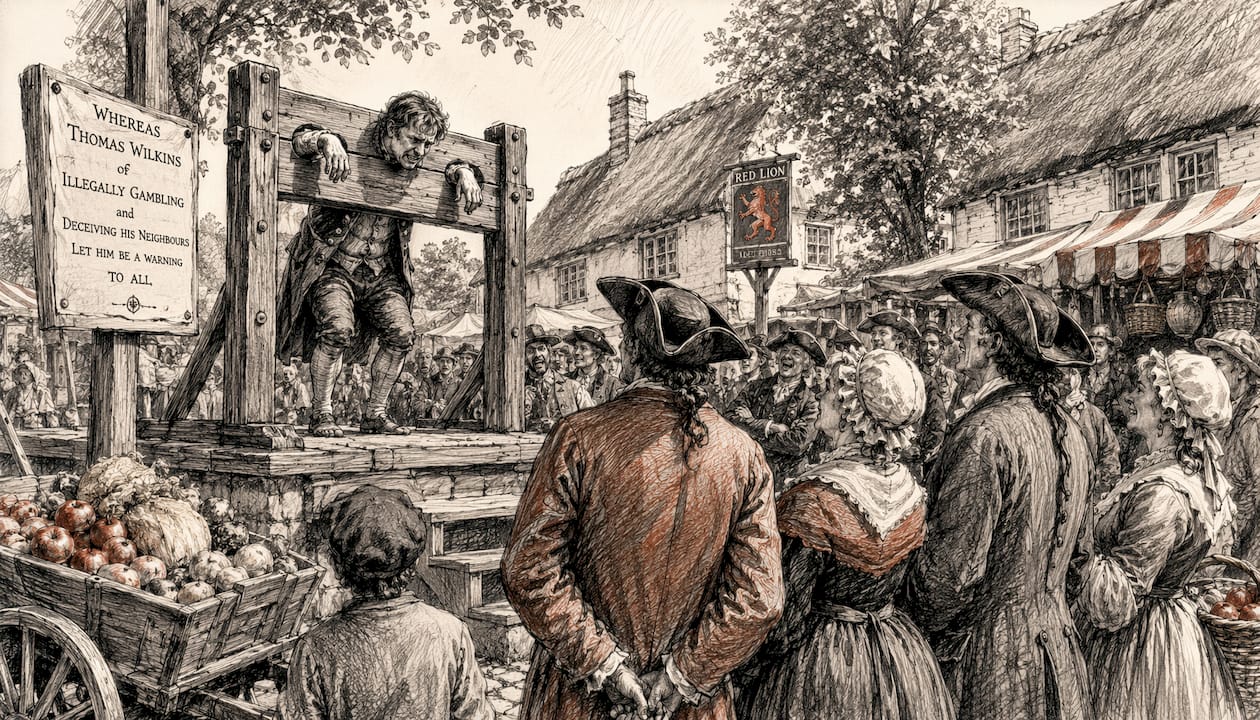
The impulse to collectively sanction those who break community norms is as old as organised society. What we now call cancel culture has direct ancestors in practices that predate the internet by centuries.
Pre-modern communities used shunning, charivari (a form of public mockery directed at social transgressors), and formal excommunication to enforce shared values. These were not fringe acts of cruelty. They were recognised mechanisms for maintaining social order in communities where reputation was a primary social currency. Cambridge University professor Nathan Cofnas has pointed to excommunication in traditional religions and social consequences against academics as early examples of the same underlying dynamic.
The American Revolution offers a particularly clear historical parallel. When the British Parliament enacted the Stamp Act, colonial merchants in New York, Boston, Philadelphia, and other seaports organised boycotts of British goods, publicly shaming and ostracising traders who refused to sign the embargo. The names of uncooperative merchants were printed and circulated, resulting in deliberate social and commercial exclusion. The structure is identical to a modern cancellation campaign: perceived transgression, collective condemnation, public identification, and economic consequence.
The specific term “cancel culture” has a much shorter history. It emerged from Black Twitter slang in the mid-2010s, where “cancelling” initially referred to a personal decision to stop supporting a person or their work. By 2015, the concept had spread widely across the platform. After high-profile cases of online shaming gained broad public attention, the term expanded to describe a widespread, outraged online response directed at a single target. Historian Nicole Hemmer has traced earlier versions of the same behaviour on the political right, including McCarthyism in the 1940s and 1950s, which targeted individuals suspected of communist sympathies, and the Hollywood blacklist that followed.
Key milestones in the modern evolution of cancel culture include:
- 2017: Sexual assault allegations against Harvey Weinstein led to his expulsion from the Academy of Motion Picture Arts and Sciences and contributed directly to the rise of the #MeToo movement.
- Late 2019: Public discourse around “cancel culture” intensified sharply, with the phrase entering mainstream political commentary.
- 2020s: The term became a shorthand in political debate, applied to incidents ranging from social media pile-ons to book bans and statue removals.
- UK context: British debates have centred on university “no-platforming” controversies, the removal of historical statues, and disputes over broadcasting standards, reflecting the same underlying tensions between accountability and free expression.
What changed between the colonial merchants and the Twitter pile-on is not human nature. It is the technology that carries the sanction.
How group identity and political divides shape cancel culture
Cancel culture is not experienced the same way by everyone. Who you are, what you believe, and which political tribe you belong to heavily shapes whether you see a cancellation as justice or persecution.
Social identity theory offers the clearest framework here. People derive a significant part of their self-concept from the groups they belong to, and they are strongly motivated to protect and enhance the status of those groups. When a cancellation targets someone perceived as an out-group member, in-group participants experience it as norm enforcement and social progress. When it targets an in-group member, the same behaviour reads as mob injustice or political persecution. The target’s group membership, not the severity of the alleged transgression, often determines the response.
Research on partisan identity confirms that political allegiance is the most potent driver of cancel culture attitudes, frequently overriding stated values like free speech or accountability. People who claim to prioritise free speech will support cancellation when the target is a political opponent, and vice versa. Values become rhetorical tools rather than genuine constraints on behaviour.
The Pew Research Center data illustrates the partisan split clearly:
| Group | Primary view of calling out on social media |
|---|---|
| U.S. adults overall | 58% view it as accountability; 38% see it as unjust punishment |
| Conservative Republicans | A notable minority describe it as censorship |
| Moderate/liberal Republicans | A smaller minority describe it as censorship |
| Democrats (regardless of ideology) | A small minority describe it as censorship |
The divide is not simply about cancel culture itself. It reflects deeper disagreements about who holds power, whose speech deserves protection, and what accountability should look like in a democratic society. Harvard University professor Pippa Norris has noted that the controversies surrounding cancel culture sit precisely at this fault line: between those who argue it gives voice to marginalised communities and those who argue it suppresses free speech and open debate.
Group dynamics compound this further. Moral positioning, the act of publicly declaring one’s values through condemnation of others, serves a social comparison function. It signals virtue to in-group members and reinforces collective identity. Strategic scaling models from recent social science research integrate Self-Categorisation Theory and Social Comparison Theory to explain how these group dynamics translate into coordinated cancellation campaigns at scale.
Pro Tip: When you encounter a cancellation story, check which political or cultural group the target belongs to before forming a view. Partisan framing shapes the narrative before you even read the details, and recognising that bias is the first step to assessing the situation accurately.
How social media and technology amplify cancel culture
Social media did not invent the impulse to cancel. It removed every structural limit that once kept that impulse contained.

Before digital platforms, geographic and social buffers meant that collective sanction was largely local. A community could ostracise a member, but the reach of that sanction was bounded by who knew the person. Social media eliminates those boundaries entirely. A post made in Edinburgh can attract condemnation from users in Lagos, São Paulo, and Toronto within hours, none of whom have any prior connection to the person or the context.
The structural effect goes further than reach. Platform affordances, the specific design features of social media tools, actively enable rapid third-party recruitment to conflicts. Quote-tweeting, sharing, and reacting are frictionless acts that allow millions of people to join a pile-on without any meaningful investment in the original dispute. Each interaction feeds the algorithm, which then amplifies the content to a wider audience, creating a self-reinforcing cycle.
Algorithmic amplification is not neutral. Platforms optimise for engagement, and outrage consistently generates more engagement than measured commentary. Outrage-driven content receives preferential distribution, which means cancellation campaigns are structurally rewarded by the platforms on which they occur. The technology does not merely carry the message. It selects for the most inflammatory version of it.
Digital features that routinely escalate minor conflicts into major public spectacles include:
- Algorithmic ranking: Content that generates strong emotional reactions, particularly anger and moral indignation, receives higher visibility scores.
- Viral sharing mechanics: Retweets, shares, and quote posts allow third parties to amplify a conflict without adding new information or context.
- Decontextualisation: Short-form content strips away nuance, making it easy to present a complex situation as a clear moral violation.
- Permanence: Digital records do not fade. A post from a decade ago can resurface and trigger a cancellation campaign with no statute of limitations.
- Anonymity and distance: Physical and social distance reduces inhibitions, making people more willing to participate in punitive behaviour online than they would be in person.
- Notification systems: Real-time alerts keep participants engaged and emotionally activated throughout the lifecycle of a campaign.
Younger people’s early adoption of social media intensified the shock-and-awe quality of cancellation campaigns, though research also suggests these online mobilisations often lack sustained political organisation beyond the initial burst of outrage. The pile-on burns hot and fast, then dissipates, leaving the target to deal with lasting reputational damage while the crowd moves on.
Pro Tip: Before sharing a cancellation story, ask whether the original post you are seeing is the full context or a screenshot selected to maximise outrage. News cycle manipulation is a documented tactic, and cancellation campaigns are particularly vulnerable to it.
The psychology behind why people cancel others
Cancel culture follows a predictable psychological sequence. Understanding it explains why ordinary, well-intentioned people end up participating in behaviour that can cause disproportionate harm.
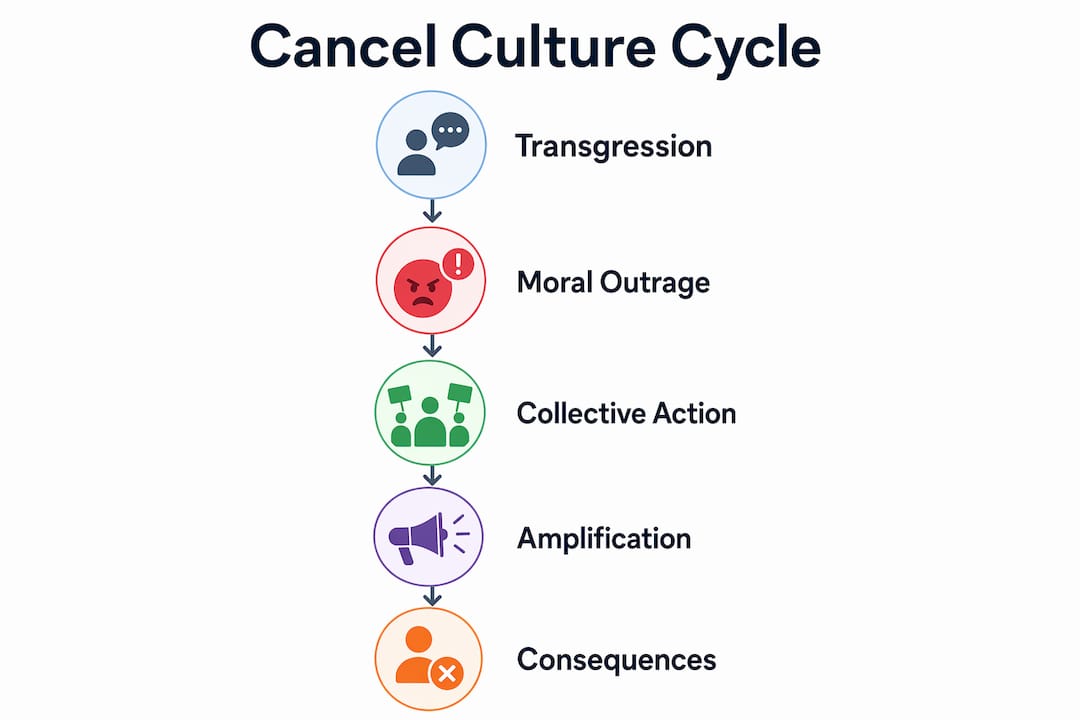
The sequence begins with the perception of a transgression. Someone says or does something that violates a widely shared norm, or is framed as doing so. This triggers moral outrage, a specific emotional state combining anger, disgust, and a sense of injustice. Moral outrage is not simply an unpleasant feeling. It is motivating. It drives people to act, specifically to punish the transgressor and signal their own moral standing to the group.
Psychology Today describes this as the “moral outrage loop”: the act of participating in collective punishment generates a psychological reward, reinforcing the behaviour and making further participation more likely. This is what makes cancel culture contagious. Each person who joins the pile-on receives a small social and psychological reward, which encourages others to join, which amplifies the campaign, which attracts still more participants.
The individual act of cancelling escalates into collective social cancelling through this contagion mechanism. What begins as one person’s expression of outrage becomes a coordinated campaign as others, seeking the same psychological rewards, add their voices. Group belonging is reinforced with every new participant, creating a feedback loop that is difficult to interrupt from within.
Several cognitive biases make this process worse. Confirmation bias leads participants to seek out information that confirms the transgressor’s guilt and dismiss evidence that complicates the picture. The bandwagon effect makes the sheer volume of condemnation feel like evidence of wrongdoing. And the fundamental attribution error causes observers to attribute the transgressor’s behaviour to character rather than context, making forgiveness or nuance feel like a moral failure.
The result is a system that routinely produces punishment disproportionate to the original offence. Due process, the principle that accusations should be tested before consequences are imposed, has no structural equivalent in social media cancellation. The speed of the pile-on means that reputational damage is done before any measured assessment is possible.
Is cancel culture accountability or mob justice? The debates you need to know
Cancel culture sits at the intersection of some of the most contested questions in contemporary public life: who gets to define acceptable speech, what accountability looks like outside formal institutions, and whether collective social pressure is a legitimate tool for social change.
The accountability argument is straightforward. Formal institutions, whether legal, professional, or political, have historically failed to hold powerful people responsible for genuine harms. Cancel culture, on this reading, is a democratisation of accountability. Media studies scholar Eve Ng defines it as “the withdrawal of any kind of support for those who are assessed to have said or done something unacceptable or highly problematic, generally from a social justice perspective.” Lisa Nakamura, a professor at the University of Michigan, describes it as “the ultimate expression of agency” for people who have limited power over what they encounter on social media.
The mob justice critique is equally serious. Legal scholars note that while cancellation by private groups is constitutionally protected free speech, it operates entirely outside the procedural safeguards that formal accountability mechanisms provide. There is no right to respond, no standard of evidence, no proportionality requirement, and no appeal process. The “democratisation” of conflict escalation means ordinary individuals can now inflict reputational harm at scale, bypassing traditional gatekeepers and due process entirely.
The economic and professional consequences for targets are real and often severe. Job losses, terminated contracts, withdrawn invitations, and sustained harassment campaigns have followed cancellations across sectors from entertainment to academia to journalism. Philosopher Slavoj Žižek has argued that cancel culture represents “a retreat into a cultural fortress” that ultimately strengthens resistance to the causes it claims to advance.
Partisan media plays a significant role in shaping how these debates land. The same cancellation event is routinely framed as heroic accountability by one set of outlets and as authoritarian censorship by another, with the framing determined almost entirely by the political identity of the target. Misinformation tactics frequently enter the picture, with cancellation campaigns sometimes built on decontextualised screenshots, selectively edited video, or outright fabrications that spread faster than corrections.
The UK context adds its own dimensions. Debates around no-platforming at British universities, the BBC’s editorial standards under public pressure, and the removal of statues associated with the slave trade have all been framed through the cancel culture lens, with the same partisan splits visible in American discourse appearing in British political commentary. Whether cancel culture is necessary, as the article’s related question asks, depends almost entirely on whether you believe existing accountability mechanisms are adequate. For those who have experienced institutional failure firsthand, the answer is often yes. For those who have been the target of a disproportionate pile-on, the answer is emphatically no.
Key takeaways
Cancel culture emerges from the intersection of deep human norm-enforcement instincts, psychological reward loops tied to moral outrage, and social media architectures that structurally amplify and accelerate collective sanction.
| Point | Details |
|---|---|
| Social media removes containment | Platform design eliminates geographic and social buffers that once limited the reach of collective sanction. |
| Partisan identity drives attitudes | Research shows political allegiance is the most potent driver of cancel culture views, overriding stated values like free speech. |
| Outrage is psychologically rewarding | Participating in collective punishment generates social and psychological rewards, making cancel culture contagious. |
| Historical roots run deep | Colonial-era boycotts and public shaming share the same structural logic as modern cancellation campaigns. |
| Pew data shows a divided public | 58% of U.S. adults view calling out on social media as accountability; 38% see it as unjust punishment. |
Whitebunnywabbit covers the political and social forces shaping public discourse. For a deeper look at how journalistic integrity affects the stories that drive these debates, explore why reporter education matters in the coverage of contentious social issues.
Leave a Reply