
Engaging a racial equity conversation is the purposeful practice of using structured, empathetic dialogue to promote understanding and inclusive action around race. Racial equity dialogue, as practitioners in education and community organising define it, differs from ordinary debate. It requires racial literacy, emotional readiness, and a commitment to sustained engagement rather than a single exchange. Activists, educators, and community leaders who apply evidence-based protocols consistently report deeper understanding and more durable change than those who rely on ad hoc discussion. This guide sets out the tools, techniques, and mindsets that make those conversations work.
What foundational tools do you need to engage racial equity conversation?
Racial literacy is the starting point for any productive racial justice dialogue. It means understanding how race operates in social systems, institutions, and everyday interactions, not just in individual attitudes. Without that grounding, participants often talk past each other, confusing personal experience with systemic pattern. Building racial literacy requires reading, reflection, and honest self-assessment before you enter any structured conversation.

Alongside literacy, a clear conversation protocol prevents discussions from collapsing into defensiveness. Preparing for racial equity talks means establishing three habits: pausing before reacting, listening to understand rather than to respond, and committing to follow-up actions after the session ends. These habits shift the conversation from performance to genuine inquiry.
The most widely cited structural framework for racial equity dialogue is Glenn Singleton’s Courageous Conversations About Race, which introduces the four agreements as foundational commitments:
- Stay engaged. Resist the urge to withdraw when discomfort rises.
- Speak your truth. Share your actual experience rather than what feels safe.
- Experience discomfort. Accept that growth happens in the uncomfortable space.
- Accept non-closure. Recognise that a single conversation will not resolve systemic issues.
These four agreements give participants permission to be imperfect. That permission is what breaks conversation paralysis. People fear saying the wrong thing, and the agreements provide a shared safety net that makes honest speech possible.
The six conditions of courageous conversation, also drawn from Singleton’s framework, extend this structure by establishing a compass of beliefs, feelings, actions, and facts. Together, the four agreements and six conditions form a protocol that educators and community facilitators can apply in classrooms, workplaces, and civic settings alike.
Pro Tip: Before any session, spend ten minutes writing down your own assumptions about the topic. Naming your biases privately makes you less likely to defend them publicly.
Which facilitation strategies keep racial equity discussions productive?
Effective facilitators keep at least 80% of conversation in a learning zone rather than a defensive posture. That figure matters because defensiveness is the single biggest barrier to progress in racial equity talks. Once a participant feels attacked, they stop listening and start protecting. The facilitator’s job is to prevent that shift.
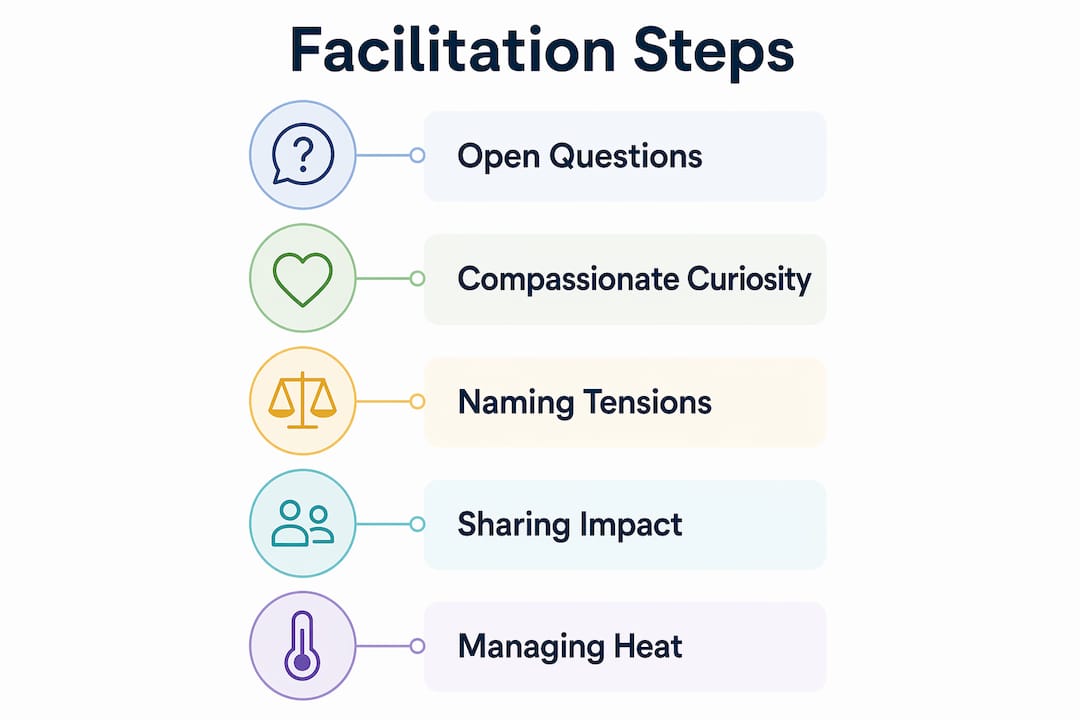
Open-ended questions are the primary tool for staying in the learning zone. “What has your experience been with this policy?” produces reflection. “Don’t you think this policy is unfair?” produces argument. The phrasing of a question determines whether you get a story or a debate.
Compassionate curiosity
Compassionate curiosity means asking what concerns someone rather than labelling their position. Instead of calling a colleague resistant, you ask what they are worried about losing. That shift from label to question opens space for connection. It is the difference between confrontation and persuasion.
Naming tensions without personal attacks is a related skill. You can say “I notice this topic brings up strong feelings in the room” without pointing at any individual. That observation acknowledges reality without assigning blame, which keeps the group moving forward.
Sharing personal impact rather than attributing intent is equally important. “When that comment was made, I felt excluded” is a fact about your experience. “You were trying to exclude me” is an accusation. The first invites dialogue. The second closes it.
| Facilitation technique | Common challenge | How to address it |
|---|---|---|
| Open-ended questioning | Participants give one-word answers | Follow up with “Tell me more about that” |
| Reframing statements | Perceived as dismissing concerns | Acknowledge the concern first, then reframe |
| Naming tensions | Feels confrontational | Use “I notice” language rather than “you” statements |
| Compassionate curiosity | Seen as deflecting | Pair the question with a genuine pause and eye contact |
| Sharing personal impact | Others feel blamed | Separate the impact statement from any intent claim |
Common mistakes to avoid in facilitation include rushing to closure, debating facts aggressively, and allowing one voice to dominate. Active listening to understand is the primary goal, not winning the argument. When facilitators model that behaviour, participants tend to follow.
Pro Tip: When a conversation heats up, try the phrase “Help me understand what you mean by that.” It signals genuine curiosity and almost always de-escalates tension.
How do you sustain racial equity conversations beyond a single session?
Immediate resolution in one conversation is unrealistic. Successful racial equity engagement treats each session as one instalment in a long-term commitment, not a problem to be solved and filed away. That reframing changes everything. It removes the pressure to reach consensus in 90 minutes and replaces it with the expectation of gradual, cumulative progress.
Organisations and community groups that sustain this work share several structural habits:
- Regular touchpoints. Quarterly culture check-ins give participants a predictable rhythm and signal that the commitment is ongoing rather than reactive.
- Clear action items. Each session should end with named tasks, responsible individuals, and realistic timelines. Vague intentions dissolve between meetings.
- Data-informed dialogue. Using demographic data, community surveys, or published research grounds conversations in shared evidence rather than competing anecdotes.
- Organisational or community support. Leaders who publicly model participation remove the stigma of engagement and signal that this work is valued, not optional.
The Georgetown Center for Social Justice describes effective racial equity dialogue as requiring alignment of head, heart, and hand. Head means intellectual reflection on systems and history. Heart means emotional engagement with lived experience. Hand means concrete action that follows from the conversation. All three must be present for dialogue to produce change rather than just awareness.
| Sustainability model | Key feature | Outcome |
|---|---|---|
| Monthly community sessions | Fixed schedule, rotating facilitation | Builds trust and shared vocabulary over time |
| Quarterly culture check-ins | Data review plus open discussion | Connects dialogue to measurable progress |
| Annual equity audit | Structured assessment with action planning | Produces accountability and public commitment |
Whitebunnywabbit covers ongoing civic engagement and social commentary that reflects this long-term approach. Readers who want to see how sustained community voices shape public discourse will find relevant context there.
What challenges arise when engaging communities in equity talks?
Emotional responses are the most predictable obstacle in racial equity discussions. Guilt, shame, anger, and grief all surface when people confront systemic injustice, and none of those responses are wrong. The facilitator’s role is to hold space for discomfort rather than rush past it. Discomfort is not a sign that the conversation is failing. It is often a sign that it is working.
Power imbalances create a different kind of challenge. When a manager and a junior employee sit in the same equity conversation, the junior employee may self-censor regardless of the stated ground rules. Third-party language focused on systemic issues rather than personal feelings helps here. Saying “research shows that organisations with homogeneous leadership make slower decisions” shifts the frame from personal accusation to structural observation.
Burnout is a real risk for facilitators and participants who engage this work intensively. Choosing strategic moments to engage, rather than attempting to correct every instance of inequity, preserves psychological safety and long-term capacity. You cannot sustain this work if you exhaust yourself in the first month.
Acknowledging diversity within racial groups is also critical. No racial group is monolithic. Treating any community as a single voice erases individual experience and burdens individuals with representing an entire group. Facilitators who avoid echo chamber dynamics create space for that internal diversity to surface.
“Vulnerability and humility are not weaknesses in racial equity dialogue. They are the conditions under which authentic connection becomes possible. When participants admit what they do not know, the conversation moves from performance to genuine inquiry, and that is where real change begins.”
Key takeaways
Effective racial equity dialogue requires racial literacy, structured protocols, and a long-term commitment rather than a single conversation.
| Point | Details |
|---|---|
| Build racial literacy first | Understand how race operates in systems before entering structured dialogue. |
| Apply the four agreements | Stay engaged, speak truth, accept discomfort, and embrace non-closure as shared commitments. |
| Use facilitation techniques | Open-ended questions and compassionate curiosity keep conversations in a learning zone. |
| Sustain through regular touchpoints | Quarterly check-ins and clear action items prevent dialogue from becoming a one-off event. |
| Navigate challenges with structure | Third-party language and holding space for discomfort reduce defensiveness and power imbalances. |
What I have learnt from years of watching these conversations unfold
The most common mistake I see is treating a racial equity conversation as a problem to be solved rather than a relationship to be built. People arrive wanting resolution. They leave frustrated when they do not get it. But the conversations that actually shift something are the ones where participants stop trying to win and start trying to understand.
Structured frameworks like the four agreements are not bureaucratic box-ticking. They are psychological permission slips. When a group agrees upfront to accept discomfort and non-closure, the whole atmosphere changes. People take risks they would not otherwise take. That is where the real dialogue begins.
The shift I notice most reliably is when someone moves from defending their position to describing their experience. That moment, when a person says “here is what this has meant for me” rather than “here is why I am right,” is when the room changes. Facilitators who learn to invite that shift, rather than waiting for it to happen spontaneously, produce far more productive sessions.
Patience is not passive. It is the active choice to stay in a conversation that has not resolved yet, to show up again next month, and to trust that cumulative dialogue produces cumulative change. That is the commitment this work requires, and it is entirely worth making.
— John
Whitebunnywabbit: resources for deeper racial equity engagement
Whitebunnywabbit publishes commentary and analysis on social justice, civic engagement, and political discourse that directly supports the kind of informed, ongoing racial equity dialogue described in this guide.

Readers who want to deepen their understanding of how education intersects with social justice will find Whitebunnywabbit’s piece on education and justice a useful companion to the frameworks covered here. The site also covers how media shapes public opinion on race, which is essential context for anyone facilitating equity conversations in community or organisational settings. Explore the full range of political and social commentary at Whitebunnywabbit to stay informed and engaged.
FAQ
What does it mean to engage in racial equity conversation?
Engaging a racial equity conversation means using structured, empathetic dialogue to build understanding of how race affects systems and lived experience. It requires racial literacy, clear protocols, and a commitment to ongoing rather than one-off discussion.
What are the four agreements in racial equity dialogue?
The four agreements, drawn from Glenn Singleton’s Courageous Conversations About Race, are: stay engaged, speak your truth, experience discomfort, and accept non-closure. They give participants a shared framework that reduces the fear of saying the wrong thing.
How do you keep racial equity discussions from becoming defensive?
Effective facilitators use open-ended questions and compassionate curiosity, asking what concerns someone rather than labelling their position. Active listening to understand, rather than to debate, keeps conversations in a learning zone.
How often should racial equity conversations take place?
Regular touchpoints such as quarterly culture check-ins are the recommended minimum for organisations committed to sustained equity dialogue. Single sessions rarely produce lasting change without structured follow-up.
How do you handle power imbalances in equity conversations?
Using third-party language that references systemic causes rather than personal feelings reduces the risk of emotional dismissal. Framing observations around research and structural patterns rather than individual behaviour protects participants and keeps dialogue productive.
Leave a Reply