
News fatigue is defined as a state of psychological exhaustion caused by prolonged exposure to excessive, predominantly negative news content. It is not a character flaw or a sign of apathy. It is a natural response from a brain that was never built to process a continuous global stream of crisis, conflict, and catastrophe. 40% of people globally now report avoiding news at least sometimes, the highest rate ever recorded. That figure tells you this is a widespread, measurable phenomenon, not a personal failing. Understanding what drives it, what it does to you, and how to manage it is the first step toward a healthier relationship with the news.
What is news fatigue and what causes it?
News fatigue is the clinical term for what researchers also call Problematic News Consumption (PNC). It describes the point at which the volume, tone, and pace of news stops informing you and starts depleting you. The news overload phenomenon has accelerated sharply with the rise of 24-hour rolling news and social media feeds designed to maximise engagement rather than understanding.
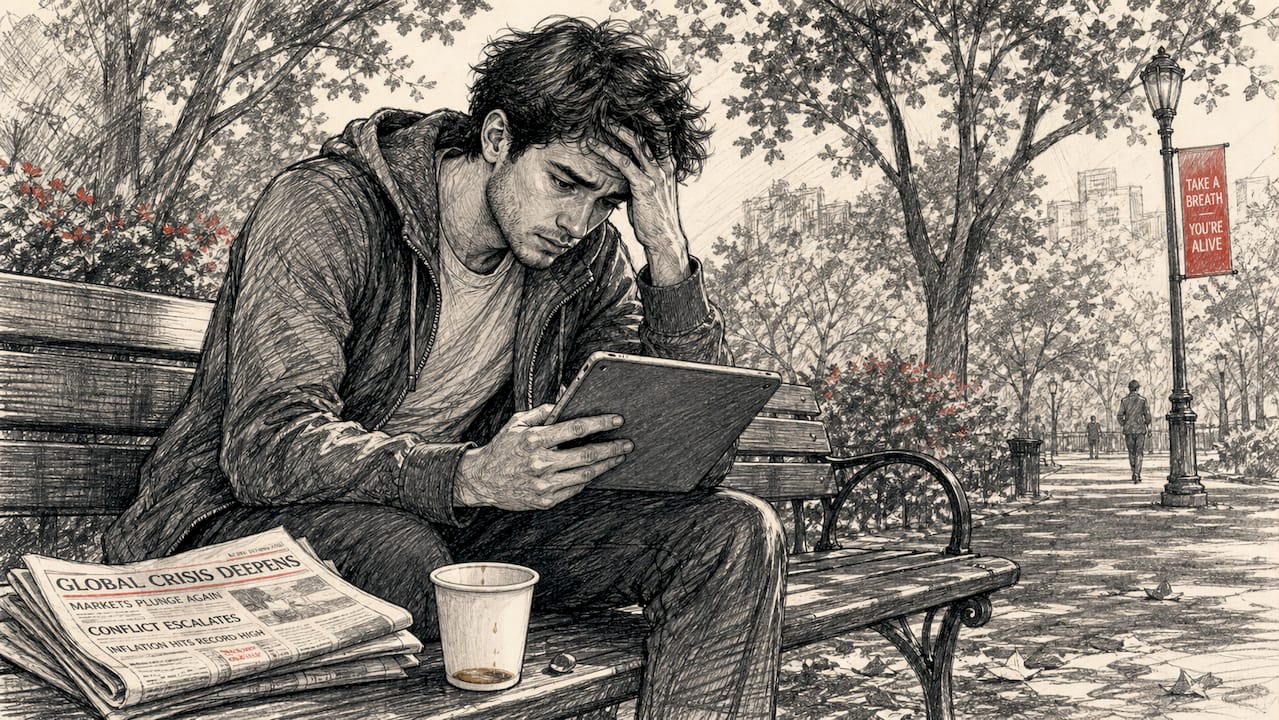
Three core forces drive the condition. First, sheer volume. The modern media environment produces more content in a single day than most people could read in a lifetime. Second, negativity bias. The human brain is wired to pay closer attention to threats than to neutral or positive information. News editors know this, which is why negative stories dominate headlines. Third, information overload and misinformation combine to create a media diet heavy in anxiety and light on resolution.
There is also an evolutionary dimension that most people overlook. News fatigue is a biological response to an environment the brain was never designed to navigate. Our threat-detection systems evolved to handle local, immediate dangers. They were not built for a continuous feed of wars, pandemics, and political crises from every corner of the planet. The result is a system stuck in a permanent state of low-level alert.
“Rage bait” content compounds this further. Algorithmically amplified outrage keeps readers scrolling, but it also keeps the stress response activated. Content homogeneity, where every outlet covers the same story in the same anxious register, removes the sense of perspective that might otherwise provide relief.
Pro Tip: If you notice you feel worse after checking the news than before, that is not a coincidence. It is your nervous system responding exactly as it was designed to, just to stimuli it was never meant to face at this scale.
How does news fatigue affect mental health and daily life?
The impact of news fatigue reaches well beyond a vague sense of tiredness. 17% of American adults meet the criteria for severe Problematic News Consumption, and 61% of that group report feeling physically or mentally unwell as a direct result. Those are not trivial numbers. They describe a significant public health pattern.
The emotional effects are well documented. Modern news coverage often produces emotional flatness rather than genuine engagement, leading to disinterest and avoidance. This is sometimes called “compassion fatigue,” where repeated exposure to suffering dulls the emotional response rather than sharpening it. You stop feeling moved by stories that would once have affected you deeply.
Excessive negative news triggers stronger physiological responses than neutral content, heightening emotional exhaustion and making it harder to disengage even when you want to. The body treats a distressing headline the same way it treats a physical threat: cortisol rises, attention narrows, and the urge to monitor for more danger increases.
The effects on daily life are just as real. Anxiety, difficulty sleeping, reduced concentration, and a sense of powerlessness are all common. Civic engagement also suffers. When people feel that nothing they do can change what they read about, they withdraw from the political process entirely. This is particularly pronounced among minority and immigrant communities, who often see their own lives and safety directly implicated in the news stories they consume.
| Effect | Description |
|---|---|
| Emotional flatness | Reduced capacity to feel empathy or concern for news events |
| Anxiety and stress | Elevated cortisol and persistent low-level worry |
| Avoidance behaviour | Actively steering clear of news to protect mental wellbeing |
| Reduced civic engagement | Withdrawal from voting, activism, or community participation |
| Sleep disruption | Difficulty switching off, particularly after evening news consumption |
The mental health and news fatigue connection is direct and measurable. Treating it as a minor inconvenience underestimates the real cost to wellbeing and public life.
How can you recognise news fatigue in yourself?
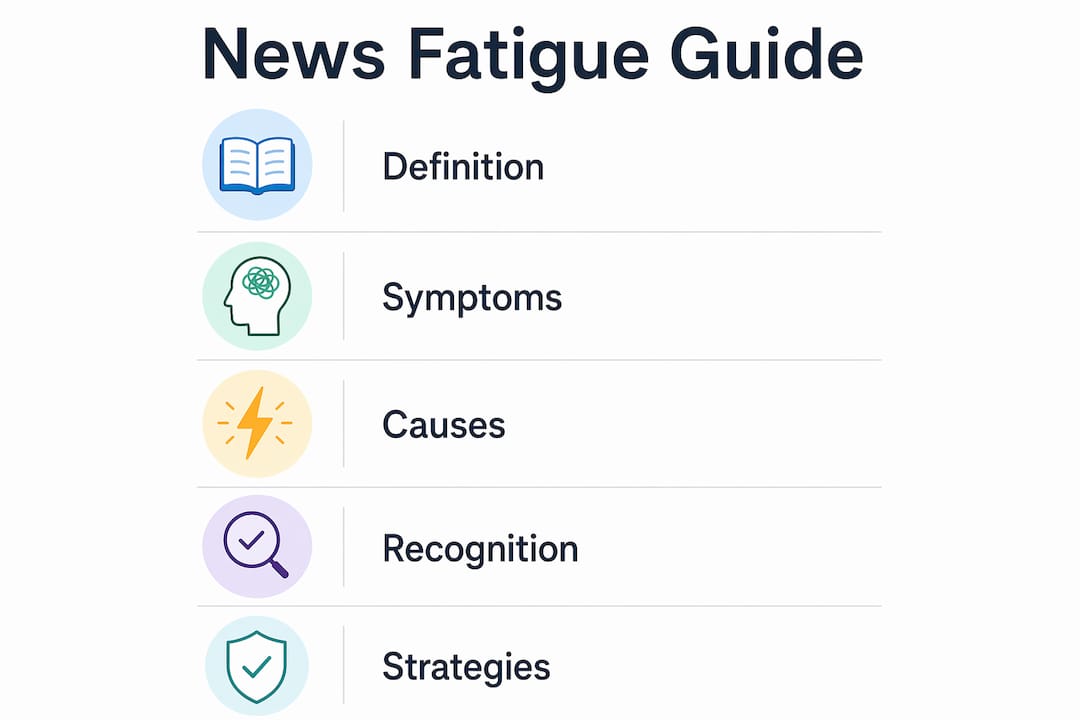
Recognising the signs early gives you the best chance of addressing them before they become entrenched. The symptoms of news fatigue fall into three broad categories: behavioural, emotional, and cognitive.
Behavioural signs:
- Avoiding news entirely, or only checking it in short, guilty bursts
- Scrolling past headlines without reading the full story
- Feeling relief when you close a news app rather than feeling informed
- Choosing entertainment over current affairs, even when you previously valued staying informed
- Delaying news checks, or setting rules for yourself that you then break
Emotional signs:
- Feeling numb or indifferent to stories that would previously have concerned you
- Experiencing a vague sense of dread before opening a news site
- Feeling helpless or powerless after reading the news
- Irritability or low mood that correlates with news consumption
Cognitive signs:
- Difficulty concentrating after reading news content
- Finding it hard to retain or process what you have just read
- Struggling to distinguish between important stories and noise
The distinction between healthy caution and dysfunctional avoidance matters here. Choosing not to read every breaking story is sensible. Avoiding all news because it feels unbearable is a sign that the news consumption mistakes you have fallen into are affecting your functioning.
Pro Tip: Keep a simple log for one week. Note how you feel before and after each news session. The pattern will tell you more than any checklist.
What practical strategies help you manage news fatigue?
Managing news fatigue does not mean ignoring the world. It means consuming news deliberately rather than passively. Setting defined time windows for news consumption, rather than checking continuously, is one of the most effective changes you can make. Two focused sessions per day, each no longer than 20 minutes, give you enough context without the cumulative toll of constant exposure.
Prioritise depth over volume
One well-reported long-form article delivers more understanding than twenty fragmented social media posts on the same topic. Prioritising trusted, in-depth journalism over reactive social feeds reduces the cognitive load of processing contradictory, incomplete information. Whitebunnywabbit covers political and current affairs topics with context and analysis, which is a more sustainable model than headline-chasing.
Curate your sources actively
Passive consumption means your feed is shaped by algorithms, not by your actual interests or needs. Active curation means choosing a small number of reliable outlets and sticking to them. Recognising news cycle manipulation tactics helps you filter out content designed to provoke rather than inform.
Close the agency gap
Identifying an actionable response to news is one of the most effective ways to reduce the psychological distress it causes. The feeling of helplessness intensifies when you absorb information with no outlet for it. Even small local actions, such as writing to a councillor, volunteering, or joining a community group, restore a sense of agency that passive news consumption strips away.
The table below compares passive and active approaches to news consumption:
| Approach | Passive consumption | Active consumption |
|---|---|---|
| Frequency | Continuous, reactive | Scheduled, deliberate |
| Source selection | Algorithm-driven | Reader-chosen, curated |
| Format | Social media fragments | Long-form, in-depth reporting |
| Emotional outcome | Anxiety, helplessness | Informed, grounded |
| Civic outcome | Withdrawal | Engagement |
- Set two fixed news windows per day and close all news apps outside those times.
- Choose three trusted outlets and remove the rest from your feeds.
- After reading a difficult story, identify one concrete action you can take, however small.
- Avoid news consumption within one hour of going to bed.
- Practise a brief digital detox one day per week to reset your baseline stress level.
Total news avoidance is not the answer. Structured, intentional engagement supports mental health far better than either compulsive consumption or complete withdrawal.
Key takeaways
News fatigue is a measurable psychological condition driven by information overload, negativity bias, and an evolutionary mismatch between the human brain and the modern media environment, and it responds well to deliberate, structured consumption habits.
| Point | Details |
|---|---|
| News fatigue is a real condition | It is defined as psychological exhaustion from excessive news exposure, not laziness or apathy. |
| Scale is significant | 40% of people globally avoid news at least sometimes, the highest rate ever recorded. |
| Mental health impact is direct | 17% of American adults meet criteria for severe PNC, with 61% reporting physical or mental illness. |
| Structured consumption helps | Setting defined time windows and prioritising depth over volume reduces fatigue effectively. |
| Agency closes the distress gap | Finding a concrete response to news stories restores a sense of control and reduces helplessness. |
Living with the news without letting it live in you
I have covered political and current affairs content long enough to know that the people most affected by news fatigue are often the most engaged and conscientious readers. They care. That is precisely why the relentless cycle wears them down.
What I have found, both personally and in observing how readers engage with content on Whitebunnywabbit, is that the shift from passive to deliberate consumption changes everything. When you choose what you read, when you read it, and what you do with it, the news stops being something that happens to you and becomes something you engage with on your own terms.
The uncomfortable truth is that most news platforms are not designed with your wellbeing in mind. They are designed to hold your attention. Recognising that is not cynicism. It is media literacy. Once you see the mechanics clearly, you can make choices that serve you rather than the algorithm.
Reframing news habits as part of your mental health practice is not a retreat from civic life. It is a precondition for sustaining it. You cannot engage meaningfully with the world if the world’s problems have left you too depleted to act.
— John
Whitebunnywabbit: read the news on your terms
News fatigue is a genuine challenge for anyone trying to stay informed without burning out. Whitebunnywabbit exists to offer political and current affairs coverage that prioritises context over noise.
If you want to understand why news literacy matters for your mental wellbeing and civic life, the resources on Whitebunnywabbit give you the grounding to read critically rather than reactively. For readers interested in how data and media trends are shaping the information environment, the future of data section offers useful context. Staying informed does not have to mean staying stressed. Whitebunnywabbit is built for readers who want to engage with the world thoughtfully.
FAQ
What is news fatigue in simple terms?
News fatigue is the mental and emotional exhaustion that comes from consuming too much news, particularly negative or distressing content. It is a natural psychological response, not a personal weakness.
What are the main symptoms of news fatigue?
Common symptoms include emotional numbness, anxiety, difficulty concentrating, a sense of helplessness, and actively avoiding news despite wanting to stay informed.
Is news fatigue the same as Problematic News Consumption?
Problematic News Consumption (PNC) is the clinical term for severe news fatigue. 17% of American adults meet the criteria for severe PNC, which includes physical and mental health consequences.
Does avoiding the news completely help with news fatigue?
Complete avoidance can actually worsen anxiety over time. Structured, intentional engagement with trusted sources supports mental health better than either constant consumption or total withdrawal.
How do I start overcoming news fatigue today?
Set two fixed news sessions per day, choose a small number of trusted outlets, and identify one concrete action you can take after reading a difficult story. Restoring a sense of agency is the fastest route to reducing distress.
Leave a Reply