
The news cycle is defined as the repeating process by which a newsworthy event is discovered, reported, updated, contested, and eventually replaced or absorbed into public memory. Every story you follow on television, social media, or a newspaper is moving through this cycle right now. Understanding what is news cycle means understanding how journalism actually works, not just what journalists say. The cycle shapes public mood, political decisions, and even market behaviour. Grasping it makes you a sharper reader of the world.
What is the news cycle and how does it work?
The news cycle is the repeating process by which a newsworthy event moves from discovery through reporting, reaction, update, and eventual replacement or memory. It is not a single broadcast or article. It is a living sequence that involves television, social media, newspapers, magazines, academic journals, and books, each playing a distinct role at a different stage. The term “information cycle” is the standard academic phrase for this process, and media scholars use it interchangeably with “news cycle” when discussing how knowledge about an event matures over time.
The cycle begins the moment an event occurs and a reporter or citizen posts the first account. From there, coverage deepens, widens, and eventually thins out as the story loses public attention or is overtaken by a newer event. The news cycle functions as a public signal loop that influences public mood, market behaviour, and political decision-making, not merely a storytelling schedule. That distinction matters enormously for anyone trying to read the news critically.

What stages make up the news cycle?
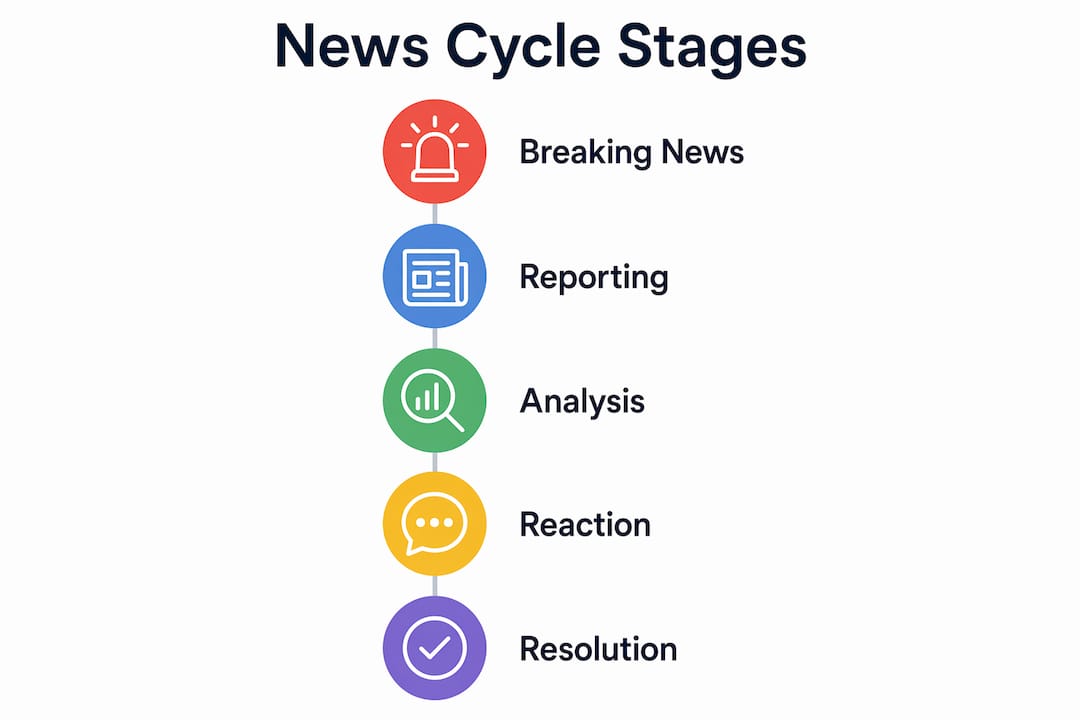
The information cycle follows a clear progression from immediate reaction to long-term analysis. Different media types serve distinct roles at each stage, and knowing which stage you are reading from tells you how much to trust what you see.
| Stage | Timeframe | Media type | Depth of coverage |
|---|---|---|---|
| Breaking news | Day 1 | Social media, TV | Brief, rapid, often unverified |
| Initial reporting | Days 2–7 | Newspapers, news websites | Broader context, some verification |
| In-depth analysis | Weeks 2–8 | Magazines, long-form articles | Detailed, fact-checked, contextualised |
| Scholarly review | Months 3–12 | Academic journals | Peer-reviewed, analytical |
| Historical record | 1 year or more | Books, archives | Definitive, comprehensive |
Breaking news arrives fast and thin. A tweet or a live television report gives you the bare facts, often incomplete. Newspapers and news websites fill in context over the following days. Magazines and long-form outlets then produce the deeper analysis that puts events in perspective. Academic journals and books arrive last, but they carry the most rigorous verification.
The depth and accuracy of reporting changes significantly across these stages. Early coverage is driven by speed. Later coverage is driven by reflection. Readers who treat a Day 1 social media post with the same authority as a peer-reviewed journal article are making a category error that the news cycle structure makes obvious once you understand it.
- Social media and TV: First on the scene, lowest verification standard.
- Newspapers: Faster than magazines, more verified than social media.
- Magazines and long-form outlets: Context and nuance, written days or weeks after the event.
- Academic journals: Rigorous analysis, published months to years later.
- Books: The final word, often written years after the event.
Pro Tip: When you encounter a breaking story, ask yourself which stage of the cycle you are reading. A Day 1 social media post and a three-month magazine investigation are not equivalent sources, even if they cover the same event.
How did the 24-hour news cycle change everything?
The 24-hour news cycle began with CNN in the 1980s and fundamentally altered the pace of journalism. Before CNN, news arrived in scheduled bulletins. After CNN, news became a continuous stream with no natural stopping point. The pressure to fill airtime created a new editorial logic: publish first, verify later.
Digital media accelerated this further. Online updates now arrive 6 to 8 hours faster than traditional print publications during major events. That speed gap sounds like an advantage, but it comes with a significant cost to accuracy. The competitive race to fill information gaps produces what journalists call the fog-of-war phase, a period of incomplete and sometimes speculative reporting before verification is possible.
The psychological effects on audiences are real and measurable. Continuous exposure to rapid news cycles raises cortisol levels, causing stress and psychological fatigue. Many readers respond by avoiding news altogether, which creates its own problems for civic engagement. The 24-hour cycle was designed to keep audiences informed. In practice, it often leaves them exhausted and misinformed during the early hours of a major story.
Editorial priorities and platform competition drive the acceleration and repetitive refresh of the news cycle, prioritising speed over accuracy during early coverage. Understanding this dynamic helps you read breaking news with appropriate scepticism rather than treating the first report as the final word.
Pro Tip: During a major breaking story, wait at least 24 hours before forming a firm opinion. The first wave of reporting is the least reliable. Read why news cycles accelerate to understand the editorial pressures behind this pattern.
Why does understanding the news cycle matter for media literacy?
Media literacy begins with understanding the news cycle. Without that foundation, readers mistake early, incomplete reports for definitive facts. The fog-of-war phase of breaking news is where misinformation takes root, because speed in breaking news comes at the cost of accuracy, and incomplete early information shapes public discourse prematurely.
The news cycle also functions as a public signal loop. It does not simply reflect reality. It actively shapes it by influencing what people worry about, what politicians respond to, and what markets price in. A story that dominates the cycle for a week can shift public opinion on a policy issue regardless of whether the underlying facts support that shift. Recognising this mechanism is the first step towards reading news as a critical observer rather than a passive recipient.
Experts recommend shifting from passive to active news consumption to combat overload and misinformation in rapid news cycles. Active consumption means asking questions rather than absorbing headlines. It means checking the stage of the cycle you are reading from and seeking out later, more verified accounts before drawing conclusions.
Practical media literacy habits for navigating the news cycle:
- Cross-reference breaking stories across at least two independent outlets before accepting them as fact.
- Identify the publication date and media type before assessing credibility.
- Seek out magazine or long-form coverage of major stories after the initial wave settles.
- Avoid sharing breaking news on social media before verification.
- Read common news consumption mistakes to audit your own habits.
Pro Tip: Headlines are designed to capture attention, not to summarise accurately. Learning how headlines shape opinion is as important as understanding the cycle itself.
Traditional news cycles versus modern overlapping loops
The older model of the news cycle followed a clear sequence. A story broke, newspapers covered it the next morning, magazines followed weeks later, and journals arrived months after that. Each stage had a defined time block and a distinct audience. The cycle was linear and relatively predictable.
Modern news cycles bear little resemblance to that model. The news cycle is now a series of overlapping loops where new developments, reactions, and reframings occur continuously rather than following a simple linear progression. A story does not wait for the newspaper to catch up before it is already being contested, updated, and reframed on social media.
| Feature | Traditional cycle | Modern cycle |
|---|---|---|
| Timeline | Sequential, predictable | Overlapping, continuous |
| Primary platforms | Print, broadcast TV | Social media, online news, podcasts |
| Update frequency | Daily or weekly | Hourly or by the minute |
| Audience interaction | Passive reception | Active commenting, sharing, contesting |
| Accuracy at launch | Higher, due to editorial delay | Lower, due to speed pressure |
| Story lifespan | Days to weeks | Hours to days, then replaced |
The implications for journalists are significant. Reporters now compete not just with other outlets but with the audience itself, which posts eyewitness accounts and commentary in real time. For readers, the overlapping loop structure means a story you read this morning may already be outdated or contested by this afternoon. Treating any single account as the complete picture is a structural mistake, not just a lapse in judgement.
Key takeaways
The news cycle is a structured, repeating process that moves from breaking news to historical record, and understanding its stages is the single most effective tool for reading news critically.
| Point | Details |
|---|---|
| News cycle definition | The repeating process of event discovery, reporting, updating, and replacement or memory. |
| Stages and media types | Social media and TV break news first; journals and books provide the most verified accounts. |
| 24-hour cycle origins | CNN launched continuous news in the 1980s; digital media now updates 6 to 8 hours faster than print. |
| Psychological impact | Rapid news exposure raises cortisol and causes fatigue, driving many readers to disengage entirely. |
| Active consumption | Shifting from passive to active news reading is the most effective defence against misinformation. |
The news cycle is faster than your ability to verify it
After years of watching news cycles play out across political crises, elections, and international conflicts, the pattern I keep returning to is this: the cycle moves faster than most readers can verify. That is not an accident. It is the product of editorial competition and platform economics that reward speed above all else.
What I find most striking is how the fog-of-war phase has become normalised. Readers now expect to be confused during breaking news. They accept early inaccuracies as the cost of being first to know. That acceptance is the real problem. The news cycle will always produce incomplete early information. The question is whether you treat that information as provisional or definitive.
My honest advice is to build a deliberate lag into your news consumption. Let a story breathe for 24 to 48 hours before you form a view. Use a personalised news feed to filter signal from noise rather than consuming everything in real time. The readers who understand the cycle are the ones who are least likely to be misled by it.
The news cycle shapes public opinion and market behaviour whether you engage with it consciously or not. The only variable is whether you are a deliberate participant or an unwitting one.
— John
Whitebunnywabbit and the tools to read news better
Whitebunnywabbit covers the political and media stories that matter, but the site also offers something less common: resources that help you understand the mechanics behind the news you consume.
The education resources at Whitebunnywabbit are built for readers who want to go beyond the headline. Whether you are a student studying media, a journalist examining your own practice, or a civically engaged reader trying to cut through the noise, the guides there address the dynamics of news cycles, media literacy, and critical consumption directly. Visit Whitebunnywabbit to explore the full range of political analysis and media commentary available on the site.
FAQ
What is the news cycle in simple terms?
The news cycle is the repeating process by which a news event is reported, updated, contested, and eventually replaced by a newer story. It spans from social media posts on Day 1 to academic journals published a year or more later.
How long does a typical news cycle last?
A single news cycle can last anywhere from a few hours for minor stories to several weeks for major political or international events. Digital media has shortened average cycle lengths significantly compared to the print era.
Why does early breaking news often turn out to be wrong?
Early breaking news suffers from the fog-of-war effect, where editorial pressure to publish quickly produces incomplete or unverified information. Accuracy improves significantly in the days and weeks following the initial report.
What is the difference between the news cycle and the information cycle?
The information cycle is the academic term for the same process. It describes how knowledge about an event matures across media types over time, from social media to peer-reviewed journals. News cycle is the common usage; information cycle is the scholarly term.
How can I protect myself from misinformation in fast news cycles?
Shift from passive to active consumption by cross-referencing stories, identifying the stage of the cycle you are reading from, and waiting for later, more verified accounts before forming firm conclusions. Avoiding satire mistaken for real news is also a practical first step.
Leave a Reply