
The Intellectual Dark Web (IDW) is defined as a loosely connected network of public intellectuals who use alternative digital media to advance heterodox viewpoints outside mainstream institutional channels. Figures such as Jordan Peterson, Eric Weinstein, Joe Rogan, and Sam Harris built this movement through podcasts and YouTube in the mid-2010s, reaching millions worldwide without a single cohesive platform. The IDW is better understood as a dispersed media ecosystem than a coherent political movement, with its influence shaped primarily by platform dynamics and audience incentives. Understanding its role requires looking past the label and examining how these voices actually operate, who they reach, and what they have genuinely changed.
What is the role of the Intellectual Dark Web in public discourse?
The IDW’s core function is to provide an alternative venue for intellectual conversations that mainstream broadcasters, academic institutions, and legacy newspapers have either avoided or actively suppressed. Alternative platforms like podcasts and YouTube allow IDW figures to bypass traditional media gatekeeping entirely, speaking directly to audiences for two, three, or even four hours at a stretch. That format alone is a structural departure from the edited, time-constrained output of television news. The importance of the Intellectual Dark Web lies precisely in this capacity to host conversations that do not fit a three-minute segment.
Long-form dialogue creates a different kind of trust. A listener who spends ninety minutes with Jordan Peterson or Sam Harris develops a sense of familiarity that a newspaper op-ed cannot replicate. This trust becomes the currency through which IDW figures influence attitudes on topics ranging from gender ideology to free speech law. The movement did not invent these debates, but it gave them a format and an audience scale that traditional media had not provided.

The IDW also operates without centralised editorial control, which is both its strength and its structural weakness. There is no editorial board deciding which arguments are permissible. That openness attracts intellectuals who feel constrained elsewhere, but it also means quality and rigour vary enormously across the ecosystem. Treating the IDW as a unified ideology is a common analytical error. It is more accurate to focus on shared themes and media strategies across a loosely associated cluster of thinkers.
Pro Tip: When assessing intellectual dark web influence, focus on the format and platform rather than the individual speaker. The medium shapes the message more than most audiences realise.
- IDW figures use long-form audio and video to build audience trust over time
- Content is distributed without editorial gatekeeping from legacy institutions
- Shared themes include free speech, opposition to political correctness, and critiques of identity politics
- The movement lacks centralised leadership or a unified political programme
What are the ideological characteristics and diversity within the IDW?
The IDW presents a broad spectrum of ideological positions, unified mainly by opposition to political correctness, identity politics, and a shared advocacy for free speech and open debate. Members range from left-leaning intellectuals such as Steven Pinker and Dave Rubin to right-leaning commentators like Ben Shapiro, with figures like Eric Weinstein and Bret Weinstein occupying positions that resist easy categorisation. This ideological range is not incidental. It is part of what gives the IDW its credibility claim: that it represents genuine pluralism rather than partisan advocacy.
The IDW also emerged partly as a reaction against postmodernist and critical theory orthodoxies in academia and mainstream media, promoting reason, universal rights, and objective truth as counter-values. Jordan Peterson’s lectures on Carl Jung and Nietzsche, Sam Harris’s arguments for secular ethics, and Steven Pinker’s defence of Enlightenment values all reflect this shared intellectual orientation. The disagreements between them, however, are real and significant.
| Member | Broad orientation | Key focus |
|---|---|---|
| Jordan Peterson | Centre-right | Mythology, psychology, opposition to compelled speech |
| Sam Harris | Centre-left | Secular ethics, neuroscience, critique of religion |
| Steven Pinker | Liberal | Enlightenment values, cognitive science, progress |
| Ben Shapiro | Conservative | Constitutional law, religious conservatism |
| Bret Weinstein | Left-heterodox | Evolutionary biology, institutional critique |
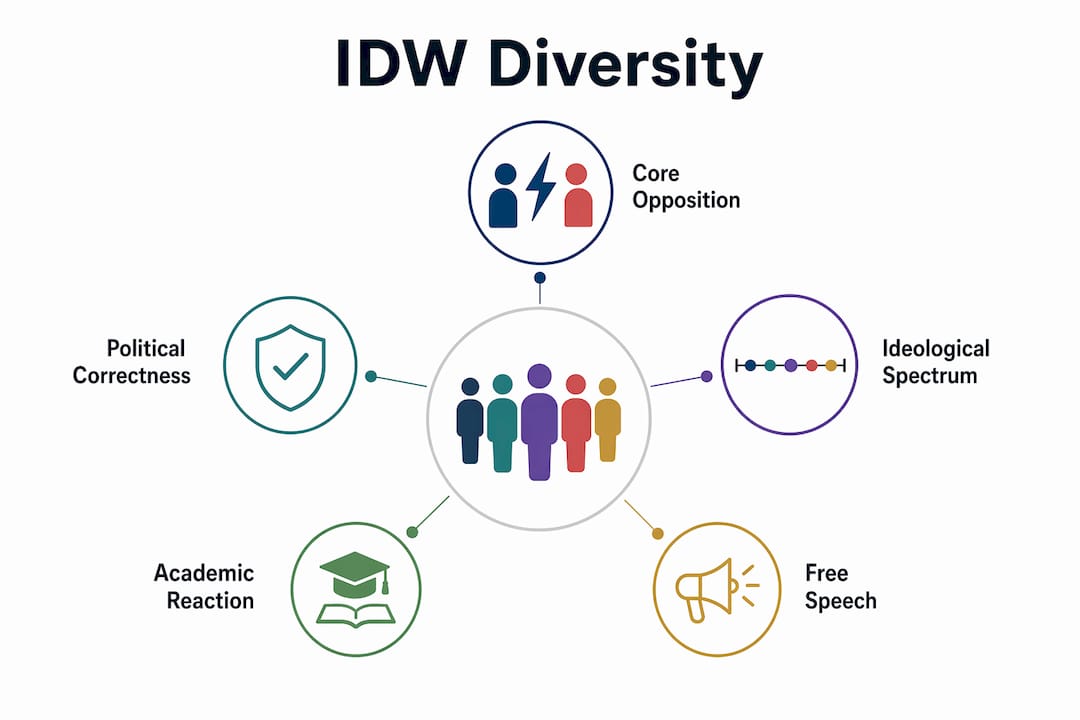
The diversity within the Intellectual Dark Web is genuine, but it operates within limits. The shared commitment to free speech functions as a kind of ideological floor, below which members rarely venture. Critics of postmodernism within the IDW emphasise restoring viewpoint diversity and resisting monocultures in intellectual life, yet the movement’s own audience demographics tend to skew male, Western, and already sympathetic to classical liberal values. That is not a disqualification, but it is a constraint on how broadly the IDW’s influence actually reaches.
What critiques and limitations surround the IDW’s role?
Critics argue the IDW overstates harms from cancel culture and political correctness, and has failed to unify politically, becoming fragmented and sometimes functioning as echo chambers rather than genuinely open forums. Progressive commentators point out that the IDW’s framing of itself as persecuted by institutional power is often exaggerated, given that figures like Peterson and Rogan command audiences in the tens of millions. Persecution and platform are difficult to hold simultaneously.
Internal fragmentation is a real and underreported problem. Some IDW members reject the label outright. Others have drifted into positions that earlier associates find untenable, creating public disputes that reveal the movement’s lack of intellectual coherence. The narrative of ‘freedom of speech’ within IDW interview ecosystems acts as a credibility device, yet audience capture dynamics subtly limit discourse boundaries. A host who depends on a particular audience for revenue has structural incentives to avoid genuinely challenging that audience’s priors.
Algorithmic curation adds another layer of complexity. A 2023 field experiment on platform X showed that algorithmic feeds shifted users’ opinions in a conservative direction, with persistent impacts even after algorithm switches. This means IDW content does not reach audiences neutrally. The platform’s own recommendation logic shapes who encounters which voices, and in what sequence. The impact of IDW on politics and society operates through nuanced pathways including content curation and followership patterns, rather than simple filter-bubble effects.
Pro Tip: When engaging with IDW content, check whether the host has meaningfully challenged a guest’s core argument, or whether the format consistently rewards agreement. The difference tells you a great deal about the actual openness of the conversation.
- Progressive critics argue the IDW exaggerates institutional suppression
- Internal disputes and label rejection reveal ideological incoherence
- Audience capture creates implicit limits on what hosts will challenge
- Algorithmic recommendation shapes IDW reach in ways neither hosts nor audiences control
What impact has the Intellectual Dark Web had on political and social issues?
Exposure to IDW-affiliated media influences cultural conversations around political correctness, identity politics, and free speech, shaping attitudes and mobilising political opinions particularly in Western societies. The IDW did not create political polarisation, but it provided a vocabulary and a set of arguments that millions of people used to articulate dissatisfaction with progressive institutional norms. That is a tangible cultural effect, regardless of one’s view of the arguments themselves.
The impact of the Intellectual Dark Web on political discourse is most visible in how mainstream debates have shifted since the mid-2010s. Topics that were once confined to academic philosophy departments, such as the limits of free speech, the epistemology of gender, and the validity of group-level statistical claims, now appear regularly in parliamentary debates, newspaper editorials, and school board meetings. The IDW did not cause this shift alone, but it accelerated the popularisation of these arguments through viral political commentary and long-form media.
| Impact area | Observable effect |
|---|---|
| Free speech debate | Mainstream normalisation of critiques against speech restrictions in universities |
| Identity politics | Wider public awareness of arguments against race and gender essentialism |
| Media trust | Accelerated decline in legacy media credibility among younger audiences |
| Political polarisation | Amplification of centre-right and heterodox left positions in digital spaces |
The movement’s future trajectory is uncertain. Several prominent IDW figures have moved into explicitly political territory, which risks collapsing the distinction between intellectual commentary and partisan advocacy. The IDW’s credibility has always rested on its claim to be above tribal politics. Once that claim becomes implausible, the audience that valued it for intellectual reasons has less reason to stay. Understanding why opinion pieces go viral helps explain both the IDW’s rise and the limits of its staying power.
Key takeaways
The Intellectual Dark Web’s role is to function as a decentralised media ecosystem that amplifies heterodox intellectual discourse through long-form digital platforms, shaping public debate on free speech, identity politics, and institutional trust.
| Point | Details |
|---|---|
| Decentralised media ecosystem | The IDW operates across podcasts and YouTube without centralised editorial control or unified leadership. |
| Ideological diversity with shared themes | Members span the political spectrum but share opposition to political correctness and advocacy for open debate. |
| Algorithmic amplification | Platform recommendation systems shape IDW reach, with persistent effects on users’ political attitudes. |
| Credibility through format | Long-form conversations build audience trust that short-form legacy media cannot replicate. |
| Fragmentation and critique | Internal disputes and audience capture dynamics limit the IDW’s claim to genuine intellectual openness. |
Why the IDW deserves more careful analysis than it usually gets
I have spent years reading commentary on the IDW, and the majority of it falls into one of two traps. Either it treats the movement as a coherent intellectual force with a unified agenda, or it dismisses it as a pipeline to radicalisation. Both readings are lazy, and both miss what is actually interesting about it.
What the IDW genuinely achieved is demonstrating that there is a large audience hungry for long-form, substantive conversation that mainstream media had stopped providing. That is a media market observation as much as a political one. The fact that Joe Rogan can hold tens of millions of listeners through a three-hour conversation about consciousness or evolutionary biology tells you something important about audience appetite, not just about Rogan.
Where I think the IDW has genuinely failed is in its relationship with its own audience. The freedom of speech narrative is real, but it has calcified in many cases into a brand rather than a practice. When hosts consistently avoid challenging their guests on core assumptions, the format becomes a performance of openness rather than the real thing. That distinction matters enormously if you are trying to assess the IDW’s actual intellectual contribution versus its cultural influence.
My honest view is that the IDW is most valuable not as a movement to follow, but as a case study in how digital media ecosystems create and sustain intellectual authority. The lessons it offers about platform dynamics, audience trust, and the limits of decentralised discourse are more durable than any individual argument its members have made.
— John
Explore more political and media analysis at Whitebunnywabbit
Whitebunnywabbit covers the kind of political and media analysis that the IDW itself claims to champion: direct, evidence-grounded, and willing to follow an argument wherever it leads. If this article has sharpened your thinking on how digital media shapes intellectual discourse, there is considerably more to explore. The site’s educational resources cover media literacy, political commentary, and the mechanics of how ideas spread in digital environments. For broader analysis of contemporary intellectual movements and the forces shaping public debate, Whitebunnywabbit is the place to keep reading.
FAQ
What is the Intellectual Dark Web?
The Intellectual Dark Web is a loosely connected network of public intellectuals, including Jordan Peterson, Joe Rogan, Sam Harris, and Eric Weinstein, who use podcasts and YouTube to advance heterodox viewpoints outside mainstream institutional media.
How does the IDW influence political discourse?
The IDW influences political discourse by using long-form digital platforms to bypass traditional media gatekeeping, building high-trust audience relationships and amplifying critiques of political correctness and identity politics at scale.
Is the Intellectual Dark Web a unified movement?
No. The IDW lacks centralised leadership, a unified ideology, and a coherent political programme. It is more accurately described as a dispersed media ecosystem united by shared themes rather than a coordinated movement.
What are the main criticisms of the IDW?
Critics argue the IDW overstates cancel culture harms, functions as an echo chamber despite claims of openness, and that audience capture dynamics limit the genuine intellectual challenge its format promises.
How do algorithms affect IDW content reach?
Research from a 2023 field experiment on platform X found that algorithmic feeds shifted users’ political opinions in a conservative direction, with effects persisting even after algorithm changes, meaning IDW content reaches audiences through a filtered, non-neutral distribution system.
Leave a Reply