
Embedded journalism is defined as the practice of attaching war correspondents to military units during active conflicts, allowing reporters to travel, live, and report from within those units. The term entered mainstream usage during the 2003 Iraq War, when the United States Department of Defense formalised the arrangement on an unprecedented scale. For media studies students and anyone tracking how conflict news reaches the public, understanding embedded journalism means grappling with a fundamental tension: proximity to the story versus independence from the story’s main actors.
What is embedded journalism and how does it work?
Embedded journalism places a reporter physically inside a military unit for the duration of a deployment or operation. The journalist eats, sleeps, and moves with soldiers, gaining access to frontline operations that no independent reporter could safely reach. This proximity produces vivid, immediate reporting that remote correspondents simply cannot replicate.
The arrangement is not informal. About 775 journalists signed formal contracts during the 2003 Iraq War, agreeing to withhold information on unit positions, future missions, and classified weapons systems. That figure illustrates the scale of the programme and the degree of institutional control involved. Signing such a contract is the price of admission to frontline coverage.
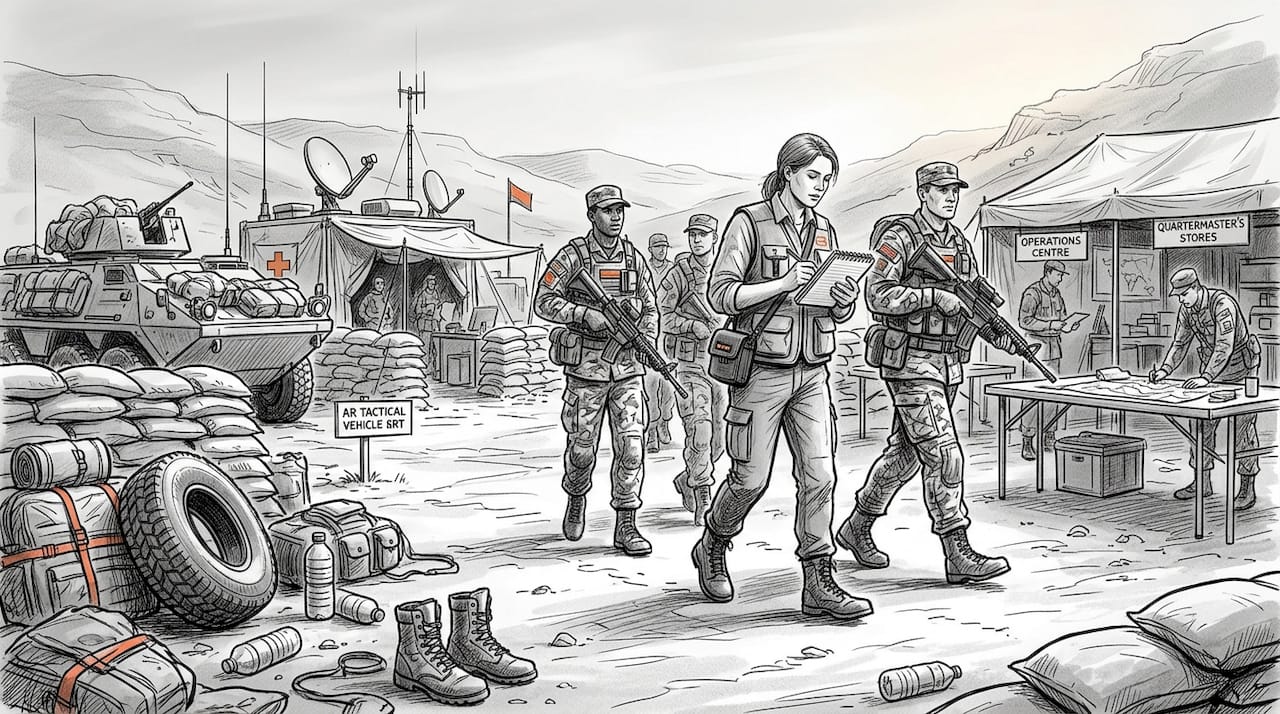
The embedded journalist’s role sits at the intersection of access and constraint. Reporters gain extraordinary material: real-time footage, soldier testimonies, and the sensory detail of combat. In exchange, they accept that the military controls their movement, timing, and the logistical pipeline through which their stories reach editors. The embedded journalism definition, then, is not simply about location. It is about a structured, contractual relationship between the press and the armed forces.
How does embedded journalism differ from traditional war reporting?
Traditional war correspondents operate independently, arranging their own transport, security, and access. They are free to interview civilians, opposition forces, and government officials without military supervision. This independence is their greatest professional asset and their greatest physical risk.
Embedded reporters trade that independence for safety and access. The contrast with so-called “unilateral” journalists, who report from conflict zones without military attachment, is stark:
- Access: Embedded journalists reach frontline operations; unilateral reporters rely on what they can independently access, often from safer distances.
- Safety: Embedded reporters benefit from military protection and logistics; unilateral reporters carry their own risk.
- Editorial control: Embedded reporters operate under contractual restrictions; unilateral reporters answer only to their editors.
- Perspective: Embedded coverage naturally centres on the military unit’s experience; unilateral reporting can incorporate civilian and opposition viewpoints more freely.
- Speed: Embedded reporters file from the action in near real time; unilateral reporters may face delays reaching the scene.
The restrictions embedded journalists accept are not merely administrative. Military embedding shapes coverage through control of movement, timing, and safety, influencing which stories get told first without a single explicit editorial instruction. That is a form of editorial influence that operates below the surface of any formal censorship.
Pro Tip: If you are studying conflict reporting, read dispatches from embedded reporters alongside those from unilateral correspondents covering the same event. The differences in framing, sourcing, and emotional register are immediately apparent and analytically revealing.
What are the advantages and disadvantages of embedded journalism?
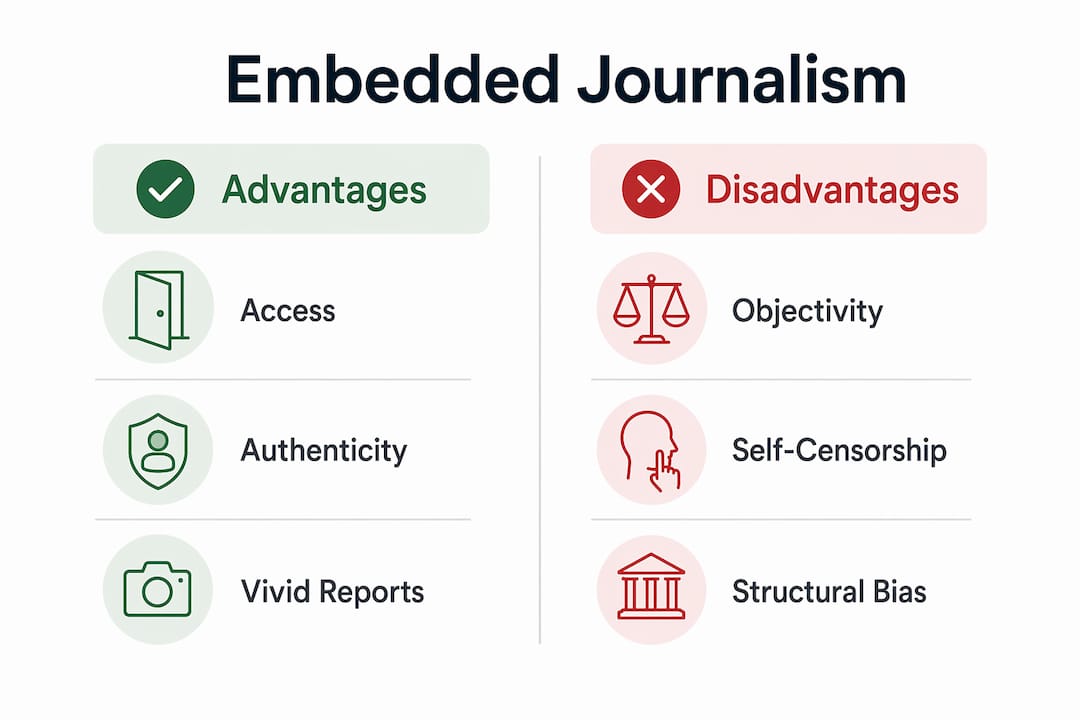
The case for embedding rests on access and authenticity. No other reporting technique puts a journalist inside a military operation with the same level of detail and immediacy. The advantages are real and should not be dismissed.
| Aspect | Advantages | Disadvantages |
|---|---|---|
| Access | Frontline presence produces vivid, immediate reporting | Access is controlled and filtered by military logistics |
| Safety | Military protection reduces physical risk to reporters | Dependency on military for safety can create reluctance to file critical stories |
| Narrative depth | Close relationships with soldiers yield human-interest detail | Coverage skews toward the soldier’s perspective, marginalising civilian voices |
| Speed | Real-time filing from the field | Military can delay or restrict transmission of sensitive material |
| Credibility | Eyewitness authority strengthens public trust | Perceived or actual bias undermines journalistic objectivity |
The access versus objectivity tension is the defining characteristic of embedded journalism. Reporters who spend weeks with a unit develop genuine relationships with soldiers. Those relationships produce empathetic, humanising coverage. They also make it harder to report critically on the unit’s conduct.
The disadvantages extend beyond individual bias. When hundreds of journalists are embedded simultaneously, as in Iraq in 2003, the aggregate effect on public understanding is significant. The dominant media narrative becomes one told from inside the military machine, with civilian suffering, opposition perspectives, and strategic failures receiving comparatively less coverage. That is not a conspiracy. It is the structural consequence of how the programme is designed.
Pro Tip: When evaluating embedded reports, ask whose voices are absent. The most revealing analytical question is not what the reporter said, but what the logistical and contractual constraints made it impossible to say.
What are the ethical and practical challenges faced by embedded journalists?
The ethical challenges of embedded journalism are not abstract. They play out in specific, documented ways that affect both individual reporters and the broader information environment.
The most immediate challenge is self-censorship. Reporters who depend on a military unit for food, transport, and physical safety are not in a neutral position when deciding whether to file a story that reflects badly on that unit. The dependency is structural, not personal, but its effects on editorial judgement are real.
Beyond self-censorship, the contractual restrictions embedded journalists accept create formal limits on what they can report. Information on unit positions, future operations, and certain weapons systems is off limits by agreement. This is not censorship in the traditional sense. It is prior restraint built into the terms of access.
Safety and training present a separate set of concerns. Many conflict reporters lack adequate safety training, protective equipment, and mental health support, according to a Reuters Institute global survey. Embedding does not resolve this. A journalist attached to a military unit is safer than one operating alone in a war zone, but they are not immune to trauma, injury, or the psychological costs of sustained exposure to combat.
“The goal is to dominate the information environment to win the war.” Lt. Col. Rick Long, United States Marine Corps, on the military’s rationale for the embedding programme.
That statement, attributed to Lt. Col. Rick Long, is the clearest articulation of what embedding serves militarily. It is not a neutral access arrangement. It is a strategic communications tool. Journalists who enter the programme without understanding this operate at a significant professional disadvantage.
Institutional responsibility is another gap. News organisations that send reporters into conflict zones bear an obligation to provide training, equipment, and psychological support. The Reuters Institute findings suggest many fall short. Embedding amplifies this gap because the military’s logistical support can create a false sense of security that reduces the urgency of employer-provided preparation.
How has embedded journalism evolved since the Iraq War?
The 2003 Iraq War did not invent embedded journalism, but it industrialised it. The Pentagon’s formal embedding programme was the largest media-military operation of its kind, and it set the template for subsequent conflicts in Afghanistan and beyond.
The military’s motives were transparent to those paying attention. Embedding was classified as a tool supporting military offensive strategies, designed to influence public narratives toward the soldier’s perspective. Managing the information environment was an explicit objective, not a side effect.
The evolution of embedded journalism since 2003 reflects several converging trends:
- Digital technology has accelerated the speed of embedded reporting, with satellite phones, social media, and portable video equipment enabling near-instantaneous filing from the field.
- Social media platforms have created new channels for embedded content, bypassing traditional editorial gatekeepers and reaching audiences directly.
- Participatory and immersive reporting has grown as a related methodology. Participatory reporting involves journalists immersing themselves in subjects’ environments to produce human-centred narratives, sharing embedded journalism’s proximity but without the military contract.
- AI-assisted analysis is beginning to influence how conflict footage and embedded dispatches are processed, verified, and distributed, raising new questions about authenticity and editorial oversight.
- Training standards have improved in some organisations following sustained advocacy from bodies including the Reuters Institute, though gaps remain significant.
The net effect on news coverage has been a public that receives more vivid, immediate conflict reporting than at any previous point in history, alongside a structural tendency for that reporting to reflect military perspectives more than civilian ones. Understanding this dynamic is not a reason to dismiss embedded journalism. It is a reason to read it critically.
Key takeaways
Embedded journalism provides unmatched frontline access but operates within a military-controlled framework that structurally shapes what reporters can observe, file, and publish.
| Point | Details |
|---|---|
| Embedded journalism definition | Reporters are formally attached to military units, accepting contractual restrictions in exchange for frontline access. |
| Scale of the 2003 programme | Around 775 journalists signed embedding contracts during the Iraq War, illustrating the programme’s institutional scope. |
| Access versus autonomy | Military control of logistics and timing shapes coverage without explicit censorship, creating structural rather than personal bias. |
| Ethical and safety gaps | Many conflict reporters lack adequate training and mental health support, a problem embedding does not resolve. |
| Military strategic intent | Embedding is designed partly to manage the information environment in favour of military objectives, not solely to facilitate neutral reporting. |
The tension that never resolves
I have spent years reading and analysing conflict coverage, and the question I return to most often is this: can a journalist embedded with a military unit ever be truly independent? My honest answer is no, and I think the field does itself a disservice by pretending otherwise.
That is not a condemnation of embedded journalism. The reporting that came out of Iraq in 2003, from journalists at the BBC, The New York Times, and dozens of other outlets, was often extraordinary in its detail and human truth. But it was extraordinary within limits. The stories that could not be told, because of contractual restrictions, logistical dependency, or the psychological weight of solidarity with soldiers, are part of the record too.
What I find most underappreciated in discussions of embedded journalism is the training deficit. Organisations send reporters into some of the most dangerous environments on earth and then fail to equip them adequately, either physically or psychologically. The Reuters Institute data on this is damning. If you are studying journalism or considering conflict reporting as a career, the question of institutional support is not secondary. It is central.
Technology is changing the practice faster than the ethics are keeping pace. AI tools, social media distribution, and portable broadcast equipment have transformed what embedded reporters can produce and how quickly. The ethical frameworks governing what they should produce have not kept up. That gap is where the most important journalism scholarship is happening right now, and it is where the most consequential decisions about conflict coverage will be made in the years ahead.
— John
Explore more at Whitebunnywabbit

Whitebunnywabbit covers the political and media stories that shape how we understand the world, including in-depth analysis of journalism practices, conflict reporting, and media ethics. If this article has prompted questions about how news is made, who controls it, and what gets left out, there is a great deal more to explore. Visit the Whitebunnywabbit education resources for further reading on media studies topics, or browse the full range of political and media commentary on the main site. The conversation about journalism’s role in conflict is ongoing, and it matters more now than ever.
FAQ
What does embedded journalism mean?
Embedded journalism means a reporter is formally attached to a military unit during a conflict, travelling and living with soldiers in exchange for frontline access. The arrangement involves contractual restrictions on what the journalist can report.
How many journalists were embedded during the Iraq War?
Around 775 journalists signed embedding contracts with the US military during the 2003 Iraq War, agreeing to withhold information on unit positions, future missions, and classified weapons.
Is embedded journalism ethical?
Embedded journalism raises genuine ethical concerns, including self-censorship, structural bias toward military perspectives, and the military’s explicit goal of managing the information environment. It is not inherently unethical, but it requires critical awareness from both reporters and readers.
What are the main qualities of embedded journalism?
The defining qualities of embedded journalism are physical proximity to military operations, contractual restrictions on sensitive reporting, dependency on military logistics, and the production of immediate, first-person conflict coverage.
How does embedded journalism differ from participatory reporting?
Participatory reporting also involves deep immersion in a subject’s environment to produce human-centred narratives, but it operates without a military contract or the logistical and editorial constraints that define embedded journalism.
Leave a Reply