

Rhetorical analysis is the practice of examining how a text uses specific strategies to persuade, inform, or entertain its audience — not what it says, but how and why it says it. Before you write a single sentence of your essay, run through this quick checklist: identify the rhetorical situation, spot the appeals (ethos, pathos, logos), select two or three key strategies, judge whether they work, then draft your thesis. A strong opening thesis sounds like this: “By combining emotive language with selective statistics, the author effectively persuades a politically anxious readership to accept stricter press regulation.” That sentence names a strategy, links it to an appeal, identifies the audience, and delivers a verdict. Everything else in your essay unpacks it.
Key takeaways
Rhetorical analysis examines how a text uses specific strategies to persuade, inform, or entertain its audience, requiring an evaluative verdict on whether those strategies succeed.
| Point | Details |
|---|---|
| Analysis vs. summary | Rhetorical analysis explains what a text does, not what it says; always take an evaluative stance. |
| Rhetorical situation first | Identify author, audience, purpose, medium, and context before analysing any appeals or devices. |
| Three core appeals | Ethos (credibility), pathos (emotion), and logos (reason) often overlap; note overlaps as your strongest evidence. |
| Claim-evidence-explain | Every body paragraph needs a claim, a short direct quotation, an explanation of effect, and a link to the thesis. |
| Thesis after evidence | Draft your thesis once you have gathered evidence, not before; it should name a strategy, an appeal, and a verdict. |
Table of Contents
- What is rhetorical analysis, and how does it differ from summary?
- What is the rhetorical situation, and why do you identify it first?
- Ethos, pathos, and logos: what do they look like in practice?
- Common rhetorical strategies and devices you need to analyse
- How to write a strong thesis and structure your body paragraphs
- A step-by-step method you can use under timed conditions
- Two worked examples showing the method in action
- Common student mistakes and how to fix them
- Why rhetorical analysis matters more than most students realise
- Sources
What is rhetorical analysis, and how does it differ from summary?
Summary tells you what a text says. Rhetorical analysis tells you what it does. The distinction sounds simple, but it trips up students at every level. When you summarise, you restate the author’s argument. When you analyse rhetorically, you reverse-engineer the persuasive blueprint — pulling apart word choice, tone, structure, and emotional appeal to show how the text produces its effect on a specific audience.
This is also why rhetorical analysis matters beyond the classroom. In an era of saturated media, the ability to distinguish legitimate rhetorical strategy from manipulation is a genuine critical skill. Whitebunnywabbit’s coverage of media bias and how it develops shows exactly why this kind of close reading has real-world stakes.
One more thing to fix early: rhetorical analysis is not about whether the author is right. Your job is to reveal the mechanics of persuasion, not to prove or disprove the claims being made. The University of Illinois Writers Workshop puts it plainly: you must take an evaluative stance on effectiveness, not on factual correctness.
What is the rhetorical situation, and why do you identify it first?
Every text exists inside a rhetorical situation — the set of circumstances that shaped it and that shape how an audience receives it. Identify this before you touch the appeals or devices, because the same sentence can function very differently depending on who wrote it, for whom, and why.
The five components to pin down:
- Author/speaker: Who is communicating? What is their position, expertise, or agenda? Look for credentials, affiliations, or tone that signals authority.
- Audience: Who is the intended reader or listener? Age, political leaning, prior knowledge, and emotional state all affect which strategies will land.
- Purpose: Is the text trying to persuade, inform, entertain, or some combination? The purpose determines whether a strategy succeeds or misfires.
- Medium: Where does the text appear? A broadsheet op-ed, a social media post, and a parliamentary speech each carry different conventions and constraints.
- Context: What historical, cultural, or political moment surrounds the text? Context can transform a neutral phrase into a charged one.
Here is a quick illustration. Take a government minister’s statement on immigration policy. Addressed to a parliamentary committee (audience: informed legislators; medium: formal debate), the statement reads as measured and evidence-led. Reframe it as a campaign leaflet dropped through suburban letterboxes (audience: undecided voters; medium: print flyer), and the same words read as a political pitch. The rhetorical situation changed; the text’s effect changed with it.
Ethos, pathos, and logos: what do they look like in practice?
Aristotle’s three appeals remain the most useful analytical framework in the toolkit. Ethos builds credibility, pathos engages emotion, and logos appeals to reason. In practice, they rarely appear in isolation.
| Appeal | What it looks like in a text | Quick example |
|---|---|---|
| Ethos | Credentials, authoritative sources, consistent and measured tone, first-hand experience | “As a former NHS consultant, I have seen the consequences of underfunding first-hand.” |
| Pathos | Emotive language, personal anecdotes, vivid imagery, appeals to shared values or fears | “Thousands of families face an impossible choice this winter: heat or eat.” |
| Logos | Statistics, logical structure, cause-and-effect reasoning, cited evidence | “A 2023 ONS report found that food bank usage rose by 37% in a single year.” |
The University of Illinois Writers Workshop offers concrete questions for assessing each appeal: Does the author establish credibility convincingly? Does the emotional appeal feel proportionate or manipulative? Is the logical evidence sufficient and fairly presented?
Pro Tip: Appeals almost always overlap. A personal anecdote from a doctor works as pathos (emotional story) and ethos (professional authority) simultaneously. When you spot an overlap, note both — it usually signals the text’s most persuasive moment, and it gives you richer evidence for your thesis.
Common rhetorical strategies and devices you need to analyse
Appeals explain the type of persuasion; strategies and devices explain the mechanics. Think of them the way the BYU Writing Centre describes it: like the parts of an engine, each device does a specific job inside the larger persuasive machine.
| Device | What it does | How to spot it |
|---|---|---|
| Tone | Sets the emotional register (urgent, measured, ironic, authoritative) | Adjective and verb choices; sentence rhythm |
| Diction | Word choice that signals attitude or targets a specific audience | Formal vs. colloquial; loaded or neutral terms |
| Imagery | Creates vivid mental pictures that make abstract ideas concrete | Sensory language; metaphor; simile |
| Repetition | Reinforces a key idea or creates rhetorical momentum | Anaphora (“We will not…”), refrains, parallel structure |
| Structure | Controls how information is sequenced and weighted | Problem-solution, chronological, climactic ordering |
| Evidence | Supports claims with data, testimony, or example | Statistics, expert quotes, case studies |
For multimodal texts — adverts, political posters, news websites, video — extend your analysis beyond words. Note colour and contrast (emotional associations), image composition (what is foregrounded and why), font size and weight (hierarchy of information), and sound or music in video (emotional priming). The same three-step cycle applies: identify the device, explain how it serves an appeal, judge whether it works. Whitebunnywabbit’s guide to rhetorical persuasion techniques in UK politics shows how these devices operate in real political communication.
How to write a strong thesis and structure your body paragraphs
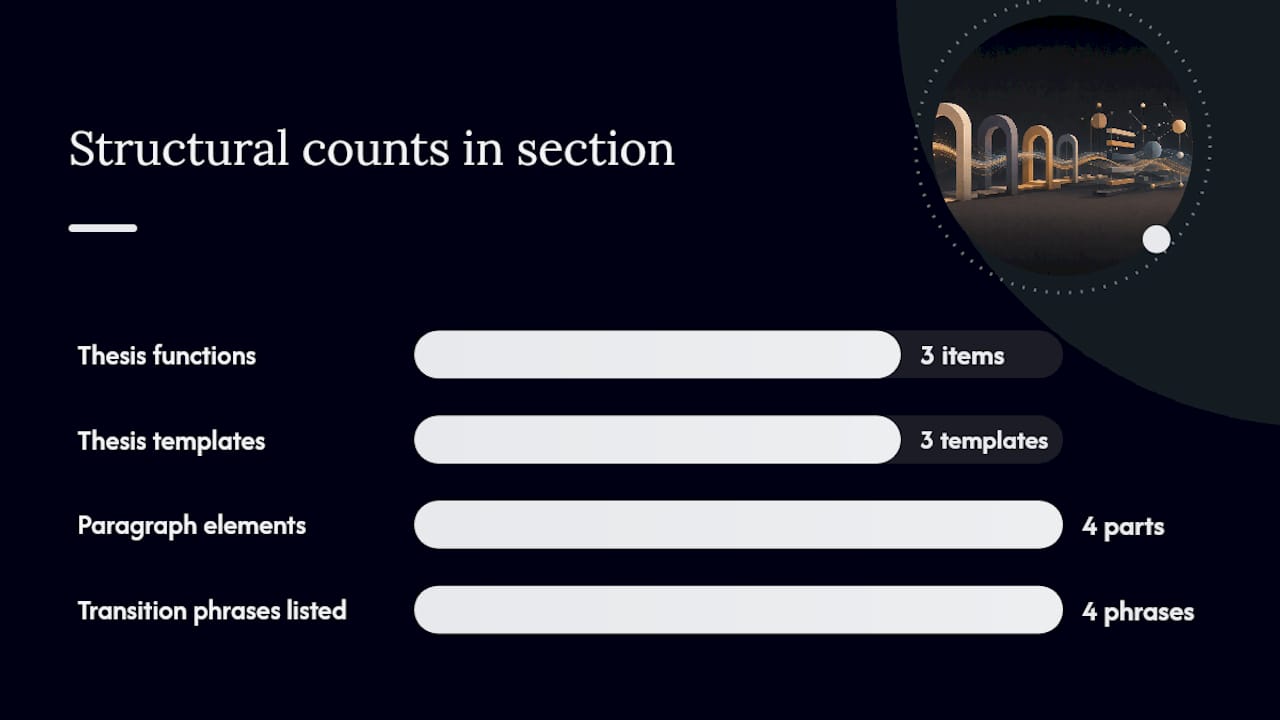
Your thesis must do three things: name the strategy or strategies, link them to an appeal or purpose, and deliver a verdict on effectiveness. Here are three fill-in-the-blank templates:
Overall evaluation thesis:
“Through [strategy/device], [author] effectively/unsuccessfully [persuades/informs/moves] [audience] to [accept/feel/do X].”
Mixed-effect thesis:
“While [author]’s use of [strategy A] strengthens [appeal], the reliance on [strategy B] undermines credibility with [audience].”
Audience-specific thesis:
“[Author]’s [strategy] succeeds with [specific audience] because [reason], though it risks alienating [secondary audience] by [effect].”
Practical writing-centre guidance stresses that the thesis should emerge from your evidence, not precede it. Draft your body paragraphs first, then write the thesis to match what you actually found.
Each body paragraph follows a claim-evidence-explain skeleton:
- Claim: State the analytical point. “The author uses anaphora to build emotional momentum.”
- Evidence: Quote directly and briefly. “The repeated phrase ‘We deserve better’ appears three times in the final paragraph.”
- Explanation: Unpack the effect. “Each repetition intensifies the sense of collective grievance, positioning the reader as part of an aggrieved community rather than a passive observer.”
- Link back: Connect to your thesis. “This emotional escalation is central to the text’s persuasive strategy.”
Useful transition phrases for moving between analytical points: “This is reinforced by…”, “A contrasting strategy appears in…”, “The effect is compounded when…”, “Taken together, these devices suggest…”
Group similar devices in the same paragraph where possible. Tone and diction, for instance, often work together and belong in a single paragraph rather than two separate ones.
A step-by-step method you can use under timed conditions
Clemson University’s writing resources frame the method as a repeating three-step cycle: identify a device, assess whether it helps or hinders the purpose, explain why. The numbered steps below build that cycle into a full workflow.
- First read (no annotations): Read the whole text once for overall impression. Note your gut reaction — that response is often where the pathos is working.
- Identify the rhetorical situation: Author, audience, purpose, medium, context. Write these down before anything else.
- Annotate for devices: On a second read, mark specific language choices, structural moves, and appeals. Use two columns if it helps: device on the left, effect on the right.
- Select two or three strongest devices: Choose the ones that best explain the text’s overall effect. Breadth is less useful than depth.
- Gather evidence: Pull two or three short quotations per device. Shorter quotes are easier to embed and analyse.
- Draft your thesis: Write it after you have your evidence, not before.
- Structure your paragraphs: One device (or cluster of related devices) per paragraph, following the claim-evidence-explain pattern.
- Write a brief conclusion: Restate the verdict, widen to significance — why does this text’s persuasive strategy matter in its context?
Suggested time allocations for a 60–90 minute timed response:
- Reading and annotating: 15–20 minutes
- Planning and thesis drafting: 10 minutes
- Writing body paragraphs: 25–35 minutes
- Conclusion and review: 10 minutes
Pro Tip: When time is short, lead with your strongest piece of evidence, not your first observation. Examiners read the opening paragraph of each body section most carefully. Put your best-supported analytical point there, and the rest of the essay benefits from the credibility it establishes.
Two worked examples showing the method in action
Annotated sample paragraphs are among the most effective teaching tools precisely because they show the gap between spotting a device and actually analysing it. The two examples below demonstrate that gap.
Example 1: op-ed paragraph
Excerpt: “Every night, somewhere in this country, a child goes to bed hungry. Not because food does not exist, but because the systems designed to distribute it have failed. We built this. We can fix it.”
Step 1 — Identify the key device: Anaphora and short declarative sentences in the final two lines; emotive imagery (“a child goes to bed hungry”) in the opening.
Step 2 — Explain how it serves an appeal: The imagery generates pathos by making an abstract policy failure personal and visceral. The short declaratives (“We built this. We can fix it.”) shift from pathos to logos-adjacent accountability, implying a causal chain: collective responsibility produces collective remedy.
Step 3 — Judge effectiveness: For a general readership already sympathetic to welfare concerns, the combination is highly effective. The emotional hook creates urgency; the logical pivot gives readers a reason to act rather than simply feel.
Verdict: The author converts statistical poverty into moral obligation through a controlled escalation of emotional and rational appeal.
Example 2: advertisement caption
Excerpt: “Trusted by professionals. Built for everyone.”
Step 1 — Identify the key device: Antithesis (professionals vs. everyone) and compressed diction.
Step 2 — Explain how it serves an appeal: “Trusted by professionals” establishes ethos through implied expert endorsement. “Built for everyone” pivots to inclusivity, broadening the appeal to a mass audience without sacrificing the credibility just established.
Step 3 — Judge effectiveness: The compression is the strategy’s strength. Seven words carry two distinct appeals simultaneously. The risk is that “everyone” can read as vague, slightly undermining the specificity of the professional endorsement.
Verdict: Economical and largely effective, though the breadth of “everyone” slightly dilutes the authority the first clause works to build.
Common student mistakes and how to fix them
- Summarising instead of analysing. Fix: after every sentence you write, ask “so what does this do to the reader?” If you cannot answer, you are summarising.
- Force-fitting appeals. Labelling everything as pathos because the text feels emotional, without establishing the rhetorical situation first, is a hallmark of weak work. Fix: identify the situation before you reach for ethos/pathos/logos.
- Judging factual accuracy instead of rhetorical effectiveness. Your job is not to fact-check the author. Fix: reframe every evaluative sentence around audience effect, not truth value.
- Over-quoting. Long block quotes eat word count and suggest you cannot select. Fix: use the shortest quotation that still contains the device you are analysing — often a single phrase is enough.
- Weak evidence selection. Picking a quotation because it sounds important rather than because it contains a specific device. Fix: annotate first, then choose quotations that directly illustrate the device you have already identified.
- One appeal per paragraph, mechanically. Real texts blend appeals. Fix: group devices by effect rather than by appeal label, and note overlaps explicitly.
On quotation selection: the best evidence is short, specific, and contains the device in a form you can quote directly. Avoid paraphrasing when the original wording is the point — the exact words are often where the rhetoric lives.
A final distinction worth fixing early: judging a text’s rhetorical effectiveness is not the same as judging its truth. A speech can be brilliantly persuasive and factually misleading. A rigorously accurate report can be rhetorically inert. Your analysis addresses the former, not the latter.
Why rhetorical analysis matters more than most students realise
Most students encounter rhetorical analysis as an exam requirement and move on. That is a missed opportunity. The skill of asking “what is this text doing to me, and how?” is the foundation of genuine media literacy — the ability to read political speeches, news coverage, and advertising without being passively shaped by them.

Rhetoric is everywhere in political communication, and the line between legitimate persuasion and manipulation is often thin. Whitebunnywabbit’s work on propaganda techniques and political misinformation explores exactly that boundary. Rhetorical analysis gives you the vocabulary to name what you are seeing, which is the first step to not being taken in by it. Once you can identify anaphora in a campaign speech or spot the ethos-building move in a think-tank report, you stop being a passive consumer of those messages. That shift in perspective is, I think, one of the most practically useful things a student can take out of an English or media studies course.
Sources
- Rhetorical Analysis
- Rhetorical Analysis
- What is rhetorical analysis?
- Rhetorical Analysis | Writers Workshop – University of Illinois
- Rhetorical analysis (BYU writing centre)
- Sample rhetorical analysis (Excelsior OWL)
Leave a Reply