
Fact-checking is the systematic process of verifying whether a claim is accurate, contextually honest, and supported by credible evidence. Understanding how fact checking works matters more now than at any point in recent memory. Misinformation travels at speed across social media, AI-generated content blurs the line between real and fabricated, and the volume of claims published daily far exceeds what any single reader can assess alone. Professional fact-checkers use established frameworks like the SIFT method, forensic media analysis, and lateral reading to cut through noise and deliver verified truth. This guide explains every stage of that process.
How fact checking works: the core process explained
Fact-checking is divided into two distinct phases: ante hoc and post hoc verification. Understanding both phases reveals why the process is more structured than most readers assume.
Ante hoc fact-checking happens before publication. Journalists and editors verify claims internally, checking documents, consulting on-the-record sources, and confirming statistics before a story goes live. This is the standard practice at major news agencies and forms the backbone of editorial quality control.
Post hoc fact-checking happens after publication. Independent organisations review public claims, political statements, and viral content, then publish their findings for public consumption. The most recognisable example is PolitiFact’s TRUTH-O-METER, a visual rating system that scores claims from “True” to “Pants on Fire.” These ratings give readers a quick, standardised way to assess credibility.
Both approaches serve different functions in the media ecosystem. Ante hoc checking protects editorial integrity before harm is done. Post hoc checking provides public accountability after a claim has circulated. Neither replaces the other.
- Ante hoc: Internal, pre-publication, editor-driven
- Post hoc: External, post-publication, organisation-driven
- Rating systems: Visual tools like TRUTH-O-METER translate complex verdicts into accessible scores
- Workflow fit: Ante hoc suits daily newsrooms; post hoc suits dedicated fact-checking units
Pro Tip: If you read a fact-check report, look for the methodology section. Reputable organisations publish exactly how they reached their verdict, not just what it was.
How do professional fact-checkers verify sources and claims?
Professional fact-checkers do not simply read a source and decide whether to trust it. They use a structured sequence of checks that combines speed with rigour.
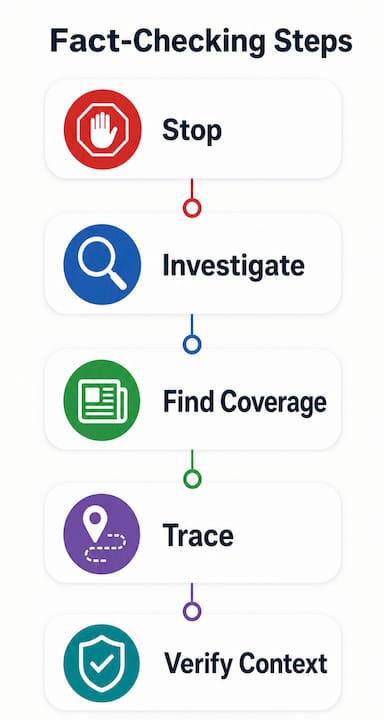
The most widely recommended framework is the SIFT method: Stop, Investigate the source, Find better coverage, and Trace claims to their origin. SIFT is designed to complete rapid online claim verification in under two minutes. It works because it forces the checker to pause before reacting, which is the single most common failure point for ordinary readers.
Lateral reading: the professional’s core technique
Lateral reading is the practice of opening multiple independent browser tabs to evaluate a source, rather than reading deeply within the source itself. Professional fact-checkers use this technique because a source’s own content rarely reveals its biases or funding. Checking independent evaluations of a source, such as press freedom indexes and third-party fact-checker ratings, produces a faster and more accurate credibility assessment.
Forensic media verification
Modern verification includes technical checks that go well beyond reading text. The Associated Press runs a 24/7 verification cycle that combines source corroboration with forensic analysis of photos and videos. That cycle includes reverse-image search, geolocation, and metadata inspection to confirm that visual content is authentic and has not been manipulated.
The steps professional fact-checkers follow in sequence are:
- Stop and assess the claim before sharing or reporting it.
- Investigate the source using lateral reading and press freedom databases.
- Find better coverage from multiple independent outlets reporting the same story.
- Trace the origin of the claim back to its primary source document or speaker.
- Run forensic checks on any photos or videos using reverse-image search and metadata tools.
- Consult on-the-record sources to corroborate documentary evidence.
Verification also goes beyond factual accuracy. Evaluating source funding, conflicts of interest, and missing context is part of the process. A claim can be technically true and still mislead readers if the surrounding context is stripped away.
| Verification method | What it checks | Speed |
|---|---|---|
| Lateral reading | Source reputation and bias | Fast (under 2 minutes) |
| Reverse-image search | Photo authenticity and origin | Fast |
| Metadata analysis | File origin, date, and editing history | Moderate |
| On-the-record sourcing | Factual corroboration | Slow |
| Press freedom index | Outlet credibility and independence | Fast |
What challenges do fact-checkers face in the digital age?
The volume of misinformation published online now outpaces the capacity of manual fact-checking. That gap is the central challenge facing the profession in 2026.
AI-generated media complicates authenticity checks at every level. Synthetic images, deepfake videos, and AI-written text can pass casual inspection without triggering suspicion. Forensic verification tools are adapting, but the technology producing false content is advancing at least as quickly as the tools designed to detect it.
- Scale: The number of claims requiring verification grows faster than fact-checking capacity.
- Speed: False claims spread within minutes; corrections often arrive hours or days later.
- AI content: Generative AI produces convincing text and images that defeat surface-level checks.
- Ephemeral content: Stories and posts that disappear after 24 hours leave no permanent record to verify.
- Correction decay: The impact of corrections weakens over time, especially when prominent figures continue repeating debunked claims.
Correction decay is particularly damaging. A correction published once rarely reaches the same audience as the original false claim. Repeated exposure to a falsehood, even after correction, can entrench belief in it. This means fact-checking must be ongoing rather than a single intervention.
Pro Tip: When you encounter a correction to a story you shared, share the correction too. The original post and the correction need the same distribution to have equal impact.
Understanding why misinformation spreads fast helps readers recognise the conditions that make fact-checking harder. Emotional content, outrage, and novelty all accelerate sharing before verification has a chance to catch up.
Why does fact-checking matter for citizens and media consumers?
Fact-checking delivers accurate information at the moment people need it most, which is when false claims are actively circulating. That timing is what makes it effective.
“Fact-checking works by slowing the viral spread of false claims on social media and providing accurate information when and where people need it. Meta’s intervention programmes reduced the viral sharing of false content by 20–40%. That reduction shows that systematic verification, applied at scale, changes how information travels.”
Fact-checking also builds media literacy over time. Readers who regularly consult fact-check reports develop a stronger instinct for spotting weak sourcing, missing context, and emotional manipulation. That skill transfers to everyday news consumption, not just formal verification exercises.
The democratic stakes are real. Political misinformation targets voters, distorts policy debates, and erodes trust in institutions. Fact-checking provides a documented, public record of what was said and whether it was true. That record matters for accountability, particularly when common political misinformation tactics are used to shift public opinion through false premises.
Fact-checking is not a cure-all. Its effectiveness depends on public willingness to accept corrections and on sustained, repeated verification rather than isolated interventions. But the alternative, leaving false claims unchallenged, produces measurably worse outcomes for public understanding.
Key takeaways
Fact-checking is the structured process of verifying claims through source investigation, forensic analysis, and lateral reading, applied both before and after publication to protect information integrity.
| Point | Details |
|---|---|
| Two core phases | Ante hoc (pre-publication) and post hoc (post-publication) checking serve different but complementary roles. |
| SIFT method | Stop, Investigate, Find better coverage, Trace origin: a four-step framework completing verification in under two minutes. |
| Forensic checks matter | Reverse-image search and metadata analysis are standard tools for authenticating photos and videos. |
| Correction decay is real | A single correction rarely reaches the same audience as the original false claim; ongoing checking is required. |
| Fact-checking reduces spread | Systematic intervention programmes have reduced viral sharing of false content by measurable margins. |
The part most people miss about fact-checking
Most readers think fact-checking is about catching liars. That framing misses the more common problem: claims that are technically accurate but stripped of context, or sources that are credible on one topic and unreliable on another.
The skill I find most underrated is knowing when to stop. Knowing when to end verification is as important as knowing how to start it. Excessive checking yields diminishing returns and wastes the time needed for the next claim in the queue. Professional fact-checkers make a deliberate decision to close a verification loop, not just drift away from it.
The SIFT method works precisely because it builds that discipline in. Two minutes of lateral reading will resolve most claims. If it does not resolve after two minutes, the claim likely requires specialist sourcing, not more general searching.
My honest view is that media literacy education should teach SIFT before it teaches anything else about news consumption. The habit of pausing before sharing is more valuable than any single piece of knowledge about which outlets to trust. Outlets change. The habit stays.
Scepticism and fairness are not opposites. The best fact-checkers I have observed apply the same rigour to sources they agree with as to sources they distrust. That consistency is what makes a verdict credible. Without it, fact-checking becomes just another form of advocacy.
— John
Whitebunnywabbit and the case for informed reading
Accurate information is not a passive resource. It requires active effort from both publishers and readers.

Whitebunnywabbit covers the political and media stories where verification matters most, from government policy to international affairs. The platform’s piece on reporters and education makes the case for why integrity in reporting is not optional. For readers interested in how data and information management are changing, the future of data page connects verification challenges to broader trends in how we produce and consume knowledge. If you want to read news with a sharper eye, Whitebunnywabbit gives you the context to do it.
FAQ
What is fact-checking in journalism?
Fact-checking in journalism is the process of verifying the accuracy of claims, sources, and evidence before or after publication. It uses methods including lateral reading, source corroboration, and forensic media analysis.
What is the SIFT method?
SIFT stands for Stop, Investigate the source, Find better coverage, and Trace claims to their origin. It is a four-step framework designed to verify online claims in under two minutes.
How does post hoc fact-checking differ from pre-publication checking?
Pre-publication (ante hoc) checking is internal and happens before a story is published. Post hoc checking is external, conducted by independent organisations after a claim has circulated publicly.
Why do corrections sometimes fail to change minds?
Correction decay means that a single correction rarely reaches the same audience as the original false claim. Repeated exposure to a falsehood, even after it has been debunked, can reinforce rather than reduce belief in it.
Can ordinary readers apply fact-checking techniques themselves?
Yes. The SIFT method and lateral reading are designed for non-specialists. Opening independent tabs to evaluate a source, rather than reading only the source itself, takes under two minutes and significantly improves accuracy in assessing claims.
Leave a Reply