
Outrage is the single most reliable engagement trigger on social media, generating 3 to 5 times higher interaction than neutral content across platforms. This is not an accident of culture or a quirk of online behaviour. It is the product of neurological wiring, algorithmic design, and social incentives working in concert. Oxford named “rage bait” its word of the year, Tulane University researchers have documented the physiological responses outrage provokes, and platform engineers at TikTok and Twitter have built systems that reward exactly this kind of emotional intensity. Understanding why outrage drives engagement is the first step toward using that knowledge wisely, whether you create content or simply consume it.
How does outrage provoke emotional and neurological responses?
Outrage is a high-arousal emotion. It raises heart rate, floods the body with adrenaline, and activates the amygdala, the brain’s threat-detection centre. This is not metaphorical. Amygdala activation overrides cognitive control, making outrage-inducing content genuinely difficult to scroll past. The brain treats a provocative post the same way it treats a predator in the bushes: as something that demands immediate attention.
This is what researchers call bottom-up attention. It is involuntary, stimulus-driven, and evolutionarily ancient. Calm, informative content requires top-down attention, which means you choose to focus. Outrage removes that choice. The result is that creators who produce rage-inducing content capture attention without the audience’s conscious consent.

The brain’s reward system compounds this effect. Repeated outrage exposure activates dopamine circuits in the dorsal striatum, the same region involved in social punishment and reward. Sharing outrage content triggers a neurological reward, which is why the impulse to repost something infuriating feels satisfying rather than unpleasant. The brain is not malfunctioning. It is doing exactly what it evolved to do: punish norm violators and signal that punishment to the group.
Norm violation is the core mechanism here. When content depicts someone breaking a social rule, whether it is a politician lying, a celebrity behaving badly, or a stranger acting rudely, the brain registers disgust and moral outrage simultaneously. This combination is uniquely potent. It motivates both attention and action, specifically the action of sharing.
- Outrage raises heart rate and adrenaline, making it physically stimulating in a way that calm content cannot match.
- Amygdala-driven attention is involuntary, meaning audiences engage before they decide to.
- Dopamine reward circuits reinforce sharing, creating habitual engagement loops over time.
- Norm violation triggers disgust and social signalling, motivating audiences to broadcast their moral stance.
- High-arousal emotional content creates a stress response that, with repeated exposure, can develop into psychological dependency.
Pro Tip: If you notice you are sharing content primarily because it made you angry, pause for ten seconds before posting. That gap is enough to engage your prefrontal cortex and make a conscious choice rather than a reflexive one.
What role do social media algorithms play in amplifying outrage?
Algorithms do not care about truth, nuance, or your wellbeing. They care about engagement signals: likes, shares, comments, watch time, and the often-overlooked hesitation signal. Algorithms prioritise hesitation and pause signals, meaning that even stopping on a post without interacting tells TikTok or Twitter that the content is worth amplifying. Outrage is uniquely good at producing all of these signals simultaneously.
A post that makes you furious generates more comments than one that makes you smile. Comments are longer, more emotionally charged, and more likely to provoke replies, which extends the thread and signals further algorithmic value. Outrage content also produces more shares, because sharing is the primary social behaviour outrage motivates. The result is a feedback loop: outrage generates engagement, engagement signals value, the algorithm amplifies the content, more people see it, more people engage, and the cycle repeats.
“Social media platforms have monetised outrage by incentivising creators to manufacture controversy, turning anger into an economic resource.” — The Conversation
This is not a side effect. It is the business model. Platforms profit from sustained attention, and outrage produces sustained attention more reliably than any other content type. A preregistered study found that algorithm-ranked feeds increase both emotional intensity and political polarisation compared to chronological feeds. Chronological feeds, which show posts in time order rather than by predicted engagement, produce measurably calmer emotional states in users.
| Engagement signal | Why outrage performs well |
|---|---|
| Comments | Outrage generates longer, more heated replies and extended threads |
| Shares | Sharing is the primary social behaviour outrage motivates |
| Watch time | Provocative content holds attention longer than neutral content |
| Hesitation/pause | Stopping on a post signals algorithmic value even without a click |
| Partisanship uplift | Algorithm-ranked feeds increase polarisation, rewarding divisive content |
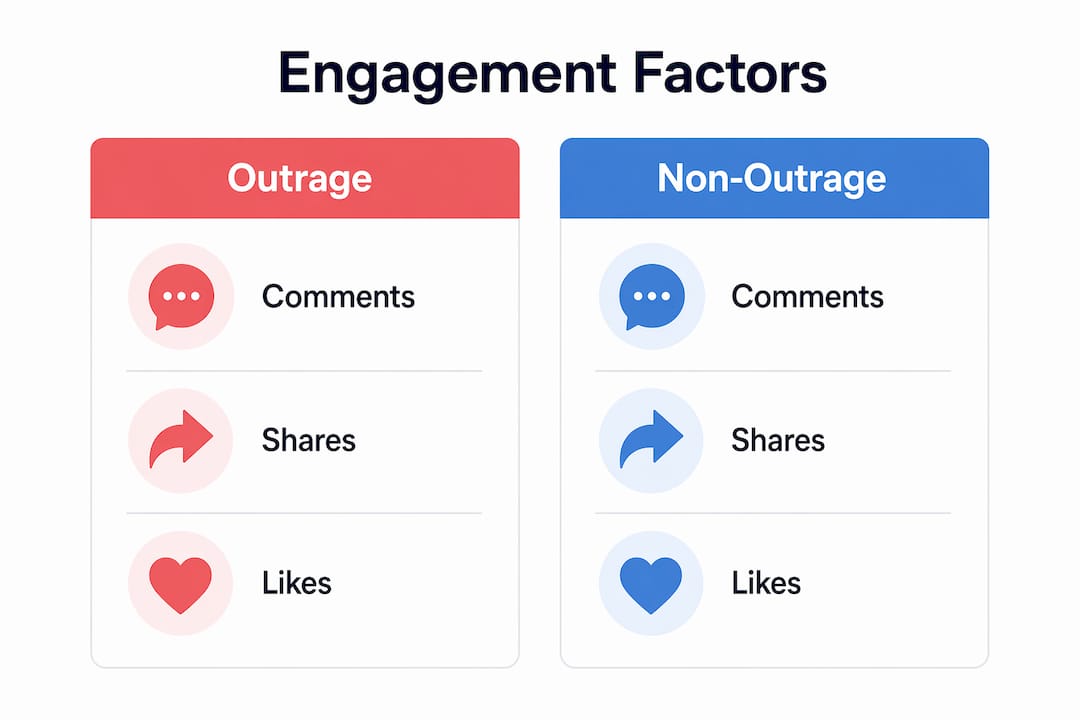
Understanding how trending topics are ranked in 2026 makes this even clearer. Platforms weight emotional intensity heavily in their ranking models, which means outrage content has a structural advantage over calm, measured posts regardless of quality or accuracy.
How does outrage serve social and identity functions online?
Outrage is not just a personal emotion. It is a social tool. When you share something that outrages you, you are not merely venting. You are signalling your values, your tribal affiliations, and your moral position to everyone in your network. This is why anger spreads more easily than joy, sadness, or disgust across social networks. It builds coalitions. It draws lines between in-groups and out-groups. It says, in effect, “I am one of the people who finds this unacceptable.”
This social signalling function explains why outrage content performs so well even when the underlying issue is trivial. The content itself is almost secondary. What matters is the opportunity it provides for identity expression and group alignment. Creators who understand this produce what is now widely called “rage bait”: content deliberately engineered to provoke moral outrage and trigger this sharing behaviour.
The numbers are striking. Viral outrage content has been observed with a 9.4% share rate, more than five times the average for the same creator’s non-outrage posts. That gap is not explained by content quality. It is explained by the social reward of sharing something that signals moral clarity to your audience.
Here is how this social mechanism plays out in practice:
- A creator posts content depicting a norm violation, real or manufactured.
- Viewers experience outrage and the simultaneous urge to signal their moral stance.
- Sharing the content serves as social currency, demonstrating values to followers.
- Coalition members amplify the post further, reinforcing tribal identity.
- The creator’s metrics spike, rewarding the strategy and encouraging repetition.
Pro Tip: Before sharing outrage content, ask yourself: “Am I sharing this because it adds genuine value to my network, or because it lets me signal my values cheaply?” The answer will often change your decision.
For a deeper look at how this dynamic shapes viral political commentary, Whitebunnywabbit has documented real-world examples showing exactly how outrage content outperforms measured analysis in engagement terms.
What are the risks of outrage-driven engagement for creators and audiences?
The engagement benefits of outrage come with serious costs, and most creators discover them too late. Outrage-driven audiences are primarily stimulus-driven and less loyal. They follow the outrage, not the creator. When the provocation stops, so does the audience. This makes outrage a poor foundation for building a sustainable following, despite its short-term metric appeal.
Creators face a structural trap. Outrage content relies on open loops that demand escalating provocation to maintain audience engagement. Each post must be slightly more shocking than the last to prevent habituation. This escalation cycle is exhausting, ethically corrosive, and ultimately self-defeating. Creators who build audiences on outrage find themselves locked into a content strategy they cannot easily exit without losing the audience entirely.
For audiences, the costs are physiological and psychological. Sustained exposure to high-arousal outrage content elevates stress hormones, disrupts emotional regulation, and, with enough repetition, creates patterns that resemble addiction. The brain’s reward system, having been trained to expect the dopamine hit of outrage engagement, begins to seek it out automatically.
- Outrage audiences are disloyal and stimulus-seeking, following provocation rather than creators.
- Creators face escalating pressure to produce more extreme content to maintain engagement levels.
- Habitual outrage consumption impairs emotional regulation and elevates chronic stress.
- Algorithms reward emotional intensity regardless of content accuracy or social value.
- Platforms profit from this cycle while creators and audiences absorb the psychological costs.
The ethical dimension is worth naming directly. Manufacturing outrage to drive metrics is a form of emotional manipulation. It exploits neurological vulnerabilities for commercial gain. That is not a neutral creative choice, and the impact of outrage on social media ecosystems extends well beyond individual creators or posts.
How can creators and users navigate outrage-driven content effectively?
Awareness is the most effective defence. A 2020 study found that explaining manipulation tactics to users measurably reduces their reactive engagement with rage bait. Simply knowing that a post is engineered to provoke you disrupts the automatic response loop. This is not about suppressing emotion. It is about inserting a moment of conscious evaluation between stimulus and action.
For creators, the practical path forward involves building audiences on value rather than provocation. This means producing content that generates top-down attention: content people choose to engage with because it informs, entertains, or challenges them in ways they find genuinely rewarding. Audiences built this way are more loyal, more likely to convert, and less likely to evaporate when the outrage cycle moves on. Understanding why opinion pieces go viral through genuine insight rather than manufactured anger is a more durable strategy.
Pro Tip: Track your engagement sources. If your highest-performing posts are consistently your most provocative ones, you are building an outrage-dependent audience. Deliberately publish one high-value, low-provocation post per week and monitor whether loyal engagement grows over time.
| Approach | Outrage-based content | Value-based content |
|---|---|---|
| Audience loyalty | Low. Followers chase provocation, not creator | High. Followers return for consistent value |
| Escalation pressure | High. Each post must exceed the last | Low. Quality compounds without escalation |
| Emotional cost | High for both creator and audience | Lower, more sustainable long-term |
| Algorithm performance | Strong short-term spikes | Steadier, compounding growth |
For users, the practical steps are straightforward. Curate your feed deliberately by unfollowing accounts that consistently produce rage bait. Use platform tools to reduce the weight of algorithmically recommended content. Practise the ten-second pause before sharing anything that made you angry. And recognise that how news goes viral is often a function of emotional engineering rather than informational value.
Key takeaways
Outrage drives engagement because it exploits neurological, algorithmic, and social mechanisms simultaneously, making it the most potent and most dangerous tool in the modern content creator’s repertoire.
| Point | Details |
|---|---|
| Neurological trigger | Outrage activates the amygdala and dopamine circuits, making engagement involuntary and self-reinforcing. |
| Algorithmic amplification | Platforms weight hesitation, shares, and comments heavily, all of which outrage produces in abundance. |
| Social signalling function | Sharing outrage serves as tribal identity expression, driving shares far beyond content quality alone. |
| Creator risk | Outrage audiences are disloyal and escalation pressure leads to burnout and ethical compromise. |
| Practical defence | Awareness of manipulation tactics measurably reduces reactive engagement and restores conscious choice. |
Why I think most creators misread the outrage opportunity
I have watched the outrage cycle play out across political commentary, news aggregation, and opinion media for years, and the pattern is always the same. A creator discovers that their most provocative post outperforms everything else. They repeat it. The audience grows fast. Then, six months later, they are trapped: the audience expects escalation, the creator is exhausted, and the content has drifted so far from their original voice that they barely recognise it.
The mistake is treating outrage as a strategy rather than a signal. When a piece of outrage content performs well, it tells you that you touched a genuine nerve, that your audience cares about something deeply. That is valuable information. The error is concluding that the outrage itself was the product, rather than the underlying issue that provoked it.
The creators I find most worth following are the ones who use that signal to go deeper. They take the nerve they touched and produce something that actually illuminates it, with nuance, evidence, and genuine analysis. That content does not spike as dramatically. But it builds something outrage never can: an audience that trusts you.
The platforms will not change their incentive structures voluntarily. That means the responsibility sits with creators and, increasingly, with informed audiences who recognise the manipulation and choose differently. Promoting healthier engagement is not naive idealism. It is a competitive advantage in a space where most creators are racing to the bottom.
— John
Explore more at Whitebunnywabbit
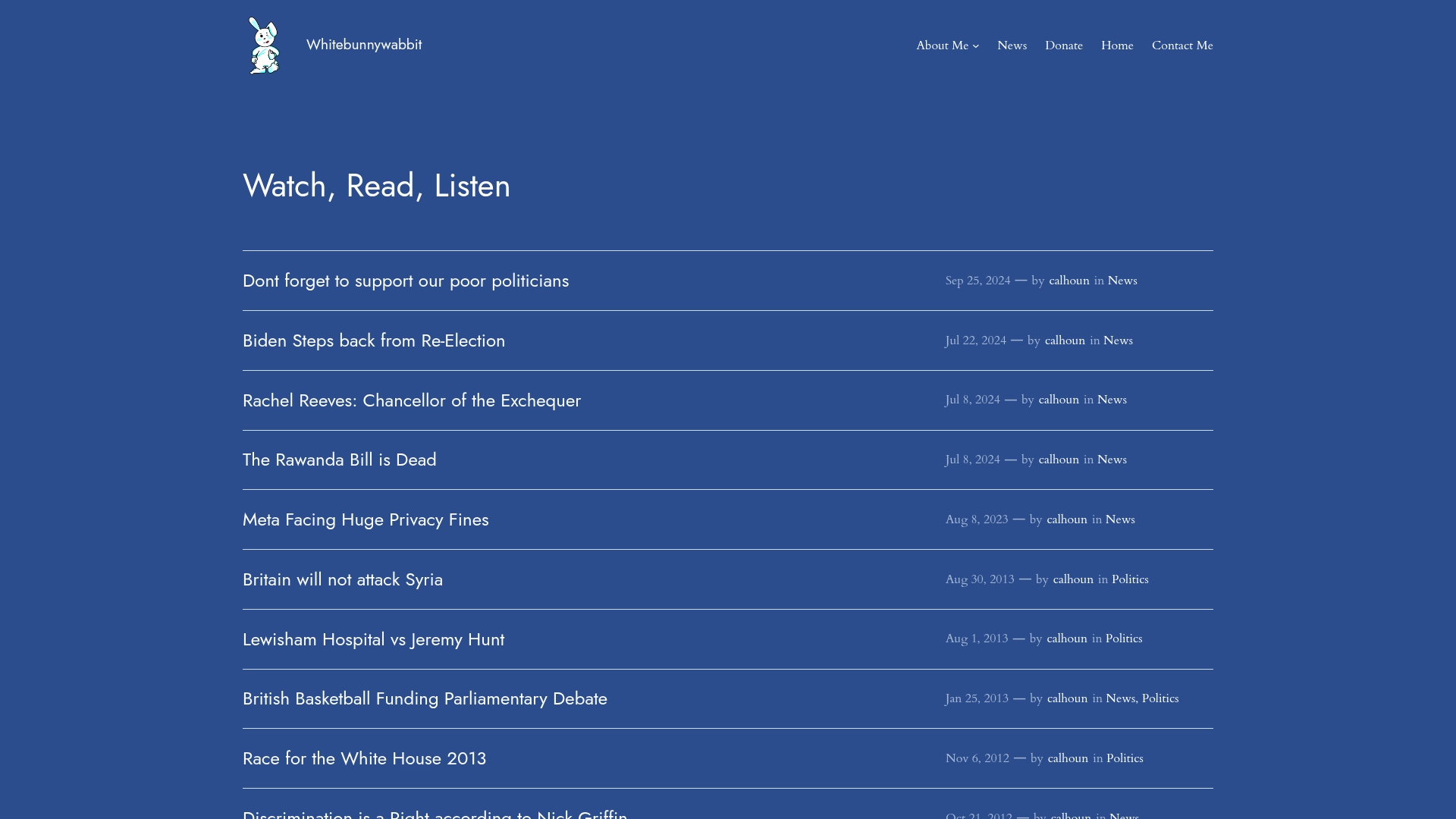
Whitebunnywabbit covers the mechanics of social media engagement, political commentary, and news culture with the kind of directness that most platforms avoid. If this article prompted you to think differently about how outrage shapes what you read and share, there is considerably more to explore. The Whitebunnywabbit news section tracks ongoing developments in platform algorithms and the content strategies that exploit them. For a broader grounding in how social media dynamics work and how to navigate them with intention, the education resources offer a structured starting point. Start at Whitebunnywabbit and see what you have been missing.
FAQ
Why does outrage generate more engagement than positive content?
Outrage activates the amygdala and triggers involuntary, bottom-up attention, making it neurologically harder to ignore than positive or neutral content. It also motivates sharing as a form of social signalling, which positive emotions do not produce at the same rate.
Do social media algorithms deliberately promote outrage?
Algorithms do not promote outrage by design, but they reward the engagement signals outrage produces, including comments, shares, extended watch time, and hesitation pauses. The result is functionally the same: outrage content receives disproportionate amplification.
What is rage bait?
Rage bait is content deliberately engineered to provoke moral outrage and trigger sharing behaviour. Oxford named it word of the year, and it describes a specific content strategy that exploits neurological and social mechanisms to drive metrics.
Can awareness of outrage tactics actually reduce its effect?
A 2020 study confirmed that explaining manipulation tactics to users measurably reduces reactive engagement with rage bait. Naming the mechanism disrupts the automatic response loop and restores conscious decision-making.
Is outrage-driven engagement sustainable for content creators?
Outrage-driven engagement is not sustainable. Audiences built on provocation are disloyal and stimulus-seeking, and creators face escalating pressure to produce more extreme content to maintain engagement, leading to burnout and ethical compromise over time.
Leave a Reply