
Opinion pieces go viral when they combine high-arousal emotions, remixable narratives, and repeated exposure to activate the psychological triggers that compel people to share. This is not a matter of luck or timing. Jonah Berger’s STEPPS model, which stands for Social currency, Triggers, Emotion, Public, Practical value, and Stories, identifies the precise psychological levers that drive shareable content. Research from CEPR, the ACM Web Science Conference, and Springer Nature published between 2025 and 2026 confirms that emotional framing, moral resonance, and narrative structure are the dominant forces behind why opinion pieces go viral at scale.
Why opinion pieces go viral: the emotional engine
Emotion is the single most powerful predictor of whether an opinion piece spreads. The critical distinction is not between positive and negative emotion but between high-arousal and low-arousal states. Anger and awe increase sharing because they generate physiological activation that pushes readers toward action. Sadness, by contrast, suppresses sharing because it produces low arousal and withdrawal rather than engagement.

This matters enormously for anyone analysing how opinion pieces spread. A piece about government corruption that frames its argument through outrage will consistently outperform one that frames the same facts through disappointment. The emotional register of the writing, not merely its factual content, determines its social reach.
High-arousal emotions also create cognitive shortcuts. When a reader encounters content that triggers anger or awe, their brain processes the material faster and with less deliberation. Emotional framing influences attention, memory, and evaluation, meaning that a well-crafted emotional hook shapes how the entire piece is remembered and judged. This is why fact-checking efforts so often fail to reverse the spread of emotionally charged opinion content.
- Anger drives sharing through moral indignation and the desire to recruit allies
- Awe drives sharing through the impulse to expand one’s social identity by association with something remarkable
- Surprise generates engagement by violating expectations and demanding resolution
- Sadness reduces sharing by lowering physiological arousal and motivation
Pro Tip: When writing opinion content, identify the single dominant emotion you want to activate before drafting a word. Every structural choice, from your opening claim to your final sentence, should serve that emotional target.
How narrative structure amplifies viral spread
Narrative diffusion is distinct from simple information diffusion. When a fact spreads online, it travels largely intact. When a narrative spreads, it evolves. Social media users co-create narratives through commentary, memes, and hashtags, transforming the original opinion piece into a remixable cultural object. This is why some opinion articles generate weeks of sustained conversation while others produce a single spike and disappear.
The practical implication is that editorial strategy must account for remixability from the outset. A claim crafted as a quotable frame, short, declarative, and emotionally charged, travels further than a nuanced argument buried in the fifth paragraph. Platforms like Twitter and TikTok accelerate this process dramatically. Narratives spread within minutes and evolve through audience participation, turning readers into co-authors of the viral story. Understanding publisher newsletter growth strategies reveals how the STEPPS framework applies directly to this kind of sustained narrative engagement.
The table below illustrates the key differences between how information and narratives diffuse across social networks.
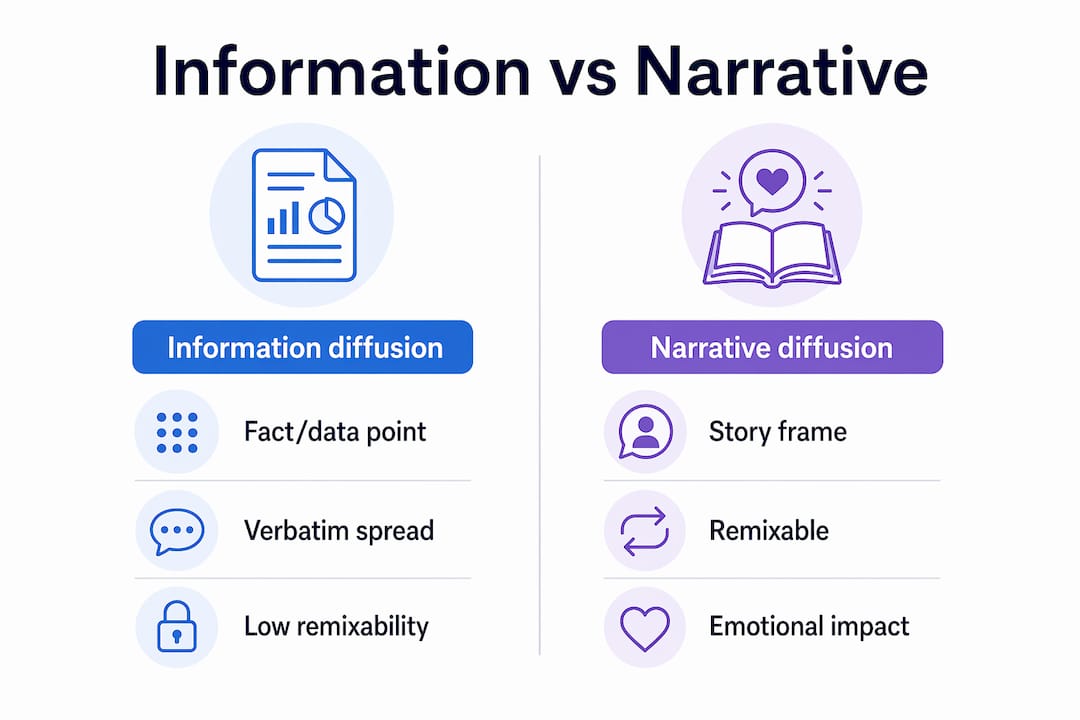
| Dimension | Information diffusion | Narrative diffusion |
|---|---|---|
| Unit of spread | Fact or data point | Argument or story frame |
| Audience role | Passive receiver | Active co-creator |
| Lifespan | Short, single spike | Extended, evolving |
| Mutation rate | Low | High through remixing |
| Engagement depth | Surface sharing | Commentary, memes, parody |
The editorial takeaway is direct. Opinion pieces that offer a clear, memorable central claim with emotional charge become raw material for audience remixing. Those that bury their argument in qualification and hedging give audiences nothing to work with. Viral success requires flexible hooks that readers can detach from the original text and carry into their own conversations.
What role does repeated exposure play in viral sharing?
Repeated exposure does not merely reinforce an opinion. It stabilises it against contradiction. Research summarised by Phys.org in 2026 found that five consistent exposures are sufficient to create a durable evaluative framework in a reader’s mind. After that threshold, contradictory information becomes significantly easier to dismiss. This concept is formalised as the Point of Critical Information, or PCI.
For opinion pieces, this finding has profound implications. The first wave of sharing is not just about reach. It is about establishing the interpretive frame through which all subsequent information on that topic will be filtered. Virality is an early-cue effect reinforced by consistency, not simply a product of momentary clicks. An opinion piece that achieves rapid early circulation effectively inoculates its audience against counter-arguments.
This also explains the mechanics of polarisation. Once a reader has encountered an emotionally framed opinion five or more times across different social contexts, their belief becomes structurally resistant to factual correction. Emotional content shapes attitudes more powerfully than facts alone, and repeated exposure compounds that effect.
- Early circulation matters most. The first 24 to 48 hours of a piece’s life determine whether it reaches the PCI threshold for large audiences
- Cross-platform presence accelerates PCI. Encountering the same argument on Twitter, in a newsletter, and on TikTok counts as separate exposures
- Consistency of framing is critical. Contradictory versions of the same argument undermine the stabilisation effect
Pro Tip: Publish opinion content simultaneously across multiple platforms and formats. A thread, a newsletter excerpt, and a short video summary of the same argument multiply exposure events and accelerate opinion stabilisation in your audience.
How moral framing shapes engagement and viral success
Moral Foundations Theory, developed by Jonathan Haidt and colleagues, identifies the core moral dimensions that organise human social behaviour: care and harm, fairness, loyalty, authority, and sanctity. Opinion pieces that activate these foundations generate engagement that goes beyond surface approval. Research presented at the ACM Web Science Conference in 2025 found that moral and affective attributes including Surprise, Trust, and Harm correlate strongly with likes, retweets, and comments on Twitter for news and opinion content.
The data reveals a more granular picture than simply “emotional content performs well.” Different moral dimensions drive different types of engagement. Harm-related content generates comments, because it provokes debate and the desire to defend or challenge. Trust-related content generates retweets, because sharing it signals one’s own credibility and alignment. Surprise-related content drives likes, because it rewards the reader for paying attention.
| Moral/affective dimension | Primary engagement type | Mechanism |
|---|---|---|
| Harm | Comments | Provokes moral debate and defensive responses |
| Trust | Retweets | Signals credibility and group alignment |
| Surprise | Likes | Rewards attention and validates curiosity |
| Anger | All types | Activates high arousal across all interaction modes |
The societal consequences of this dynamic are significant. Opinion pieces optimised for moral engagement do not merely spread. They deepen the grooves of existing belief structures. Moral framing sustains polarisation by making disagreement feel like a moral rather than an intellectual matter. Writers and analysts who understand this mechanism are better positioned to both create impactful content and critically evaluate the opinion pieces they encounter.
Key takeaways
Opinion pieces go viral through the interaction of high-arousal emotion, remixable narrative structure, repeated early exposure, and moral framing that converts passive readers into active sharers.
| Point | Details |
|---|---|
| Emotion drives sharing | High-arousal emotions like anger and awe increase sharing; sadness suppresses it. |
| Narrative remixability extends reach | Quotable, declarative claims give audiences material to co-create and amplify. |
| Five exposures stabilise opinion | The PCI threshold makes early, cross-platform circulation the most critical window. |
| Moral framing deepens engagement | Harm, Trust, and Surprise each drive distinct interaction types beyond simple likes. |
| Emotional framing resists correction | Fact-checking fails when emotional framing has already shaped memory and evaluation. |
What I’ve learnt from watching opinion content spread
I have spent years watching opinion pieces detonate across social media and then trying to reverse-engineer why. The honest answer is that the science described above is more predictive than most writers want to admit. The pieces that spread are rarely the most carefully argued. They are the ones that make you feel something before you have finished the first paragraph.
What troubles me about this is the ethical dimension. The same mechanisms that make a genuinely important piece of political commentary spread also make a manipulative one spread just as effectively. Emotional framing that overrides factual correction is a tool, and like any tool, its value depends entirely on the intentions of the person wielding it. I have seen writers at serious publications consciously engineer outrage into pieces that did not warrant it, purely to maximise distribution. The short-term metrics rewarded them. The long-term damage to public discourse was invisible in the analytics.
The most durable opinion writers I have observed do something different. They treat their audience as co-creators rather than targets. They write claims that are clear enough to be quoted, honest enough to withstand scrutiny, and emotionally grounded in genuine conviction rather than manufactured provocation. That combination is harder to achieve than pure sensationalism, but it builds the kind of sustained credibility that keeps audiences returning. The science of virality is not a recipe for manipulation. It is a map of human psychology that writers can choose to respect or exploit.
— John
Explore viral content dynamics with Whitebunnywabbit
If the mechanics of viral opinion content interest you, Whitebunnywabbit offers a consistent stream of political commentary, news analysis, and media criticism that puts these principles into practice. The site’s coverage of government policy, international affairs, and social debate gives you a live laboratory for observing how emotional framing, narrative structure, and moral triggers operate in real published content.
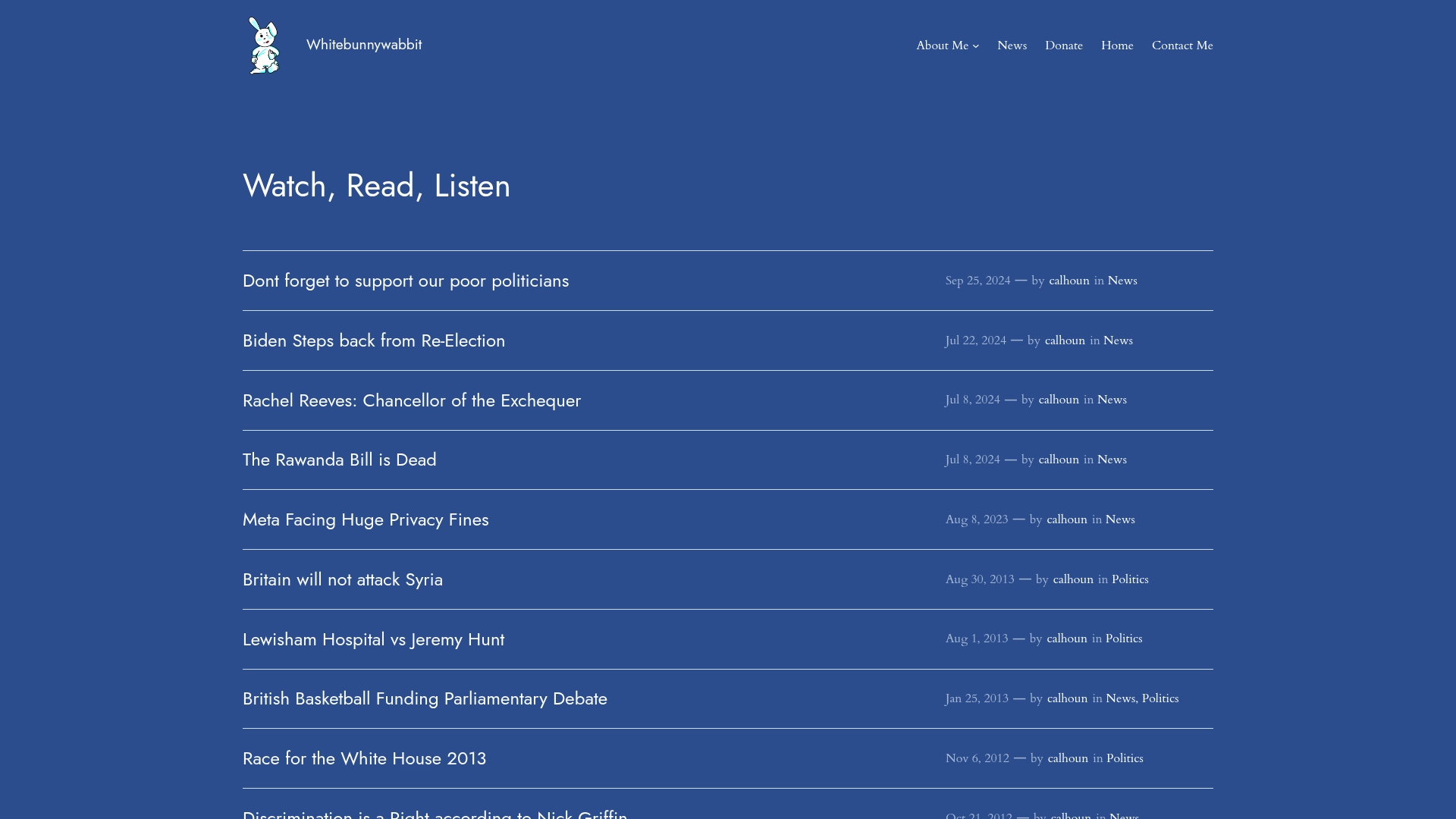
Visit Whitebunnywabbit to read opinion pieces and commentary that engage directly with the forces shaping public discourse. For readers who want to go deeper into the educational side of media literacy and viral content analysis, the education resources section offers further context on how these dynamics play out across modern platforms.
FAQ
What makes opinion pieces go viral rather than news articles?
Opinion pieces activate high-arousal emotions and moral frameworks more directly than straight news reporting, making them more likely to trigger the psychological sharing impulse. The STEPPS model identifies emotion and social currency as the dominant drivers, both of which opinion writing is structurally designed to produce.
How many times does someone need to see an opinion before it shapes their view?
Research published in 2026 found that approximately five consistent exposures are sufficient to stabilise an opinion at the Point of Critical Information, after which contradictory facts become easier to dismiss. This makes early, cross-platform circulation the most strategically significant phase of any viral opinion piece.
Why does emotional content resist fact-checking?
Emotional framing influences attention, memory, and evaluation before deliberate reasoning engages, meaning the emotional impression is formed before the factual content is fully processed. CEPR research from 2026 confirms that emotions override factual correction by shaping how audiences encode and recall the original piece.
What is narrative diffusion and why does it matter for viral opinion writing?
Narrative diffusion describes how an argument spreads as a remixable frame rather than a verbatim text, with audiences reshaping it through memes, commentary, and hashtags. Springer Nature research from 2025 shows this process extends the lifespan and reach of opinion content far beyond what simple information sharing achieves.
Which moral dimensions generate the most engagement on social platforms?
ACM Web Science Conference findings from 2025 identify Harm, Trust, and Surprise as the moral and affective dimensions most strongly correlated with comments, retweets, and likes respectively on Twitter. Harm-related content provokes the deepest debate, while Trust-related framing drives the broadest distribution through retweets.
Leave a Reply