
A media embargo is a request or agreement that information must not be published before a specific date, time, or condition is met. It is not a law and it carries no legal force. It works because both sides get something: journalists get advance material and time to prepare accurate coverage, and PR teams get coordinated timing that stops one outlet scooping the rest before anyone has checked the facts.
That trade only works if the terms are precise. A vague embargo is worse than no embargo at all, because ambiguity is exactly what causes leaks and disputes.
Every functioning embargo has four elements, and if any one of them is missing, the arrangement tends to fall apart:
- What: the exact material covered by the embargo, whether that’s a press release, a research paper, or advance access to a product.
- Who: which journalists or outlets have been given the material, and on what basis.
- When: the precise lift time, stated to the minute, with a named time zone.
- Consequences: what happens if the embargo is broken, and whether that’s spelled out in advance or left to custom.
Key Takeaways
A media embargo works because it trades advance access for coordinated, accurate timing, and it only holds together when the terms are stated precisely and agreed in writing.
| Point | Details |
|---|---|
| Definition comes first | An embargo is a request or agreement to hold publication until a set time, not a legal restriction. |
| Precision prevents disputes | State the exact lift time to the minute with a named time zone every single time. |
| Opt-in builds trust | Confirm journalists agree to embargo terms before sending material, and get it in writing. |
| Match lead time to complexity | Give days for research or medical stories, hours for routine updates. |
| Respond to breaches proportionately | Assess scope and accuracy before deciding whether to lift early or restrict future access. |
Table of Contents
- What is a media embargo and how does it work?
- Why do organisations use media embargoes?
- Where are media embargoes used in practice?
- How should PRs issue and manage an embargo?
- How should journalists handle embargoed material?
- How long do embargoes typically last, and how does time-zone practice work?
- What happens when an embargo is broken?
- Exclusives, background briefings and other embargo alternatives
- Why do critics say media embargoes get misused?
- A ready-to-use checklist and embargo template
- Where to read more on media embargoes
- What actually matters when you’re deciding on an embargo
- Sources
What is a media embargo and how does it work?
A press embargo is a request by a source that information not be published until a specified date or condition is met. It functions as a timing agreement, built on trust and professional convention, rather than a contract enforceable in court. Nobody gets sued for breaking an embargo. What they lose instead is access, and in journalism, access is currency.
The mechanism is simple. A PR team or institution sends material to selected journalists ahead of time, clearly marked as embargoed, along with a lift date and time. Journalists who accept the terms get a head start on research, interviews, and fact checking. In return, they agree to hold the story until the embargo lifts. The Wikipedia overview of news embargoes frames this as a mutual timing arrangement designed to let reporters prepare accurate coverage rather than race to publish first on thin information.
The system depends entirely on goodwill. There’s no regulator policing embargo compliance, no fine for jumping the gun. What keeps it working is that breaking an embargo tends to get you cut off from future advance access, and in most newsrooms, that’s a real cost.
Why do organisations use media embargoes?
The honest answer is that embargoes exist to buy time, and time is valuable to both sides for different reasons. For journalists, it means the difference between a rushed 300 words and a properly checked, well sourced piece. For the organisation issuing the release, it means dozens of outlets publishing on the same morning rather than a scattered trickle of coverage over two weeks.

Accuracy is the strongest justification. Complex material, particularly scientific or medical research, often needs specialist input before a journalist can write about it responsibly. Giving reporters two or three days ahead of publication lets them call independent researchers, check methodology, and avoid the kind of breathless misreporting that plagues health journalism. Coordinated timing also matters commercially: a product launch covered simultaneously across dozens of outlets creates far more market noise than the same story trickling out over a fortnight.
But embargoes carry real costs when they’re misused. A leak can undercut the entire strategy overnight. Overused embargoes on trivial announcements breed resentment among journalists, who start viewing them as PR theatre rather than genuine collaboration. And in some cases, an embargo becomes less about accuracy and more about manufacturing artificial hype around an announcement that didn’t need one.
Pro Tip: If your announcement isn’t complex enough to need extra preparation time, and you’re only using an embargo to create a sense of occasion, skip it. Journalists notice the difference, and it costs you credibility the next time you actually need one.
Where are media embargoes used in practice?
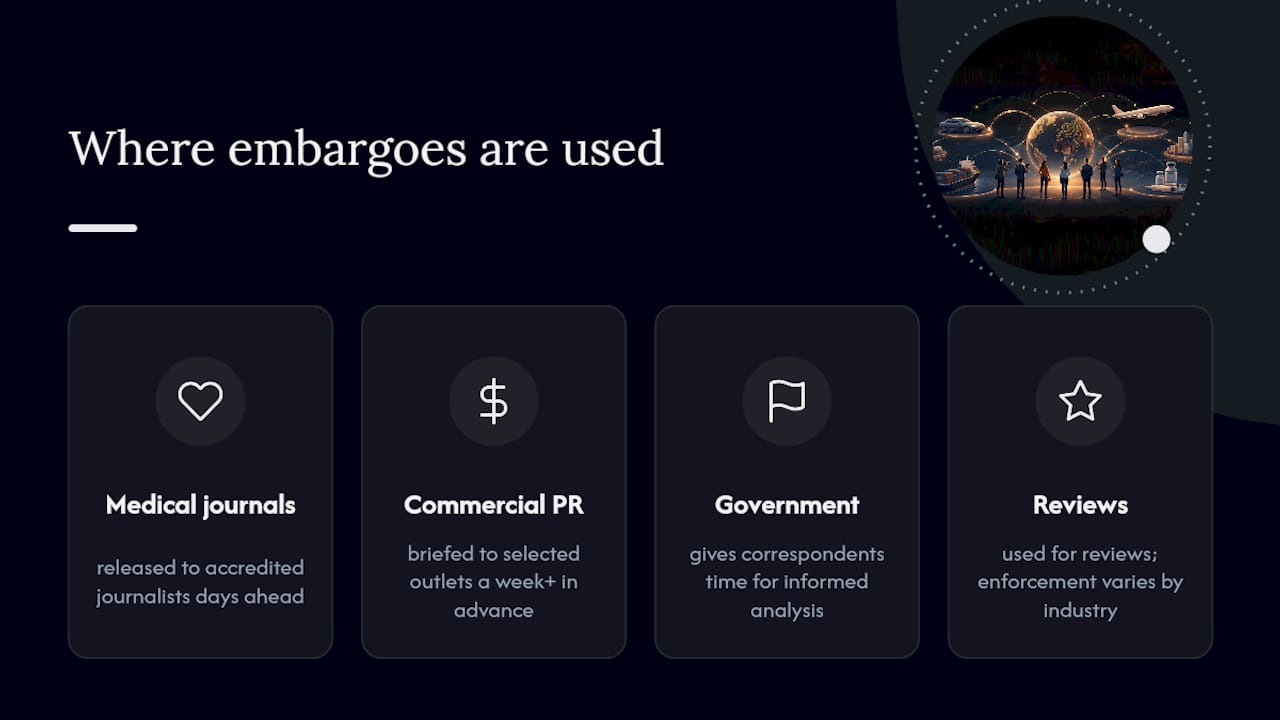
Medical and scientific journals are the clearest example of embargoes working as intended. Journals including the Lancet, the Journal of the American Medical Association (JAMA), and the New England Journal of Medicine (NEJM) all run formal embargo systems, releasing papers to accredited journalists days ahead of publication so reporters can interview independent experts and check claims before the findings go live. This is one of the oldest and most respected uses of the practice, and the Wikipedia entry on news embargoes specifically cites these journals as examples of embargo systems built around scientific rigour rather than marketing.
Commercial PR uses the same mechanism for entirely different reasons. A technology company launching a new device will often brief selected outlets under embargo a week or more in advance, giving reviewers time to test the product properly while ensuring every outlet publishes at the same moment, maximising collective visibility.
The whole point of a well run embargo is that it should make the story better, not just make the launch louder. When it stops doing the first thing and only does the second, something has gone wrong.
Government departments and policy bodies use embargoes ahead of major announcements or statistical releases, giving correspondents time to prepare informed analysis rather than reactive coverage. Review embargoes for games, films, and hardware work similarly, though enforcement culture varies sharply between industries. Medical journals generally treat a broken embargo as a serious professional matter; a games publisher might simply drop that outlet from the next review cycle.
How should PRs issue and manage an embargo?
Not every announcement needs one. Before setting an embargo, ask whether the story genuinely requires preparation time, whether coordinated timing actually adds value, and whether you have anything substantial enough that journalists will accept the constraint. If the answer to all three is no, a straightforward press release works better and avoids the friction.
Once you’ve decided an embargo is justified, the process runs roughly like this:
- Set the exact lift time, stated to the minute, with the named time zone spelled out (not just “9am”, but “9:00am GMT”). This single step prevents most embargo disputes, according to guidance from Instant Press on running embargoes correctly.
- Decide who gets it. Will this go to a wide list under embargo, or will one outlet get an exclusive with everyone else receiving the material only after publication?
- Ask before you send. Confirm with the journalist that they’re willing to accept embargoed material before sending it, rather than emailing it cold and assuming compliance. PR Newswire’s guidance on embargoes and exclusives treats this opt-in step as standard good practice.
- Label the release unambiguously. State “EMBARGOED UNTIL [time, date, time zone]” in the subject line and at the top of the document itself, not buried in a footnote.
- Provide genuine value for the wait. Include background material, data, and access to spokespeople so journalists have something worth the embargo, not just the same release everyone else got.
- Confirm receipt and agreement. A short reply confirming the journalist has received the material and understood the terms avoids “I didn’t realise” disputes later.
- Monitor for early publication across social platforms and news aggregators, and have a plan ready if it slips.
Pro Tip: Give real lead time. Days, not hours, for anything substantive. A two-hour embargo on a complex announcement tells journalists you don’t actually want them to do proper work on it, according to the how-to guidance from Instant Press.
A simple embargo line you can adapt: “EMBARGOED UNTIL 09:00 GMT, Tuesday 14 April 2026. Not for publication, broadcast, or online release before this time. Contact [name/email] with any questions on these terms.”
How should journalists handle embargoed material?
Treat every embargo as something to verify, not something to assume. Before accepting embargoed material, confirm who’s sending it, check that the lift time and time zone are stated explicitly, and get the terms in writing rather than relying on a verbal understanding. If a PR contact won’t confirm the exact terms in an email, that’s a warning sign worth taking seriously.
Accepting an embargo should never mean surrendering your independence as a reporter. You can hold a story until the agreed time and still call other sources, challenge the framing, or decide the story isn’t as significant as the press release claims.
Journalists should feel free to refuse an embargo, or negotiate its terms, when the conditions attached are unreasonable. That includes embargoes that restrict you from seeking independent comment, that come with no real substance to justify the wait, or that try to bundle in extra conditions such as guaranteed favourable coverage. An embargo governs timing. It should never govern content.
Once you’ve accepted, the professional expectation is straightforward: hold the story exactly until the stated time, and don’t tip off colleagues or sources in a way that risks an early leak. If you receive embargoed material you never agreed to, industry convention generally treats unsolicited embargoes as non-binding, though checking your own outlet’s policy is worth doing before you act on that.
How long do embargoes typically last, and how does time-zone practice work?
Lead time should match complexity. A straightforward product update might warrant a same-day embargo of a few hours. A complex scientific paper, a major policy announcement, or an investigative feature backed by an embargoed briefing typically needs several days, sometimes longer, so journalists can properly research and verify.
Academic journals set the gold standard for precision here. JAMA and similar publications typically release papers to accredited press days ahead of the public publication date, with a lift time stated to the exact minute in a named time zone, because their readership spans multiple continents and ambiguity would cause chaos.
The most common failure point isn’t the length of the embargo. It’s sloppy time-zone communication. “5pm” means nothing useful to an international press list. “5:00pm Eastern Time (10:00pm GMT)” leaves no room for error.
| Use case | Typical lead time | Recommended confirmation step |
|---|---|---|
| Medical or scientific research | 3 to 7 days | Written confirmation of exact lift time and named time zone |
| Major product launch | 3 to 10 days | Opt-in agreement plus a reminder email before lift |
| Government or policy briefing | 1 to 3 days | Confirmation to accredited correspondents only |
| Routine product update | Same day, a few hours | Simple email confirmation, no formal sign-off needed |
| Game, film, or hardware review | 1 to 7 days | Confirmation of platform and publication format allowed |
What happens when an embargo is broken?
The scope of the breach determines the response. If a single outlet jumps the gun by a few minutes because of an automated publishing system, that’s a different problem to a deliberate early leak designed to scoop competitors.
For PRs, the first move is establishing exactly what happened and how widely the story has already spread. If it’s contained, a quiet call to the outlet involved, asking them to hold or amend, is usually enough. If it’s already circulating on social media, the more realistic option is often lifting the embargo early for everyone rather than trying to enforce a timeline that’s already collapsed.
For journalists on the receiving end of someone else’s leak, the immediate question is whether the material you’ve now seen circulating is accurate, and whether the leak came from a genuine breach or simply a miscommunication about the terms. Publishing on the back of someone else’s mistake carries its own reputational risk if the facts turn out to be wrong.
A simple decision flow for handling a breach:
- Confirm the scope: is this one outlet or widespread?
- Assess accuracy: is the leaked material correct, or has it been misreported?
- Decide whether to lift the embargo early for all recipients, to limit further damage.
- Contact the breaching outlet directly, calmly, and in writing.
- Record the incident before deciding on any longer-term access changes.
The Wikipedia entry on embargo practice notes that the standard industry sanction for a broken embargo is exclusion from future embargoed material from that source, which functions as an effective deterrent precisely because ongoing access is so valuable to working journalists.
Consequences typically scale with severity:
- A minor, accidental slip might just get a friendly warning and a request to be more careful.
- A deliberate early publication for competitive advantage usually means that outlet loses embargoed access going forward.
- Repeated or flagrant breaches can damage a publication’s standing with an entire industry sector, not just one source.
Exclusives, background briefings and other embargo alternatives
Embargoes aren’t the only tool for managing sensitive timing, and confusing them with related terms causes real problems. An exclusive gives one outlet first access to a story with no embargo restriction on anyone else. There’s no shared lift time because nobody else has the material yet. On background means a source can be used for context and understanding but not quoted directly or attributed by name. Off the record means the information can’t be published at all, in any form, unless the source later agrees otherwise. Not for attribution allows publication of the substance but strips out the source’s identity.
- Exclusive: one outlet, no embargo, first-mover advantage traded for depth over reach.
- Embargo: multiple outlets, shared lift time, breadth of coverage traded for coordinated impact.
- On background: context and framing only, no direct attribution.
- Off the record: not publishable at all in its current form.
- Not for attribution: publishable, but the source stays anonymous.
Choose an exclusive when depth and relationship-building with one trusted outlet matters more than reach, such as a sensitive investigative story that benefits from one reporter’s full attention. Choose an embargo when broad, simultaneous coverage matters more, such as a product launch or research finding meant for wide public consumption.
Why do critics say media embargoes get misused?
Some of the sharpest recent criticism of embargo practice has come from journalists covering fast-moving, hype-driven sectors. Trista Kelley, writing for DL News on embargo misuse in crypto PR, argues that embargoes were originally built as mutual agreements to help distribute complex material accurately, not as a publicity lever to manufacture a sense of occasion around routine announcements.
An embargo is supposed to be a courtesy extended in both directions, giving journalists time and giving sources coordinated coverage. When it becomes a power play, a way to dictate coverage terms or manufacture artificial buzz, it stops being an agreement and starts being a demand.
The pattern criticised most consistently is embargoes attached to announcements with nothing genuinely complex or sensitive about them, seemingly designed only to create a false sense of exclusivity or urgency. Journalists on the receiving end of this tend to notice quickly, and the Health Journalism glossary on embargo practice makes a similar point: reporters resent embargoes used as a shortcut rather than genuine support for a strong story, and trust erodes fast once that pattern repeats.
Pro Tip: If you’re a PR professional and you’re not sure whether your announcement warrants an embargo, ask yourself honestly whether a journalist would agree it needed the extra time. If the answer is no, they’ll notice, and the next embargo you actually need will land with less credibility.
A ready-to-use checklist and embargo template
Before sending anything under embargo, run through this list:
- Confirm the announcement genuinely needs preparation time or coordinated timing, not just a sense of occasion.
- Set the exact lift time to the minute, with the time zone named explicitly.
- Decide your distribution list and whether it’s a wide embargo or a single exclusive.
- Ask each journalist to opt in before sending the material, and get written confirmation.
- Include genuinely useful content: backgrounders, data, and access to spokespeople.
- Have a monitoring plan in place for social media and news aggregators ahead of the lift time.
- Prepare a fallback plan for what you’ll do if the embargo breaks early.
A usable embargo line: “EMBARGOED UNTIL 09:00 GMT, Tuesday 14 April 2026. Not for publication, broadcast, or online release before this time. Any questions on these terms should be directed to [contact name and email].”
Pro Tip: Keep your backgrounder and spokesperson materials ready to send the moment an embargo breaks, not after. If it slips, you want to be reacting with a plan already in hand, not scrambling to write one under pressure.
Where to read more on media embargoes
- CASRAI’s definition of a press embargo gives the clearest formal definition and outlines typical applications across business, medical, and government contexts.
- The Wikipedia overview of news embargoes covers the history of the practice and how major medical journals apply it.
- PR Newswire’s guide to embargoes and exclusives offers a practical how-to framework for PR teams, including opt-in best practice.
- Instant Press’s explainer on running embargoes correctly breaks embargo terms down into a usable four-part contract structure.
- DL News’s commentary on embargo misuse provides a critical industry perspective on how the tool gets abused.
What actually matters when you’re deciding on an embargo
Most guidance on embargoes focuses on process, timing, labelling, opt-in emails, and skips the harder question: whether the announcement deserves one at all. That’s the judgement call the research here actually supports. An embargo is a tool for genuinely complex or sensitive material where extra preparation time produces better coverage. It is not a tool for making an ordinary announcement feel more important than it is.
The conventional advice tends to treat embargoes as a neutral formality, something you attach to a release as a matter of course. That’s where it falls short. Journalists aren’t neutral about embargoes. They notice, quickly, when one is doing real work versus when it’s theatre, and that judgement shapes how much goodwill a PR contact has left for the next request.
If there’s one thing worth prioritising above the checklists and templates, it’s restraint. Use embargoes sparingly, reserve them for stories that genuinely need the lead time, and be scrupulously precise about the terms every time you do. The organisations and journals that get the most value from embargoes, medical journals chief among them, aren’t the ones sending them most often. They’re the ones whose embargoes journalists have learned to trust because they consistently deliver on the promise: real substance, real preparation time, and a fair deal on both sides.
Sources
- Press embargo — CASRAI
- News embargo — Wikipedia
- How to Use Embargos & Exclusives in PR | PR Newswire
- What Is a Media Embargo? (And How to Use It Right) | IP
- An embargo is an agreement, not a crypto PR hype tactic – DL News
Leave a Reply