

Authoritarian regimes fall into five principal categories that comparative politics scholars use to classify and study them: monarchic, military, single-party (and no-party), personalist (strongman), and hybrid or competitive electoral forms. Each type differs in who holds power, how succession works, and what mechanisms keep the regime in place. Most real-world cases blend features from more than one category, which is why dimensional measures — party dominance, military role, and personalism — are often needed alongside categorical labels for fine-grained analysis.
Here is a quick-reference summary before the full analysis:
- Monarchic authoritarianism: rule legitimised through hereditary dynasty; power concentrated in a royal family, often with a consultative council but no genuine electoral competition.
- Military authoritarianism: a junta or officer corps seizes and holds power; rule justified by order, national security, or anti-corruption rationales.
- Single-party authoritarianism: a party organisation monopolises political life; elections exist but are non-competitive; the party apparatus penetrates the state and economy.
- No-party authoritarianism: all parties are banned; the ruler governs through personal networks, the bureaucracy, or tribal/clan structures.
- Personalist authoritarianism: power is concentrated in one individual who controls the military, party, and state through personal loyalty rather than institutional rules.
- Hybrid / competitive authoritarianism: formal democratic institutions (elections, legislatures, courts) exist but are systematically abused by incumbents to prevent genuine competition.
Many regimes sit across two or more of these categories simultaneously, and their character shifts over time. A military regime can personalise; a single-party state can develop competitive authoritarian features. Dimensional measures capture that fluidity in ways that fixed typological boxes cannot.
Table of Contents
- What are the major categorical typologies you need to know?
- How do dimensional approaches improve on categorical typologies?
- What are hybrid and competitive authoritarian regimes?
- How do authoritarian regimes maintain power?
- Country case studies: mapping types to real states
- Key takeaways
- Useful sources and datasets for further research
What are the major categorical typologies you need to know?
Four typologies dominate the comparative politics literature, and each approaches classification from a slightly different angle. Understanding all four gives you the vocabulary to engage with most empirical work in the field.
Hadenius and Teorell: five types and their pathways
Hadenius and Teorell’s fivefold typology distinguishes monarchical, military, no-party, one-party, and multiparty authoritarian regimes. Their coding logic turns on two axes: the organisational basis of rule and the degree of electoral competition permitted. The no-party category captures regimes where all parties are formally prohibited — a distinction Geddes’ framework does not make explicit. Their data covering 1972–2003 shows that limited multiparty authoritarian regimes became the predominant form over that period, and they are among the more fragile types with a notable propensity to transition toward democracy, though they can equally revert to harder authoritarianism.
Linz: the original conceptual map
Juan Linz’s foundational work identified authoritarianism as a distinct regime type sitting between democracy and totalitarianism, characterised by limited political pluralism, no elaborate guiding ideology, no extensive political mobilisation, and a leader who exercises power within loosely defined but predictable limits. Linz also mapped historical subtypes: bureaucratic-military regimes (institutionalised officer rule), traditional authoritarian regimes (personal or dynastic rule with weak formal institutions), corporatist regimes (interest groups incorporated into the state apparatus), and post-totalitarian regimes (systems that have moved away from full totalitarian mobilisation but retain the party structure, as in late-Soviet Eastern Europe).

Lai and Slater: the organisational power approach
Lai and Slater focus on the organisational infrastructure of authoritarian rule, distinguishing between regimes that rely on a ruling party (which can mobilise resources and manage elites) and those that rely on a military or personal network. Their framework emphasises that the presence of a ruling party is the single strongest predictor of regime durability, because parties solve the collective action problem among elites more reliably than juntas or personal loyalty networks.
The table below cross-compares these typologies on the dimensions that matter most for research design.
| Dimension | Single-party | Military junta | Personalist | Monarchic | Hybrid/multiparty |
|---|---|---|---|---|---|
| Basis of rule | Party organisation | Officer corps | Individual leader | Hereditary dynasty | Mixed or party-military |
| Level of institutionalisation | High (party hierarchy) | Medium (military chain) | Low (personal networks) | Medium (dynastic norms) | Variable |
| Elections | Managed/hegemonic | Absent or suspended | Absent or performative | Absent or consultative | Managed/competitive |
| Succession mechanism | Party-institutionalised | Junta rotation | Personalist uncertainty | Hereditary | Variable |
| Ideology and mobilisation | Party ideology, moderate mobilisation | Order/security rationale, demobilisation | Personality cult, variable | Dynastic legitimacy, low mobilisation | Legitimation through elections |
How do dimensional approaches improve on categorical typologies?
Categories are useful for quick classification, but they treat regime type as a fixed property when it is often a moving target. Dimensional approaches model authoritarianism along continuous scales, which allows researchers to track change over time and to capture cases that straddle categorical boundaries.
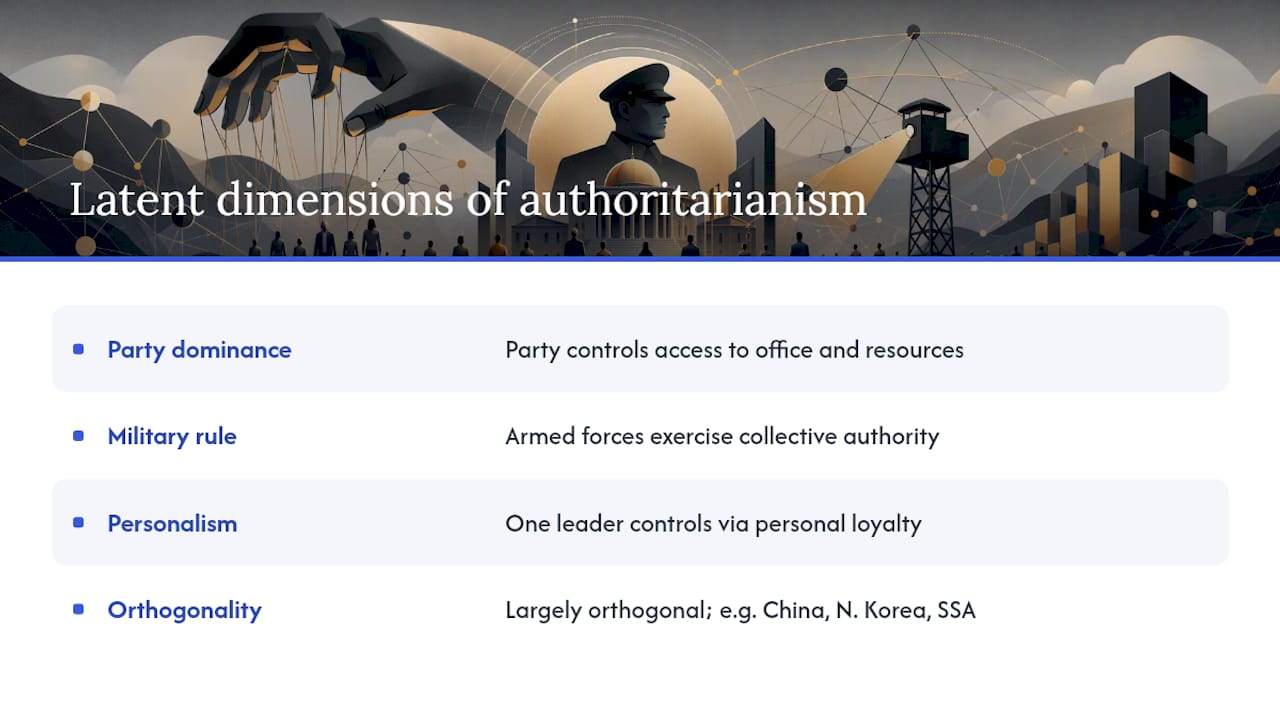
The most influential recent contribution identifies three latent dimensions that structure autocratic rule: party dominance, military rule, and personalism. These dimensions are estimated from historical data on dozens of observable features of autocratic governance, using latent variable methods that recover underlying characteristics not directly measurable from any single indicator.
Party dominance captures the degree to which a ruling party controls access to office, resources, and policy. Indicators include whether the party has an autonomous internal hierarchy, whether it penetrates the military and security services, and whether it manages elite recruitment. High party dominance tends to correlate with longer regime survival and more predictable succession.
Military rule captures the degree to which the armed forces, as an institution, exercise collective authority over the regime. This is distinct from a personalist leader who happens to have a military background: the dimension measures whether the officer corps as a body constrains and directs political decisions.
Personalism captures leader-centred rule — the degree to which one individual controls the military, party, and state through personal loyalty rather than formal rules. Standard democracy-autocracy scales (such as Polity scores) often miss this dimension entirely, which is why personalism has distinct implications for outcomes like war proneness and economic mismanagement that categorical labels alone cannot explain.
Crucially, these three dimensions are largely orthogonal: a regime can score high on party dominance and low on personalism (China), or high on personalism and low on party dominance (many sub-Saharan African cases), or high on both simultaneously (North Korea). That orthogonality is what makes dimensional approaches analytically powerful: they capture combinations that categorical boxes force into a single label.
A practical caution: latent variable estimates are sensitive to coding choices and the historical data used to train them. V-Dem indicators and Polity scores can be combined with latent variable methods to recover these dimensions, but you must document your coding thresholds and report time-variation rather than relying on a single cross-sectional snapshot. Snapshots conceal transitions that are often the most theoretically interesting moments.
The five modes of conceptualisation identified in the literature on conceptualising authoritarianism — a priori, scale-based, typological, dimensional, and generic — help explain why typologies and dimensional measures coexist rather than one superseding the other. Each mode answers a different kind of research question. Typologies answer “what kind of regime is this?”; dimensional measures answer “how much of each characteristic does this regime have, and how has that changed?”
What are hybrid and competitive authoritarian regimes?
Hybrid regimes occupy the contested middle ground between consolidated authoritarianism and liberal democracy. The concept of competitive authoritarianism, developed by Steven Levitsky and Lucan Way, describes systems in which formal democratic institutions exist — elections, legislatures, courts, a nominally free press — but incumbents abuse them so systematically that the playing field is fundamentally uneven. The competition is real enough to be meaningful, but not fair enough to threaten the incumbent’s hold on power under normal conditions.
Typical features of competitive authoritarian regimes include:
- A media environment dominated by state-aligned or owner-aligned outlets, with independent journalism harassed or financially strangled.
- An uneven legal playing field where opposition figures face prosecution, disqualification, or asset seizure.
- Electoral manipulation ranging from gerrymandering and voter registration obstacles to outright fraud.
- Selective repression: targeted arrests of prominent critics rather than the blanket terror characteristic of harder authoritarian systems.
- Formal institutions (courts, electoral commissions) that retain the appearance of independence but rule in the incumbent’s favour when it matters.
Andreas Schedler’s concept of electoral authoritarianism covers a broader range of cases in which elections are held but are not genuinely competitive, including both competitive authoritarian regimes and more closed hegemonic systems. The distinction between the two matters for coding: a competitive authoritarian regime is one where the opposition can sometimes win at lower levels of government, while a hegemonic electoral authoritarian regime is one where the ruling party wins everywhere, always, by large margins.
The Oxford Research Encyclopedia of Politics entry on autocracy estimates that a significant portion of contemporary countries are governed by some form of dictatorship, and hybrid or competitive authoritarian strategies that combine elections with strong incumbency advantages have become the dominant form. This matters for researchers because it means that most of the authoritarian world today is not the closed, party-mobilising, censorship-heavy system of mid-twentieth-century imagination, but something more ambiguous and harder to code.
How do authoritarian regimes maintain power?
The mechanisms autocrats use to survive are more varied than the blunt instrument of repression alone. Research consistently shows that regimes combining multiple mechanisms last longer than those relying on coercion alone.
The principal mechanisms are:
- Propaganda and media control: shaping the information environment through state media, censorship, and news cycle manipulation tactics that crowd out critical coverage.
The table below maps these mechanisms to regime families.
| Mechanism | Monarchic | Military junta | Single-party | Personalist | Hybrid/competitive |
|---|---|---|---|---|---|
| Security coercion | Selective | High (early phase) | Moderate-high | High, personalised | Selective, targeted |
| Legal repression | Moderate | Moderate | High (party law) | Variable | High (lawfare) |
| Patronage/clientelism | High (tribal/family) | Moderate | High (party networks) | High (personal) | High (electoral) |
| Elite co-optation | High (council/family) | Junta bargaining | Party hierarchy | Personal loyalty | Coalition management |
| Managed elections | Absent/consultative | Absent or plebiscitary | Hegemonic | Performative | Competitive but skewed |
| Media control | High | High | High (party media) | High (personal cult) | Partial, harassment |
| Economic incentives | Rentier distribution | Variable | State economy | Personal patronage | Growth legitimation |
One of the more counterintuitive findings in the literature is that institutions — parties, legislatures, managed elections — are often instruments of survival rather than signs of liberalisation. The Oxford Research Encyclopedia documents that autocrats who use institutionalised democratic forms tend to last longer, because these institutions allow elites to bargain, reduce the unpredictability that triggers coups, and provide a credible power-sharing framework. Seeing a legislature in an authoritarian state and concluding the regime is moderating is one of the most common analytical errors students make.
Pro Tip: When coding mechanisms in small-n case studies, look for personnel overlaps between the ruling party, security services, and the senior bureaucracy — these overlaps are a reliable indicator of how deeply co-optation has penetrated the state. Budget allocations to security agencies relative to social spending are a second practical proxy for the balance between coercion and legitimation.
The role of media watchdogs in tracking press freedom constraints is also worth consulting when assessing the media control dimension across cases, since watchdog organisations often produce the most granular country-level data on censorship and journalist harassment.
Country case studies: mapping types to real states
Classifications are analytical tools, not permanent labels. The cases below reflect the predominant scholarly characterisation at the time of writing, with caveats about hybrid features and historical change.
North Korea
North Korea is the closest contemporary approximation to a totalitarian regime in modern datasets. The Korean Workers’ Party provides the organisational backbone, but power has become intensely personalised under the Kim dynasty, making it a party-personalist hybrid with hereditary succession. Mass ideological mobilisation through the Juche ideology and the Songbun social classification system distinguishes it from typical authoritarian demobilisation. Elections exist as pure performance: turnout is reported at near 100% with a single candidate per seat. Repression is extreme and pervasive, including a network of political prison camps. Scholars disagree about whether the party or the Kim family is the primary locus of power, but the personalist dimension scores very high by any measure.
China
China under the Chinese Communist Party (CCP) is the paradigmatic single-party authoritarian regime, though with growing personalist features since Xi Jinping consolidated power after 2012. The party penetrates the military (through the Central Military Commission), the economy (through state-owned enterprises and party cells in private firms), and civil society. Elections exist at village level but are tightly managed; national leadership is selected through opaque intra-party processes. Institutionalisation is high by authoritarian standards, which is a major reason for the regime’s durability. The personalism dimension has risen markedly since the abolition of presidential term limits in 2018, making China an instructive case of a regime shifting along a dimension without changing categorical type.
Saudi Arabia
Saudi Arabia is the clearest contemporary example of monarchic authoritarianism. The Al Saud family rules through a combination of dynastic legitimacy, Islamic religious authority (in alliance with the Wahhabi clerical establishment), and oil-funded patronage. There are no national elections for the legislature; the Consultative Council (Shura) is appointed. Succession has historically been managed within the senior princes, though Mohammed bin Salman’s consolidation of power since 2017 has introduced a personalist dimension that sits uneasily with the traditional collegial model. Repression is selective but can be severe, as the 2018 killing of journalist Jamal Khashoggi illustrated.
Iran
Iran is a hybrid theocratic-authoritarian system that defies easy categorical placement. Formally, it has competitive elections for the presidency and parliament, but the unelected Guardian Council vets all candidates, disqualifying those deemed insufficiently loyal to the Islamic Republic. The Supreme Leader holds ultimate authority over the military, judiciary, and foreign policy, making Iran a form of competitive authoritarianism layered over a theocratic institutional structure, with a significant personalist dimension concentrated in the Supreme Leader’s office. The regime uses a combination of ideological legitimation (Shia Islamic governance), selective repression, and economic patronage through the Revolutionary Guards’ business empire.
Russia
Russia under Vladimir Putin is the textbook case of competitive authoritarianism as described by Levitsky and Way. Formal democratic institutions exist: elections, a parliament, courts, a nominally free press. But the playing field is systematically skewed through media dominance, legal harassment of opposition figures, electoral manipulation, and selective prosecution. The personalism dimension has intensified since 2022, with Putin’s inner circle narrowing and institutional constraints weakening. Russia also illustrates the danger of snapshot classification: it was more plausibly coded as a limited multiparty authoritarian regime in the early 2000s and has moved toward harder personalist authoritarianism since.
Myanmar
Myanmar illustrates the military junta model in its most direct form. The Tatmadaw (armed forces) seized power in a coup in February 2021, ending a decade of managed democratic transition. The junta suspended the constitution, dissolved the elected government, and established a State Administration Council. Repression has been severe, including mass arrests, torture, and airstrikes on civilian populations. The coup reversed what had appeared to be a managed liberalisation pathway, demonstrating that competitive authoritarian transitions can collapse back into hard military rule. The military’s economic interests — through its conglomerate holdings — provide a material basis for continued rule independent of popular support.
Venezuela
Venezuela under Nicolás Maduro (and before him Hugo Chávez) is a competitive authoritarian regime with strong personalist features. Formal elections continue, but the regime has systematically dismantled institutional checks: the Supreme Court was packed with loyalists, the National Assembly was bypassed through a parallel Constituent Assembly, and opposition candidates face disqualification, imprisonment, or exile. Economic collapse has eroded the oil-funded patronage system that sustained Chávez-era popularity, forcing greater reliance on coercion and international support from Cuba, Russia, and China. The regime sits high on the personalism dimension and uses political misinformation tactics extensively to manage the information environment.
Morocco
Morocco is a monarchic authoritarian regime with managed multiparty features. King Mohammed VI holds executive authority over defence, foreign policy, and religious affairs, while elected governments manage day-to-day administration within limits set by the palace. The 2011 constitutional reforms, prompted by Arab Spring protests, expanded the prime minister’s formal powers without fundamentally altering the palace’s dominance. Political parties compete in elections, but the palace retains veto power over policy and personnel. This makes Morocco a case of limited pluralism within a monarchic framework — closer to Hadenius and Teorell’s multiparty authoritarian category than to a pure no-party monarchy.
Egypt
Egypt since the 2013 military coup that brought Abdel Fattah el-Sisi to power is best classified as a military-personalist hybrid. The armed forces dominate the economy through a vast network of military-owned enterprises, and Sisi has concentrated personal authority to a degree that goes beyond typical junta governance. Elections are held but are not competitive: the 2018 presidential election saw Sisi win with over 97% of the vote after credible challengers were pressured to withdraw. Civil society has been systematically dismantled, with NGOs, journalists, and academics facing prosecution under broad counter-terrorism and cybercrime laws. The regime scores high on both the military and personalism dimensions.
Key takeaways
Authoritarian regimes are best understood through a combination of categorical typologies and dimensional measures, since no single framework captures the full range of variation across cases and time.
| Point | Details |
|---|---|
| Five main categorical types | Monarchic, military, no-party, one-party, and multiparty authoritarian regimes are the core categories used in comparative politics research. |
| Dimensions add analytical depth | Party dominance, military rule, and personalism are orthogonal latent dimensions that capture variation categorical labels miss. |
| Hybrids are now the norm | Limited multiparty and competitive authoritarian regimes are the most common form today, and also the most fragile. |
| Institutions can entrench autocracy | Parties, legislatures, and managed elections often prolong authoritarian survival rather than signalling liberalisation. |
| Classifications are time-varying | Regime type is not a fixed property; coding across multiple years and reporting change is methodologically necessary. |
Study tip: When designing a research project, choose typologies when your question is about regime-type effects on a specific outcome (e.g., “do military regimes initiate more wars?”). Switch to dimensional measures when your question is about variation within a regime type or about change over time (e.g., “does increasing personalism predict economic mismanagement?”). The two approaches are complementary, not competing.
Useful sources and datasets for further research
Hadenius, A. & Teorell, J. — “Authoritarian Regimes: Stability, Change, and Pathways to Democracy, 1972–2003” (Kellogg Working Paper 331)
The primary source for the fivefold typology (monarchical, military, no-party, one-party, multiparty). Essential for anyone coding regime type across time; the Kellogg ND PDF is freely available and includes coding rules and frequency data.
Wahman, M., Teorell, J. & Hadenius, A. — related measurement studies
Extend the Hadenius-Teorell framework with updated coding and survival analysis. Useful for replication and for understanding how the typology performs across different time periods.
Cambridge Core — “The Latent Characteristics That Structure Autocratic Rule”
The key reference for dimensional measurement. The Cambridge article explains the latent variable method and provides estimates of party dominance, military rule, and personalism across cases. Consult this before choosing between categorical and dimensional approaches for a quantitative project.
Oxford Research Encyclopedia of Politics — “Autocracy”
A peer-reviewed synthesis covering definitions, typologies, mechanisms, and durability research. The OxfordRE entry is an excellent starting point for literature reviews and includes the estimate that roughly 40% of contemporary states operate under some form of dictatorship.
Encyclopaedia Britannica — “Authoritarianism”
Useful for the authoritarian-totalitarian distinction and for accessible definitions. The Britannica entry is a reliable secondary source for introductory framing, though primary scholarly sources should be cited in academic work.
Ermakoff — “Conceptualizing Authoritarianism”
The Wisconsin sociology working paper maps five modes of conceptualisation and is particularly useful for methodology sections explaining why you chose a typological versus dimensional approach.
Systematic Typology Ordering of Autocracies (2009)
The journal article provides an empirical ordering that confirms totalitarian regimes are rare in modern data. Useful for contextualising where specific cases fall on the authoritarian-totalitarian spectrum.
Wikipedia — “Authoritarianism”
Treat as a pointer to primary sources rather than a citable reference. The Wikipedia article synthesises Linz, Geddes, Lai and Slater, and Levitsky and Way usefully, and its footnotes are a reliable guide to the primary literature.
V-Dem and Polity datasets
V-Dem (Varieties of Democracy) and Polity 5 are the two most widely used comparative datasets for regime coding. V-Dem’s disaggregated indicators are particularly useful for operationalising the dimensional approach; Polity scores are better for long time-series comparisons. Always triangulate across datasets and document your coding choices — single-dataset conclusions are vulnerable to measurement error.
Leave a Reply