

News algorithms decide what you see by scoring candidate stories on a mix of content features, user signals and business rules, then ranking those scores for each individual reader. For anyone following UK politics, that process matters enormously: a story about a parliamentary vote or a policy reversal may reach millions or almost nobody depending on how it scores at each stage. The systems doing this scoring draw on three broad technical families, content-based filtering, collaborative filtering and hybrid approaches, and they operate inside a pipeline that runs from candidate selection through to the final screen layout. Ofcom’s expanding oversight under the Online Safety Act means these mechanisms are now a live regulatory concern in the UK, not just a technical curiosity.
Table of Contents
- How news algorithms work: the three core approaches
- How a news-ranking pipeline works step by step
- What signals do algorithms actually look at?
- How feedback loops and filter bubbles affect political news
- How UK platforms compare and what regulation says
- Practical steps to broaden your news diet
- How publishers and journalists respond to algorithmic incentives
- Key takeaways
- The algorithm is not neutral, and neither are we
- Useful sources
How news algorithms work: the three core approaches
News recommender systems typically rely on three filtering mechanisms, each with distinct implications for political coverage.
Content-based filtering matches stories to a reader’s past interests by analysing the content itself: topic tags, named entities, keywords and article metadata. If you regularly read pieces about Westminster spending debates, the system infers you want more of the same. The upside is novelty within a topic; the downside is that it can lock you into a single political frame.

Collaborative filtering works differently. It looks at what readers similar to you have engaged with and uses that collective behaviour to predict your preferences. An academic review of news recommender systems found this approach can systematically hide content that falls outside a user’s peer group’s consumption patterns. A story about local council cuts might never surface for a reader whose peers only engage with national political commentary.
Hybrid systems blend both signals, often weighting them differently depending on how much behavioural data exists for a given user. New readers get more content-signal weight; established users get more behavioural weight. Most major platforms now use hybrid approaches because neither method alone is reliable enough at scale.
How a news-ranking pipeline works step by step
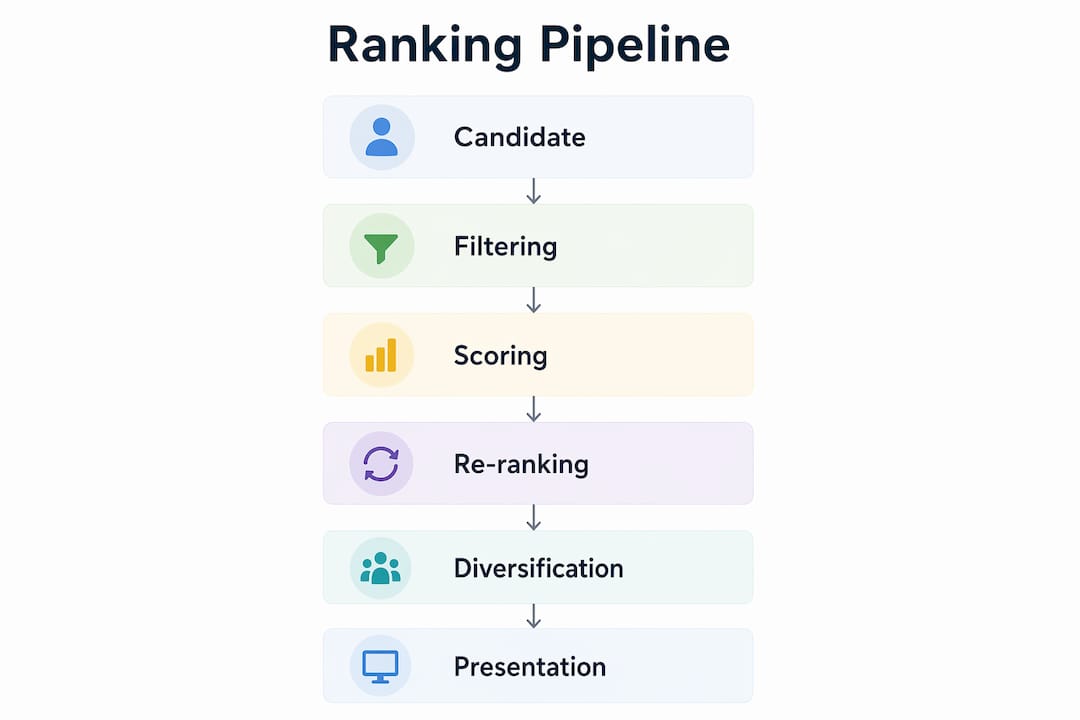
The pipeline is where abstract algorithmic logic becomes a concrete editorial decision. There are six stages.
- Candidate generation. The system pulls a pool of eligible stories from its index, filtered by language, region and basic relevance. For a UK reader, this typically means English-language content with a UK or international politics tag.
- Filtering. Duplicate detection, spam removal and basic quality checks narrow the pool. Some platforms apply source-authority filters here.
- Scoring. Machine-learning models assign each candidate a predicted engagement score for this specific user, drawing on the signals covered in the next section.
- Re-ranking and ensemble. Multiple models may run in parallel; their outputs are combined and adjusted. Diversity rules can be applied here to prevent the same source or topic dominating.
- Finishing. This is where human judgement re-enters. Editors or product rules can pin stories, set exposure minimums for under-served topics, or suppress content that scores well algorithmically but conflicts with editorial policy. The New York Times uses exactly this kind of editorial finishing, combining contextual bandits with pinning and importance rules on its homepage.
- Presentation. The ranked list is rendered for the reader’s device, with layout choices (card size, image prominence) that can themselves influence which stories get clicked.
| Stage | Primary actor | Key constraint |
|---|---|---|
| Candidate generation | Automated index | Language, region, recency |
| Filtering | Automated models | Quality, duplication |
| Scoring | ML models | Predicted engagement per user |
| Re-ranking | Ensemble models | Diversity, source balance |
| Finishing | Editors and product rules | Editorial policy, business rules |
| Presentation | Front-end system | Device, layout format |
What signals do algorithms actually look at?
Signals are the raw inputs that feed the scoring stage. The main ones are:
- Engagement metrics: click-through rate, scroll depth, watch time and shares. Watch time is particularly influential on video-led platforms; a political interview that holds viewers for four minutes will outscore a shorter clip even if the shorter one is more newsworthy.
- Recency: most systems apply a time-decay function, so a story published an hour ago scores higher than an identical story from yesterday. This is why accelerating news cycles and algorithmic recency signals reinforce each other.
- Source authority: platforms weight signals from established, high-authority publishers more heavily. Google states it uses authoritativeness, relevance and freshness among its news ranking signals, and that some experiences such as Top Stories are not personalised.
- User profile: explicit follows, topic preferences and search history.
- Geolocation and device: a reader in Manchester will see different local stories than one in Bristol, and mobile layouts prioritise different content lengths than desktop.
Google reported surfacing content from over 145,000 sources in a single month, which gives a sense of the scale at which these signals operate. At that volume, even a small weighting adjustment can shift which political stories reach millions of readers.
How feedback loops and filter bubbles affect political news
The risks here are structural, not accidental. Adaptive recommender systems use your behaviour to predict future preferences, which means the system is always optimising for what you have already shown interest in. Over time, that creates a feedback loop: you engage with centre-left commentary, the algorithm surfaces more of it, you engage with that, and the loop tightens. Research documents how this selective exposure contributes to filter bubbles and, at scale, to political polarisation.
Misinformation travels through the same mechanism. A false story that generates high early engagement, shares and outraged comments, scores well on the metrics that matter to the algorithm before fact-checkers have had time to respond. Platforms exercise significant gatekeeping power while disclosing limited details about which signals they reward, which makes independent scrutiny difficult.
For UK readers, echo chamber behaviours can develop gradually and invisibly. The feed feels normal; it is simply narrower than it was six months ago.
Pro Tip: Once a week, search for a major political story using a private or incognito browser window. The results you see there, without your personalisation history, are a rough baseline for what the algorithm has added or removed from your regular feed.
How UK platforms compare and what regulation says
Platform types differ meaningfully in how they balance personalisation against editorial curation.
| Platform type | Ranking priority | Personalisation level | UK example |
|---|---|---|---|
| Search news aggregator | Authoritativeness, freshness, relevance | Mixed (Top Stories unpersonalised; “For you” personalised) | Google News |
| Social feed | Engagement prediction, network signals | High | Facebook, X |
| Publisher homepage | Editorial finishing, exposure rules | Low to medium | BBC News, Guardian |
| Podcast/audio aggregator | Subscription and behaviour | Medium | BBC Sounds |
Google News separates personalised sections such as “For you” from non-personalised headline sections, giving readers some control. Social feeds apply engagement prediction far more aggressively, with recency and watch time dominating.
On regulation, Ofcom’s role has expanded under the Online Safety Act 2023, which places transparency and safety obligations on the largest platforms operating in the UK. Platforms must now assess how their recommender systems may contribute to harms, including the spread of misinformation. This does not yet amount to full algorithmic disclosure, but it marks a shift from voluntary self-reporting toward enforceable accountability.
- Ofcom can require platforms to produce risk assessments covering recommender system design.
- The Act’s provisions on illegal content and misinformation apply to algorithmically amplified material, not just user-posted content.
- Smaller publishers and independent sites remain largely outside this framework.
Practical steps to broaden your news diet
- Switch to unpersonalised views. On Google News, use the Headlines tab rather than “For you.” On the BBC News website, browse by section rather than relying on the homepage feed.
- Follow sources outside your usual frame. If you read primarily left-leaning commentary, deliberately follow two or three outlets with different editorial positions. The algorithm will adjust.
- Use Full Coverage. Google News’s Full Coverage feature aggregates multiple sources on a single story without heavy personalisation. It is one of the more useful tools for getting breadth on a breaking political story.
- Clear or pause your activity history. Both Google and major social platforms allow you to pause activity-based personalisation in settings. Doing so resets the behavioural signal weight.
- Use a personalised news feed you have built yourself, using RSS readers such as Feedly or Inoreader, where you choose the sources rather than letting the algorithm choose for you.
Pro Tip: Before sharing a political story, search the headline in quotes on a second platform. If only one outlet is running it, that is a reason to pause, not amplify.
Pro Tip: Check common misinformation tactics before forwarding a story that confirms your existing views. Confirmation bias and algorithmic amplification work in the same direction.
How publishers and journalists respond to algorithmic incentives
Newsrooms have adapted their workflows around algorithmic visibility, sometimes at a cost to editorial depth. Common tactics include metadata optimisation (writing headlines and tags that match platform ranking signals), A/B testing of headlines to maximise click-through rate, and exposure boosting, where editors manually promote stories that the algorithm has under-served.
The trade-off is real. Engagement-driven metrics push publishers toward content that generates quick reactions: outrage, surprise, strong opinion. Long-form policy analysis and nuanced reporting on, say, a local authority budget rarely compete with a shareable political row on pure engagement terms. Publishers who depend on platform traffic for revenue face structural pressure to optimise for the algorithm’s preferences rather than their own editorial values.
The finishing step described earlier is one practical countermeasure. By setting exposure minimums for under-served story types, pinning investigative pieces regardless of their predicted engagement score, and using editorial bandits that balance importance against predicted clicks, newsrooms can preserve some editorial integrity. The clickbait dynamics that algorithms reward are not inevitable; they are a choice that publishers can, with effort, push back against.
Key takeaways
News algorithms rank stories through a six-stage pipeline using content, behaviour and editorial signals, and readers who understand that pipeline can actively work against its narrowing effects.
| Point | Details |
|---|---|
| Three core mechanisms | Content-based, collaborative and hybrid filtering each shape political visibility in distinct ways. |
| Pipeline has six stages | Candidate generation through to finishing; human editorial rules can override algorithmic outputs at the finishing stage. |
| Engagement signals dominate | Click-through rate, watch time and recency are the primary scoring inputs on most platforms. |
| Feedback loops narrow exposure | Adaptive systems reinforce existing interests, contributing to filter bubbles and polarisation over time. |
| Readers can act now | Switch to unpersonalised views, build your own RSS feed, and use Full Coverage to get breadth on breaking stories. |
The algorithm is not neutral, and neither are we
The framing that algorithms are simply mirrors, reflecting what readers want back at them, does not hold up. They are editorial systems with commercial objectives, and those objectives do not always align with what a politically engaged reader actually needs.
At Whitebunnywabbit, the response to this is deliberate: editorial choices are made on the basis of what is worth covering, not what is likely to perform well on a platform’s engagement metrics. That means publishing analysis of policy detail that will never trend, and resisting the pull toward the quick take that generates shares but adds little to public understanding. The tension between reach and depth is genuine. A piece that reaches 200 readers who engage seriously with it is worth more, editorially, than one that reaches 2,000 who skim the headline and move on. Algorithms, as currently designed, disagree. Understanding that disagreement is the first step toward reading the news on your own terms rather than the platform’s.
Useful sources
- News recommender systems: a programmatic research review — Academic review of content-based, collaborative and hybrid filtering mechanisms and their implications for news diversity.
- Understanding Social Media Recommendation Algorithms, Knight First Amendment Institute — Detailed technical and policy analysis of engagement-prediction logic across major platforms.
- How The New York Times incorporates editorial judgment in algorithms, Nieman Lab — Case study on editorial finishing, pinning and exposure-boosting in a major newsroom.
- Algorithms and quality news, Center for News, Technology & Innovation — Policy primer on platform gatekeeping, transparency gaps and the impact on news quality.
- Research on algorithmic effects, feedback loops and polarisation — Peer-reviewed research on how adaptive recommender systems drive selective exposure and contribute to polarisation.
- How Google News works — Google’s own explanation of its automated, dynamic news systems and source breadth.
- Understanding how news works on Google Search — Google’s account of authoritativeness, freshness and the distinction between personalised and unpersonalised news experiences.
- How Google News stories are selected — Google’s support documentation distinguishing personalised from non-personalised sections.
- Social media algorithms in 2026: how they rank content, Hootsuite — Practical overview of ranking signals across social platforms, including watch time, engagement and recency.
Leave a Reply