
What is a culture war, and why does it divide society?
A culture war is a conflict between social groups with opposing values, moral frameworks, and visions of how society should be organised. It goes well beyond ordinary political disagreement. Where a policy dispute can be resolved through compromise, a culture war treats the other side’s worldview as fundamentally illegitimate. That is the distinction that makes it so corrosive.
Sociologist James Davison Hunter, who popularised the term in the early 1990s, described it as a conflict between two irreconcilable worldviews about what is “fundamentally right and wrong about the world we live in.” For Hunter, a culture war is not about winning a vote. It is about controlling the meaning of society itself.
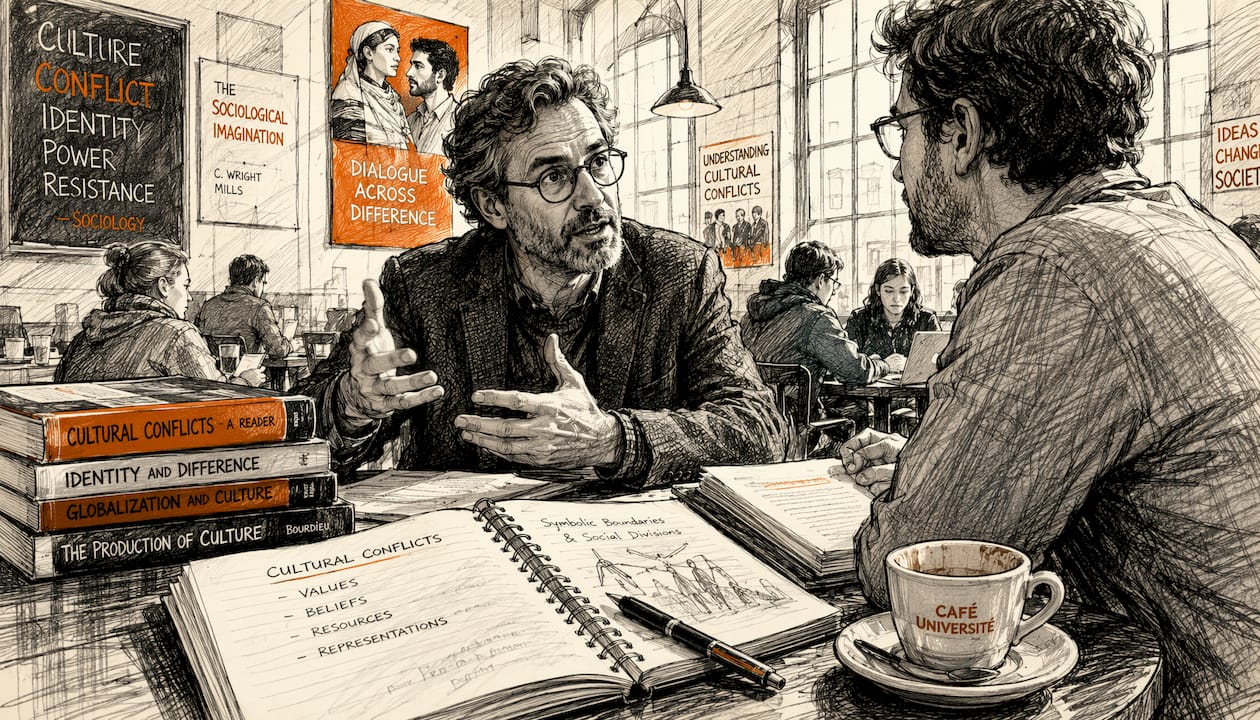
In the UK, culture war debates tend to cluster around identity, institutions, and national memory. They carry enormous media and political weight, though they do not always reflect the concerns of most British people.
Core attributes of a culture war include:
- Irreconcilable worldviews: Each side views the other’s values as a threat, not just a difference of opinion.
- Symbolic flashpoints: Disputes over statues, flags, or protest gestures stand in for deeper ideological battles.
- Elite amplification: Politicians, commentators, and media figures drive the intensity, often more than the general public does.
- Moral framing: Issues are cast in terms of right and wrong, making compromise feel like betrayal.
- Political instrumentalisation: Culture war rhetoric is frequently deployed to mobilise voters and distract from economic or policy failures.
Table of Contents
- Where does the term “culture war” come from?
- What do experts say about culture wars in the UK?
- Key examples and flashpoints of culture wars in the UK
- Is the “culture war” framing actually useful?
- Key takeaways
Where does the term “culture war” come from?
The phrase has older roots than most people realise. The term originates from the German Kulturkampf, meaning “culture struggle,” a 19th-century conflict between the Prussian state under Otto von Bismarck and the Roman Catholic Church over who held authority in German civil society. It was a genuine political and religious power struggle, not a metaphor.
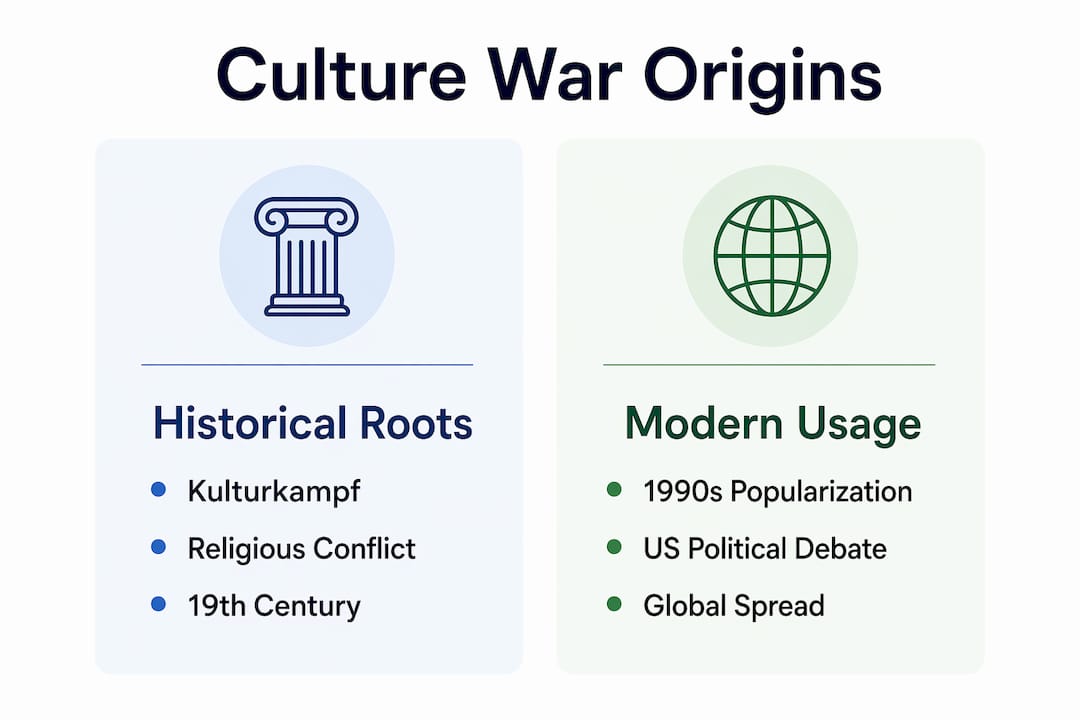
The modern usage is largely an American invention, though its influence spread quickly to Britain and beyond. James Davison Hunter placed the concept at the centre of social science in 1991 with his book Culture Wars: The Struggle to Define America, arguing that American society had fractured along a fault line between “orthodox” and “progressive” moral visions. A year later, Patrick Buchanan brought the idea into mainstream political consciousness when he declared at the 1992 Republican National Convention that a “cultural war” was underway, “a struggle for the soul of America.”
After Buchanan’s speech, the term became a journalistic staple almost overnight. It framed an antagonism between two visions of the future: one defending traditional values, the other welcoming social change. Many scholars trace the underlying tensions back to the 1960s, when liberation movements challenged norms around sex, family, and patriotism.
Key historical milestones in the development of the culture war concept:
- 1871–1878: Bismarck’s Kulturkampf in Prussia establishes the term as a descriptor for state-versus-church ideological conflict.
- 1960s: Countercultural movements in the US and UK challenge traditional norms on gender, race, and sexuality, planting the seeds of later polarisation.
- 1991: James Davison Hunter publishes Culture Wars, placing the concept in academic and public discourse.
- 1992: Patrick Buchanan’s Republican National Convention speech brings “culture war” into everyday political language.
- 2016 onwards: Brexit in the UK and the rise of populist politics globally intensify culture war dynamics around national identity, immigration, and institutional trust.
| Period | Development | Significance |
|---|---|---|
| 1871–1878 | Bismarck’s Kulturkampf | Origin of the term; state vs. Church authority |
| 1960s | Countercultural movements | Challenged traditional norms; seeds of polarisation |
| 1991 | Hunter’s Culture Wars published | Academic framework established |
| 1992 | Buchanan’s RNC speech | Term enters mainstream political discourse |
| 2016 | Brexit referendum | UK culture war dynamics intensify around identity |
What do experts say about culture wars in the UK?
Research from the King’s College London Policy Institute offers some of the sharpest analysis of how culture wars operate in a British context. Their findings challenge the assumption that the UK is as deeply divided as the political rhetoric suggests. Culture war debates in Britain tend to be high-profile and media-saturated, but they frequently do not reflect the priorities of ordinary citizens.
Culture wars are often elite-driven, with politicians, commentators, and media figures framing symbolic issues to polarise society and obscure substantive economic or political debates, as discussed in public debates and arguments. Most ordinary citizens hold more moderate or ambivalent views than the loudest voices on either side suggest.
King’s College London Policy Institute
Hunter’s framework remains the most cited in academic literature. For him, culture wars set worldviews as existential enemies, which structurally blocks any meaningful compromise. When your opponent’s values are not just wrong but a threat to civilisation, negotiation becomes impossible. That logic is precisely what makes culture wars so useful to political actors who benefit from division.
Oxford University Press notes that culture wars are not new. They are an enduring historical phenomenon, intensified today by instant global communication. The speed and reach of social media means that a local flashpoint, a statue being toppled, a protest gesture, a university speech controversy, can become a national ideological battle within hours. What changes is not the underlying conflict but the velocity and scale of the argument.
Key expert findings on UK culture wars:
- Most British people occupy a moderate position on culture war issues; the perceived extremes are amplified by political and media narratives.
- Culture wars lack a resolution mechanism, tending to escalate exclusionary tactics rather than genuine debate.
- Elite actors on both sides frame issues to pull public discourse towards their preferred narrative, eclipsing the moderate centre.
- The underlying driver is anxiety about shifting social norms and identity, which means resolving individual flashpoints does not end the conflict.
Key examples and flashpoints of culture wars in the UK
1. The statues debate
The toppling of the Edward Colston statue in Bristol in June 2020 became one of the most vivid UK culture war moments in recent memory. For one side, it was a necessary reckoning with a history of slavery. For the other, it was an attack on national heritage and the rule of law. Neither side was really arguing about a statue. They were arguing about who gets to define British identity and history. Major UK culture war flashpoints like this one are regularly amplified by media as symbolic battles over values, far beyond their immediate context.
2. Brexit as a culture war fault line
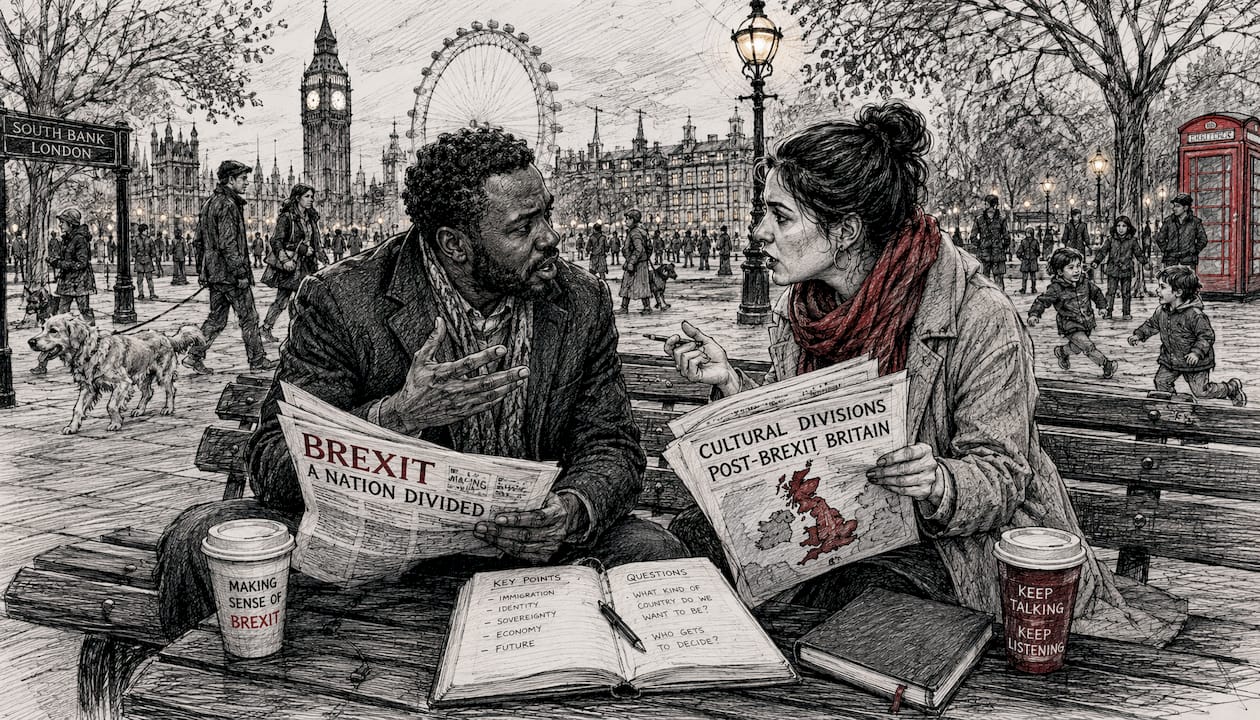
Brexit was not simply a constitutional question about EU membership. Research from the University of Manchester identified it as a crystallisation of Britain’s culture wars, with the Leave/Remain divide mapping closely onto attitudes about national identity, immigration, and social change. The referendum gave political form to a pre-existing cultural fracture between those who felt left behind by globalisation and those who embraced it.
3. Protests, gestures, and “taking the knee”
When England footballers took the knee before matches during Euro 2020, it triggered a national argument that had almost nothing to do with football. Government ministers weighed in. The gesture became a proxy for competing views on racial justice, national pride, and the perceived influence of progressive politics on public life. That a sporting gesture could generate weeks of political controversy illustrates how culture war dynamics work: the symbol matters less than what each side believes it represents.
4. Trans rights and gender recognition
Few issues have generated more heat in British public life over the past several years than debates around gender recognition reform and trans rights. The conflict cuts across traditional party lines, pitting progressive and feminist voices against each other as well as against conservative opinion. It has drawn in the Scottish Government, the UK Supreme Court, and major institutions, making it one of the most sustained culture war flashpoints in recent British political history.
5. Universities, free speech, and “cancel culture”
Arguments about free speech on university campuses have become a recurring feature of British culture war debates. Critics argue that progressive orthodoxy silences dissenting voices; defenders of campus speech policies argue that vulnerable students deserve protection from harassment. The Higher Education (Freedom of Speech) Act 2023 was a direct legislative response to this flashpoint, showing how culture war arguments can translate into actual law. Understanding why cancel culture emerges helps explain why these campus disputes generate such disproportionate national attention.
6. Media, social media, and the amplification effect
Social media does not create culture wars, but it accelerates them dramatically. Outrage drives engagement on platforms like X (formerly Twitter) and Facebook, which means inflammatory culture war content spreads faster and further than nuanced analysis. Algorithms reward conflict. A moderate, considered take on a contested issue gets far less traction than an outraged one. This structural bias shapes what the public perceives as the dominant view, even when most people privately hold more measured positions.
Pro Tip: When you encounter a culture war story in the news, ask who benefits from the argument running hot. The answer is usually not the general public.
7. Immigration and multiculturalism
Immigration has been a recurring fault line in British culture wars for decades, but the intensity has increased since the mid-2000s. Debates about multiculturalism, integration, and national cohesion are regularly framed in culture war terms, with one side accusing the other of either racism or naïve idealism. The role of partisan media in shaping these debates is substantial: tabloid coverage of immigration consistently frames it as a cultural threat, while progressive outlets frame restrictionist policies as moral failures.
8. How culture wars shape UK elections and policymaking
Culture war issues have become an explicit part of British electoral strategy. The Conservative Party under Boris Johnson and later Rishi Sunak made “culture war” positioning a deliberate tactic, targeting what strategists called “red wall” voters with messaging on statues, flags, and national identity. Labour, meanwhile, struggled to navigate these debates without alienating either its traditional working-class base or its younger, more progressive urban voters. The result was that symbolic cultural issues consumed political bandwidth that might otherwise have gone to housing, the NHS, or economic policy.
Public intellectuals play a significant role here too, often widening the gap between media narratives and what the public actually cares about. When think tanks, columnists, and academics frame every policy question as a front in a culture war, it becomes harder for politicians to treat issues on their practical merits.
Is the “culture war” framing actually useful?
There are serious reasons to be sceptical of the culture war frame, even while acknowledging that real cultural conflicts exist.
The most fundamental critique is that culture war rhetoric exaggerates division. Empirical data consistently shows that most people hold moderate or ambivalent views on the issues typically labelled as culture war battlegrounds. Polarisation is real among political elites and media commentators; it is far less pronounced in the general population. When the loudest voices on both sides treat every disagreement as an existential conflict, they misrepresent where most people actually stand.
A second problem is that the framing is often strategic rather than descriptive. Culture war rhetoric is a tool for mobilising voters and donors, not a neutral description of social reality. When politicians frame an issue as a culture war, they are usually trying to activate tribal loyalties rather than solve a problem. News cycle manipulation plays directly into this: a well-timed culture war story can dominate the news agenda for days, crowding out coverage of policy failures or economic difficulties.
The binary structure of culture war framing is also intellectually limiting. Complex social questions, about how to balance free expression with protection from harm, or how to honour history while acknowledging its injustices, get collapsed into two camps. Anyone who holds a nuanced position gets pulled towards one side or the other, as Hunter himself acknowledged. The middle ground does not disappear, but it becomes invisible in public discourse.
Key criticisms of the culture war concept:
- It overstates the depth of public division, which is far less pronounced than media coverage implies.
- It serves elite interests by distracting from substantive economic and policy debates.
- It reduces complex, multi-dimensional issues into a false binary.
- It lacks any resolution mechanism, tending to escalate rather than resolve conflict.
- It can be weaponised by any political faction, making it an unreliable guide to genuine social tensions.
Pro Tip: Treating a culture war issue as a genuine policy question, asking what evidence supports which approach, is often the most effective way to cut through the noise.
Key takeaways
Culture wars describe conflicts over competing worldviews that go beyond ordinary disagreement, treating the opposing side’s values as fundamentally illegitimate rather than simply different.
| Point | Details |
|---|---|
| Definition and origin | The term derives from the German Kulturkampf and was popularised by James Davison Hunter in 1991 to describe irreconcilable worldview conflicts. |
| UK-specific dynamics | King’s College London research shows UK culture war debates are high-profile but often do not reflect the moderate views most British people actually hold. |
| Elite amplification | Culture wars are frequently driven by politicians, media, and commentators rather than genuine mass public division. |
| Real-world flashpoints | UK examples include the Colston statue, Brexit, trans rights debates, and free speech controversies on university campuses. |
| Critical limitation | The culture war frame reduces complex issues to binary conflicts and lacks any mechanism for resolution, tending to deepen rather than resolve division. |
Leave a Reply