
Donating effectively to social causes is defined as directing your money to organisations where it produces the greatest measurable change, with full transparency and accountability. The term “effective philanthropy” is the recognised industry standard for this practice, and it goes far beyond simply writing a cheque to a familiar name. Frameworks from organisations such as 80,000 Hours and Giving What We Can show that cause selection, charity evaluation, and strategic planning together determine whether your giving creates real impact or simply feels good. This article gives you the practical tools to do it properly.
How to donate effectively to social causes: choosing the right cause
The single most powerful decision you make as a donor is not which charity to pick. It is which cause area to fund. Cause prioritisation outweighs micro-level charity evaluation in determining overall effectiveness. That means your first task is to decide where your resources can do the most good, not to browse charity websites at random.
High-impact cause areas share three qualities: they affect large numbers of people, they are underfunded relative to their scale, and they have proven, measurable solutions. Global health, poverty reduction, and access to education consistently meet all three criteria. Causes such as malaria prevention, direct cash transfers to people living in extreme poverty, and early childhood education have decades of evidence behind them.
A portfolio approach works well here. Rather than betting everything on one cause, you spread your giving across two or three areas that reflect both your values and the evidence. This balances personal motivation with impact potential, which matters because sustained giving requires genuine commitment.
- Identify your values. Write down the two or three issues that concern you most. Your giving will last longer when it connects to something you care about deeply.
- Check the evidence base. Look for cause areas with published research on outcomes. Global health interventions, for example, have strong randomised controlled trial data.
- Assess funding gaps. A cause that receives little attention from major institutional funders often offers more leverage for individual donors.
- Set a cause portfolio. Commit to two or three cause areas for at least one year before reassessing. Consistency compounds impact.
- Review annually. New evidence emerges. Adjust your cause mix when the data justifies it, not because of media coverage.
Pro Tip: Giving What We Can publishes an annual review of high-impact cause areas. Reading it takes under an hour and can sharpen your cause selection considerably.
How do you evaluate a charity before donating?
Once you have chosen your cause areas, the next step is identifying which organisations within those areas use money well. Financial transparency is the starting point. Effective nonprofits allocate between 65% and 85% of expenses directly to programmes, with 75% as a practical baseline. An organisation spending less than 65% on programmes warrants closer scrutiny.

Beyond the spending ratio, look for public reporting on outcomes, not just activities. A charity that tells you it “raised awareness” without showing what changed is not demonstrating impact. You want to see data: lives improved, people housed, children educated, and by how much.
Using multiple rating platforms together, such as Charity Navigator, CharityWatch, Give.org, and Candid, gives a fuller picture than any single source. No one rating site captures everything. Cross-referencing reveals inconsistencies and fills gaps in transparency.
Key red flags to watch for:
- Vague mission statements that describe broad goals without specific programmes or target populations.
- High fundraising costs consuming more than 25% of total expenditure, which leaves less for actual work.
- No publicly available financial documents, including IRS Form 990 for US-registered organisations, which is a legal requirement and a primary transparency tool.
- Unsolicited donation requests by phone or email, which are frequently linked to fraud.
- Resistance to questions about how funds are used or what outcomes have been measured.
Pro Tip: Even 20 minutes of due diligence before donating significantly raises your confidence and reduces the risk of misallocation. Set a timer and work through one charity at a time.
Verifying legal registration is non-negotiable. In the UK, check the Charity Commission register. For US-based organisations, the IRS tax-exempt organisation database is publicly searchable. An unregistered organisation asking for donations is a serious warning sign regardless of how compelling its story sounds.
What is the best way to plan your donations strategically?
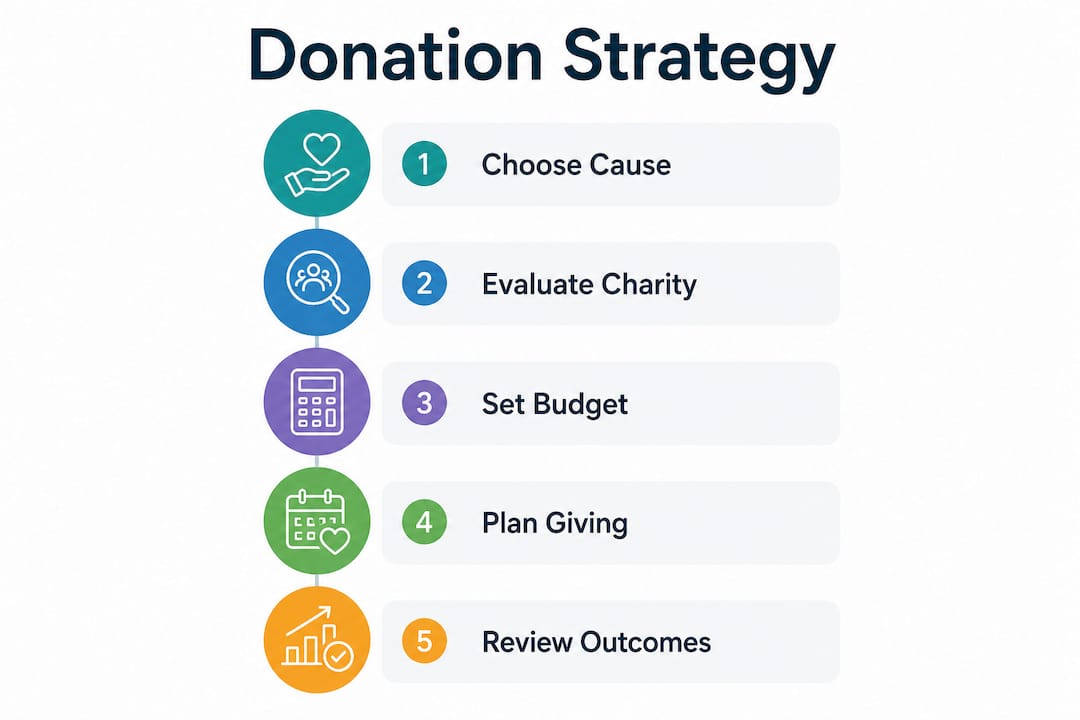
Strategic giving starts with a budget. The 10% pledge, popularised by Giving What We Can, is a well-tested benchmark. Donating 10% of post-tax income to highly effective charities can be over 20 times more impactful than a career in clinical medicine in saving lives. That figure reframes what individual giving can achieve when directed well.
Recurring donations outperform one-off gifts in two ways. They give charities reliable income to plan programmes, and they remove the friction of deciding whether to give each month. Set up a standing order and treat it like a utility bill.
Diversifying across 3–5 top-rated charities within your chosen cause areas captures 80–90% of the impact of perfect giving while managing risk. No single charity is immune to leadership changes, funding crises, or shifts in programme effectiveness. A portfolio protects your impact.
- Set your annual giving budget. Calculate 10% of your post-tax income, or start with a smaller percentage and increase it each year.
- Choose 3–5 vetted charities across your cause areas. Spread your budget proportionally based on your confidence in each organisation.
- Set up recurring payments. Monthly standing orders are more reliable than annual lump sums for both you and the charity.
- Decide between unrestricted and restricted gifts. Unrestricted donations give charities flexibility to allocate funds where they are most needed. Restricted gifts fund specific programmes but can create bottlenecks if one area is already well-funded.
- Apply a year-end rule. Set a rule to donate unallocated funds to vetted charity indices by 31 December each year. This prevents giving paralysis from deferring your contributions indefinitely.
On tax, the 2026 rules in the US enforce a 0.5% adjusted gross income floor before itemised charitable deductions apply. Some high-impact opportunities, including political advocacy and certain impact investments, are not tax-deductible at all. Prioritising impact over tax efficiency is often the more effective choice.
Pro Tip: If you cannot decide between two charities, split your allocation equally for one year, then review outcomes data before rebalancing.
Common mistakes that reduce your giving impact
The most damaging mistake donors make is giving based on emotion without checking legitimacy. A compelling story or a well-produced video does not confirm that an organisation uses funds well. Emotional appeals are a fundraising technique, not evidence of impact.
Overreliance on a single charity rating website is the second most common error. Each platform uses different criteria and data sources. Relying on one gives you a partial view. Cross-referencing across Charity Navigator, CharityWatch, and Candid takes less than 30 minutes and produces a far more reliable assessment.
“Giving paralysis is one of the biggest threats to effective philanthropy. Donors who spend months researching without committing often end up giving nothing, or giving hastily at year-end to whatever is most visible. A pre-commitment rule, such as donating unallocated funds to a vetted index by a fixed date, solves this problem before it starts.”
Ignoring accountability signs is a third pitfall. Charities that publish annual reports, audited accounts, and outcome data are demonstrating accountability. Those that do not are asking you to trust them without evidence. Accountability is not optional for organisations seeking public funds.
Focusing solely on tax deductions rather than impact leads donors toward large, well-known organisations that may not be the most effective. Some high-impact opportunities are not tax-deductible. If the tax benefit drives your decision more than the outcome, you are optimising for the wrong variable.
Finally, analysis paralysis is real. Donors who research indefinitely without committing miss years of potential impact. Set a research deadline, make a decision, and review it annually. Imperfect giving that happens is better than perfect giving that never does.
Key takeaways
Effective philanthropy requires cause selection, charity due diligence, and a structured giving plan working together to produce real social impact.
| Point | Details |
|---|---|
| Cause selection comes first | Choose cause areas based on evidence and personal values before evaluating individual charities. |
| Programme spending ratio matters | Look for charities allocating 65–85% of expenses to programmes, with 75% as a reliable baseline. |
| Use multiple rating sources | Cross-reference Charity Navigator, CharityWatch, Give.org, and Candid for a complete picture. |
| Portfolio giving reduces risk | Spreading donations across 3–5 vetted charities captures most of the impact while managing uncertainty. |
| Commit to a year-end rule | Donate unallocated funds by 31 December each year to prevent giving paralysis and ensure annual deployment. |
Why I think most donors are solving the wrong problem
Most articles on charitable giving focus on how to find a trustworthy charity. That is the wrong starting point. After years of following effective philanthropy strategies and reading the research from 80,000 Hours and Giving What We Can, I am convinced that cause selection is where most donors should spend the majority of their thinking time.
The difference in impact between a mediocre charity in a high-priority cause and an excellent charity in a low-priority cause can be enormous. A well-run organisation addressing a problem that is already heavily funded will achieve far less than a competent one working in a neglected area. Most donors never consider this.
I have also found that the fear of making the wrong choice is what stops people from giving at all. The portfolio approach changed that for me. Spreading giving across several vetted organisations removes the pressure of a single high-stakes decision. You do not need to find the perfect charity. You need to find a small group of good ones and commit.
The data-driven approach to giving does not have to feel cold. Knowing that your giving is likely to save lives, rather than simply feeling like it might, makes the habit more rewarding, not less. Whitebunnywabbit covers these issues regularly because they sit at the intersection of politics, policy, and social change. That is exactly where effective philanthropy lives.
— John
Whitebunnywabbit’s resources on impactful giving
Whitebunnywabbit publishes analysis on the social causes that matter most, from education and justice to political accountability.
If you want to understand where charitable giving intersects with real policy change, the site’s coverage of education and social justice is a strong starting point. For donors interested in how supporting marginalised communities connects to effective philanthropy, that section offers grounded, reported perspectives. Whitebunnywabbit does not sell products or services. It publishes the kind of informed commentary that helps you think more clearly about where your money can do the most good.
FAQ
What does it mean to donate effectively to social causes?
Effective giving means directing your money to organisations where it produces the greatest measurable change, guided by cause prioritisation, financial transparency, and evidence of outcomes rather than emotional appeals alone.
How much of my income should I donate to charity?
Giving What We Can recommends a 10% pledge of post-tax income as a benchmark. Research from 80,000 Hours shows that 10% directed to highly effective charities can be over 20 times more impactful than many professional alternatives.
How do I know if a charity is legitimate?
Verify registration with the Charity Commission (UK) or the IRS tax-exempt database (US), review publicly available financial documents such as IRS Form 990, and cross-reference ratings across Charity Navigator, CharityWatch, and Candid.
Is it better to give a large one-off donation or smaller recurring gifts?
Recurring donations are generally more valuable to charities because they enable reliable programme planning. A monthly standing order removes decision friction and ensures your giving continues consistently throughout the year.
Should I prioritise tax deductions when choosing where to donate?
Tax efficiency is a secondary consideration. Some high-impact opportunities, including political advocacy and certain impact investments, are not tax-deductible. Prioritising impact over tax benefit produces better social outcomes in most cases.
Leave a Reply