
Wire services are professional organisations that collect, verify, and distribute news content to subscribing media outlets simultaneously through a structured digital pipeline. The Associated Press (AP) and Reuters are the two most recognised names in the field, reaching audiences in over 150 countries through licensing agreements with broadcasters, newspapers, and digital platforms. Understanding wire services matters because they form the backbone of global news dissemination, not a peripheral feature of it. Every time a regional newspaper runs a story about a foreign election or a natural disaster, a wire service almost certainly gathered and transmitted that content first. Whitebunnywabbit covers the mechanics of this process because it shapes what you read, watch, and hear every day.
How wire services work: from field report to your screen
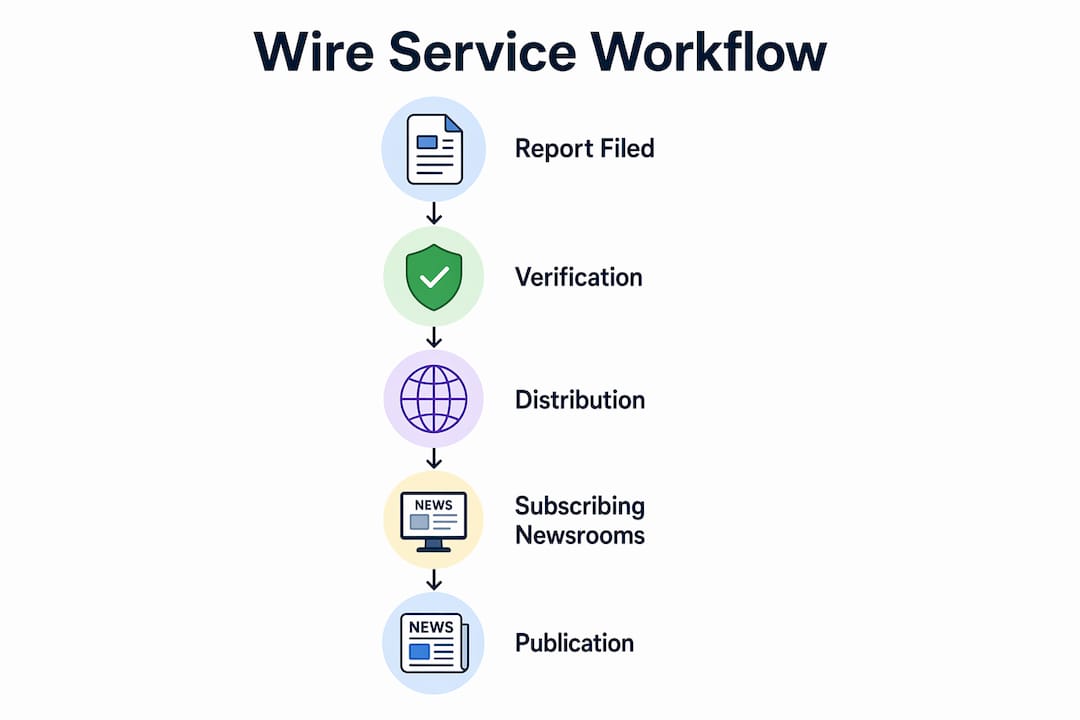
The wire service process follows a clear sequence. Each stage adds a layer of verification and structure before content reaches a newsroom.
-
Field reporting. Correspondents and freelance reporters file raw copy from locations worldwide. These reports arrive as text, photographs, or video, often within minutes of an event occurring.
-
Desk editing. A team of editors at the wire service’s central desk reviews every submission. They check facts, apply house style standards such as those set by the AP Stylebook, and confirm that claims are attributed to at least two independent sources where possible. AP Stylebook standards require multi-source attribution to protect credibility.
-
Metadata tagging. Editors assign metadata to each piece of content before transmission. Urgency classifications include routine, urgent, and flash, with flash reserved for the most time-sensitive breaking news. Topic codes, geographic tags, and content type labels are added at this stage.
-
Digital transmission. Content travels over secure IP-based data feeds. Wire services use structured transmission protocols such as NITF (News Industry Text Format) and ANPA to send feeds efficiently and securely, replacing the satellite and leased lines of earlier decades.
-
Newsroom ingestion. Subscribing newsrooms receive feeds through APIs or content management systems. Editors then decide whether to publish content as received, edit it for local context, or use it as background for original reporting.
Pro Tip: If you work in a newsroom, check whether your CMS allows urgency-level filtering on incoming wire feeds. Prioritising “flash” and “urgent” tags means you never miss a breaking story buried in routine traffic.
The speed of this pipeline is what makes wire services indispensable. A correspondent in Nairobi can file a report, have it verified in London or New York, and see it published on a news portal in Tokyo within the hour.

What is the business model behind wire services?
Wire services sustain themselves through subscription fees and, in some cases, cooperative ownership structures. The model differs between agencies, but the core principle is the same: media outlets pay for access to a continuous content feed.
-
Cooperative ownership. AP operates as a not-for-profit cooperative, jointly owned by its member news organisations. Members pay fees, and revenues are reinvested into news gathering operations rather than distributed as profit. This structure gives members a stake in the agency’s editorial direction.
-
Commercial subscription contracts. Other agencies operate on direct subscription pricing. Fees vary by region, content type, and the size of the subscribing outlet. A national broadcaster pays significantly more than a small regional newspaper.
-
Licensing and attribution requirements. Subscribers must credit the wire service in published content, typically with a byline such as “AP” or “Reuters.” Republishing wire content without attribution violates the licensing agreement and can result in legal action.
-
Supplementary revenue streams. Some agencies generate additional income through archival licensing, data services, and financial news feeds sold to trading platforms and investment firms.
The cooperative model is worth understanding because it explains why AP content tends to carry a different editorial character from commercially driven agencies. Member ownership creates accountability to journalists rather than shareholders.
What editorial standards do wire services follow?
Wire services apply strict editorial protocols that most individual newsrooms cannot match at scale. These standards are the reason major outlets trust wire content as a reliable starting point.
Wire editors require attribution to multiple independent sources and mandate full disclosure when a story relies on a single party. This is not optional practice. It is a condition of publication within the wire system.
Wire copy follows the inverted pyramid style, placing the most critical information at the top of every story. This structure allows editors at subscribing outlets to cut content from the bottom without losing the essential news value. A story about a parliamentary vote, for example, leads with the result, then the margin, then the reaction, then the background.
-
Breaking news (“must-run” content). Certain stories carry a must-run designation, meaning subscribing outlets are expected to publish them promptly. These are typically high-impact events: elections, disasters, major policy announcements.
-
Evergreen and feature content. Editors distinguish between must-run breaking news and supplementary features, using the latter as secondary input to fill space or provide context rather than as urgent publication priorities.
-
Photographs and video. Visual content carries its own metadata, including caption text, location data, photographer credit, and usage restrictions. Editors must check these restrictions before publishing.
Pro Tip: When using wire photographs, always read the usage rights metadata before publication. Some images are licensed for online use only, others for print only. Publishing outside the permitted format can trigger a licensing dispute.
The consistency of these standards across thousands of stories per day is what makes wire services function as infrastructure rather than just another content source.
How have wire services adapted to the digital news ecosystem?
Wire services began as telegraph networks in the 19th century, transmitting text over physical wires to newspaper offices. The name stuck even as the technology changed entirely. Today, digital platforms and automated aggregators ingest wire feeds to maintain constant breaking news updates across 24-hour news portals and mobile applications.
The shift to IP-based transmission and API delivery has made wire content faster and more accessible than at any previous point. A news aggregator can pull a wire feed, apply automated tagging, and display a story to readers within seconds of the wire service publishing it. This acceleration connects directly to why news cycles accelerate in ways that affect both journalists and readers.
| Era | Transmission method | Typical delivery speed |
|---|---|---|
| 19th century | Telegraph wire | Hours |
| Mid-20th century | Teletype machine | 30–60 minutes |
| Late 20th century | Satellite and leased lines | Minutes |
| Present day | IP-based feeds and APIs | Seconds |
Wire services also address what researchers call the “coverage gap.” Local outlets cannot afford to produce credible international news themselves, so wire services fill that gap by supplying verified global content at a fraction of the cost of maintaining foreign correspondents. A regional newspaper in Wales can carry a story from Kyiv or Nairobi without employing a single foreign correspondent.
Wire services remain indispensable in modern journalism precisely because digital platforms amplify their reach rather than replace their function. The assumption that social media or citizen journalism has made wire services obsolete misreads how newsrooms actually operate. Most digital news portals depend on wire feeds for the volume and speed of content they publish daily.
Key takeaways
Wire services are the verified, structured backbone of global news distribution, and no digital platform has replaced that function.
| Point | Details |
|---|---|
| Operational pipeline | Wire services move content from field reporters through desk editing, metadata tagging, and digital transmission to newsrooms. |
| Editorial rigour | AP Stylebook standards and multi-source attribution requirements protect the credibility of wire content at scale. |
| Business model | Cooperative agencies like AP reinvest fees into reporting; commercial agencies price subscriptions by region and content type. |
| Digital adaptation | IP-based feeds and APIs now deliver wire content in seconds, making wire services faster and more embedded in digital platforms than ever. |
| Coverage gap | Wire services supply verified international news that local and regional outlets cannot afford to produce independently. |
Wire services and the newsroom reality
I have spent years reading about and analysing how news reaches the public, and the most persistent misconception I encounter is that wire services are a passive, mechanical process. Journalists and students often assume that wire content simply flows into a newsroom and gets published unchanged. That is rarely true, and the exceptions matter enormously.
The wire service defence is a legal principle worth knowing. If a local outlet publishes wire content without significant modification, legal accountability for errors generally rests with the wire agency rather than the outlet. The moment an editor rewrites the story, that protection disappears. This is not a technicality. It shapes how cautious editors approach wire copy, and it explains why some newsrooms have strict policies about how much they alter incoming feeds.
What strikes me most is how wire services solve a problem that no amount of social media or citizen journalism has managed to fix: the credibility gap. A tweet from a bystander at a disaster site is not the same as a verified wire report filed by a trained correspondent and checked by a desk editor. Understanding this distinction is central to avoiding common news consumption mistakes that lead readers to treat unverified content as fact.
Wire services are also not immune to the pressures of the digital age. Speed sometimes competes with accuracy, and the must-run designation can push content to publication before full verification is complete. The best newsrooms treat wire content as a starting point, not a final word.
— John
Whitebunnywabbit: going deeper on journalism and media
Whitebunnywabbit publishes in-depth commentary and analysis on the processes that shape how news reaches the public.

If this article has clarified how the wire service pipeline operates, the site’s broader coverage of journalism education and integrity takes that understanding further. Whitebunnywabbit also examines the relationship between data and information flow in the digital age, which connects directly to how wire feeds are ingested and distributed by modern platforms. For readers researching news dissemination, media literacy, or the editorial standards that separate credible journalism from noise, the site offers a consistent, opinion-grounded perspective on all of it.
FAQ
What is a wire service in journalism?
A wire service is a professional organisation that gathers news from correspondents worldwide and distributes it simultaneously to subscribing media outlets via digital feeds. AP and Reuters are the most widely recognised examples, reaching audiences in over 150 countries.
How does wire service content reach a newsroom?
Wire content travels over secure IP-based data feeds using structured protocols such as NITF and ANPA. Subscribing newsrooms receive it through APIs or content management systems, where editors decide whether to publish, edit, or use it as background research.
What is the inverted pyramid style used by wire services?
The inverted pyramid places the most important information at the top of a story and less critical detail below. This allows editors to cut content from the bottom to fit space without losing the essential news value of the piece.
What is the wire service defence?
The wire service defence is a legal principle stating that if a local outlet publishes wire content without significant modification, legal responsibility for errors lies primarily with the wire agency rather than the outlet. Rewriting the story transfers that responsibility to the publisher.
Are wire services still relevant in the digital age?
Wire services remain central to modern journalism. Digital platforms and automated aggregators depend on wire feeds to maintain continuous breaking news coverage, and local outlets rely on wire content to fill the coverage gap left by the absence of foreign correspondents.
Leave a Reply