

News aggregation is the automated or semi-automated process of collecting news content from multiple online sources and consolidating it into a single platform for convenient access. The term “news aggregator” is the standard industry label for any tool or service that performs this function. RSS, Atom feeds, and web scraping are the three primary technical methods that power aggregation pipelines. Platforms like Google News pull from over 20,000 publishers worldwide, which shows just how vast the scope of modern aggregation has become. For readers who want comprehensive coverage of current events without visiting dozens of individual sites, understanding how aggregation works is the first step to using it well.
What is news aggregation and how does it work technically?
News aggregation works as a pipeline with three core stages: crawling, parsing, and storing content for display. Each stage has its own technical demands, and a failure at any point breaks the entire flow.
The most reliable method is the RSS or Atom feed. Publishers generate these structured XML files automatically whenever new content is published. An aggregator polls these feeds every 15–60 minutes, checks for new entries, and pulls them into its database. This is fast, clean, and low on server load for both sides.

Not every publisher offers a feed, which is where web crawling and scraping come in. A crawler visits a news site’s homepage or section pages, reads the HTML, and extracts headlines, links, and article text. The aggregation pipeline then parses that raw HTML into structured data. This works well for static pages but breaks down on sites that load content with JavaScript, since the crawler sees an empty page rather than the rendered article.
Solving the JavaScript problem requires headless browsers or specialist scraping APIs. A headless browser runs a full web engine in the background, waits for JavaScript to execute, and then reads the completed page. This is computationally expensive but necessary for modern news sites that rely heavily on client-side rendering.
Once content is collected, deduplication becomes critical. Wire services like Reuters and AP syndicate the same story to hundreds of outlets simultaneously. Without deduplication, a single event generates a flood of near-identical entries. Effective aggregators use source URLs as stable keys to identify and filter redundant stories before they reach the reader.
The final layer is algorithmic curation. Machine learning approaches rank and personalise content based on reading history, dwell time, and trending signals. This shifts feeds from simple chronological lists to relevance-ranked streams tailored to individual readers.
Pro Tip: If you build or manage your own feed reader, subscribe directly to a publisher’s RSS or Atom feed rather than relying on scraped content. Feed-based aggregation is more stable and less likely to break when a site redesigns its pages.
What are the main types of news aggregators?
News aggregators divide into two broad categories based on how they select and present content: automated platforms and human-curated services.
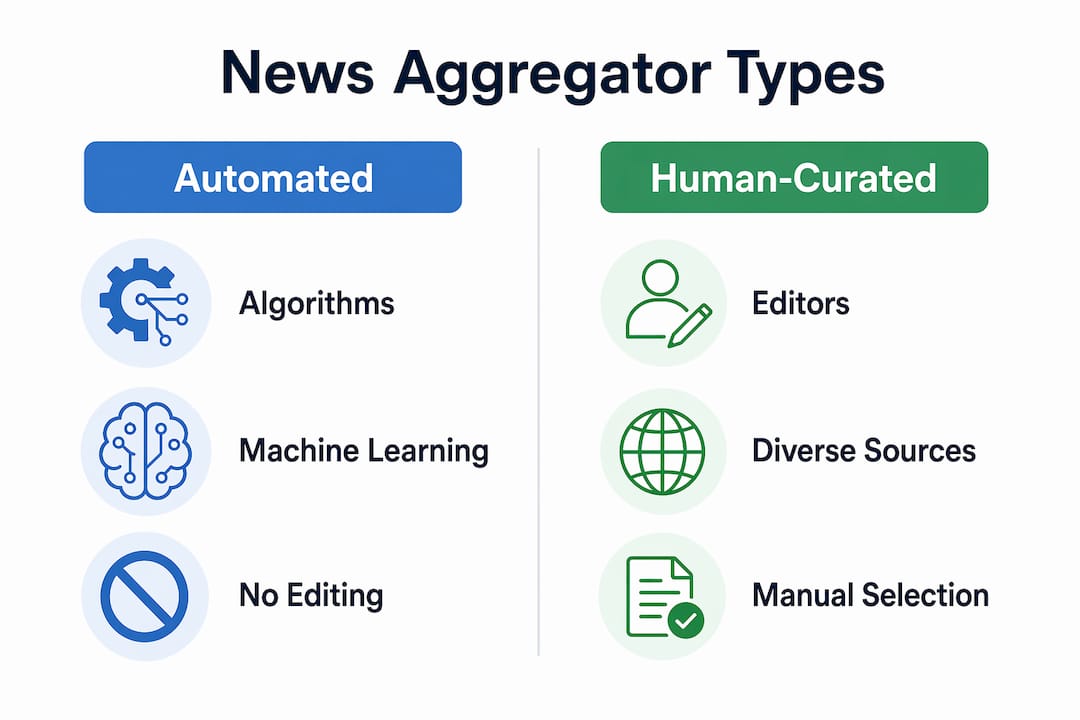
Automated aggregators use algorithms and machine learning to collect and rank stories without editorial intervention. They scale easily across thousands of sources and update in near real time. The trade-off is that they can amplify trending or sensational content over substantive reporting.
Human-curated aggregators rely on editors or communities to select and contextualise stories. They tend to produce higher quality selections, particularly for complex topics like international affairs or policy. The limitation is speed and scale. A small editorial team cannot match the volume of an automated system.
Between these two poles sit several hybrid models:
- Feed readers (such as personal RSS clients): the reader selects sources manually and sees everything those sources publish, in chronological order. Full control, no algorithmic filtering.
- Algorithmic recommendation platforms: the platform selects sources and ranks stories based on user behaviour. Convenient but prone to filter bubbles.
- Topic-based aggregators: content is organised by subject area rather than by source. Useful for readers who follow specific beats like politics, science, or finance.
- Business intelligence feeds: aggregation tools for media monitoring and financial sentiment analysis, used by organisations rather than individual readers.
| Aggregator type | Curation method | Best for | Main weakness |
|---|---|---|---|
| Feed reader | User-selected RSS/Atom | Full source control | Requires manual setup |
| Algorithmic platform | Machine learning | Broad, effortless discovery | Filter bubble risk |
| Human-curated service | Editorial team | Quality and context | Limited volume and speed |
| Topic-based aggregator | Category tagging | Beat-specific coverage | May miss cross-topic stories |
The right choice depends on how much control you want versus how much convenience you need. Most experienced readers combine at least two types.
What are the benefits and potential drawbacks of news aggregators?
News aggregators save time. Instead of visiting twenty news sites individually, you get a consolidated view in one place. That efficiency is the core value proposition, and for most readers it is reason enough to use one.
The benefits extend beyond convenience:
- Exposure to diverse sources: a well-configured aggregator surfaces publishers you would not have found independently.
- Real-time updates: feeds refresh continuously, so breaking news reaches you quickly.
- Searchable archives: most platforms store past stories, making it easy to track how a story developed over time.
- Business applications: organisations use aggregation for media monitoring, competitive intelligence, and financial sentiment analysis.
The drawbacks are real and worth taking seriously.
Algorithmic curation prioritises content that matches your existing interests. Over time, this narrows your information diet rather than broadening it. The result is a filter bubble where you see more of what you already believe and less of what challenges you.
Human-curated aggregators reduce this risk because editors actively seek out diverse and contrasting perspectives. Purely automated platforms do not. The shift from user-selected subscriptions to machine-curated feeds has changed how audiences consume news, and not always for the better.
Content duplication is another genuine problem. Syndicated stories from wire services appear dozens of times across a feed unless the aggregator handles deduplication properly. Incomplete articles are also common. Many aggregators display only a headline and summary, requiring a click through to the original source, which defeats some of the convenience benefit.
Source reliability is the final concern. An aggregator is only as trustworthy as the publishers it draws from. If the feed includes low-quality or partisan sources, the aggregated output reflects that. Readers need to check where their aggregator pulls content from, not just what it surfaces.
How can you use news aggregation for better information access?
Getting the most from a news aggregator requires a deliberate approach rather than passive consumption. The technology does the collecting. You still need to do the thinking.
Follow these steps to build a well-rounded aggregation setup:
- Choose your aggregator type first. If you want full control, start with a feed reader and use RSS feeds to subscribe directly to publishers you trust. If you prefer convenience, use an algorithmic platform but treat it as a starting point, not a complete picture.
- Deliberately include sources you disagree with. Algorithmic platforms will not do this for you. Add at least two or three outlets that represent perspectives outside your usual reading. This is the most effective way to avoid an echo chamber and maintain genuine media literacy.
- Verify source quality before subscribing. Check whether a publisher has an editorial standards policy, a named editorial team, and a track record of corrections. Aggregating from unreliable sources multiplies misinformation rather than reducing it.
- Use aggregators alongside direct visits. For stories that matter to you, read the full article on the original publisher’s site. Aggregated summaries strip context. The original piece often contains nuance that the headline and first paragraph do not capture.
- Audit your subscriptions every few months. Feeds go stale, publishers change focus, and your information needs evolve. A regular review keeps your aggregation setup relevant and prevents feed bloat.
Pro Tip: Set up a separate folder in your feed reader for sources you find challenging or unfamiliar. Read from that folder at least once a week. It takes five minutes and consistently broadens your perspective in ways an algorithm never will.
Building a personalised news feed is a skill, not a one-time setup. The readers who get the most from aggregation treat it as an ongoing practice rather than a set-and-forget tool.
Key takeaways
News aggregation is most effective when you combine automated feed collection with deliberate source selection and regular critical review.
| Point | Details |
|---|---|
| Core definition | News aggregation consolidates content from multiple sources into one platform using RSS, scraping, or algorithms. |
| Technical pipeline | Crawling, parsing, deduplication, and curation each affect the quality of what you ultimately read. |
| Types of aggregators | Feed readers offer control; algorithmic platforms offer convenience; human-curated services offer quality. |
| Filter bubble risk | Algorithmic curation narrows your information diet over time unless you actively add diverse sources. |
| Best practice | Combine an aggregator with direct visits to original sources and a regular audit of your subscriptions. |
Why I think most readers are using aggregators wrong
The promise of news aggregation is access to more perspectives in less time. The reality, for most readers, is the opposite. They set up an algorithmic feed once, never adjust it, and end up reading a narrower range of opinions than they did before.
I have watched this pattern play out repeatedly. The algorithm learns what you click on and serves you more of it. Within a few weeks, your feed looks like a confirmation machine rather than a window onto the world. The role of partisan media in shaping opinion is already significant. An uncritical aggregation habit amplifies that effect at the individual level.
The fix is not to abandon aggregation. It is to treat it as infrastructure rather than editorial judgement. Use it to collect. Use your own critical thinking to evaluate. The technology has improved enormously since the early RSS readers of the late 1990s, when developers like Ramanathan Guha helped lay the groundwork for what became a global information habit. But the fundamental challenge has not changed: a tool that collects information cannot tell you what to think about it.
My honest advice is to fix your news consumption habits before you add more technology to the mix. An aggregator built on bad habits just delivers bad content faster.
— John
Whitebunnywabbit and the future of news aggregation
Whitebunnywabbit covers the intersection of news, politics, and data with a focus on how information reaches readers and what shapes it along the way.
For readers who want to go deeper than the daily feed, Whitebunnywabbit’s coverage of the future of data examines how aggregation technologies are evolving, from machine learning curation to multi-source data pipelines. The site also publishes practical guides on building better reading habits, understanding algorithmic bias, and finding reliable sources in a crowded media environment. If you are serious about staying informed rather than just staying busy, Whitebunnywabbit is worth adding to your regular reading.
FAQ
What is a news aggregator?
A news aggregator is a platform or application that collects content from multiple news sources and displays it in a single interface. It uses RSS feeds, web scraping, or algorithms to gather and organise stories automatically.
How does news aggregation work?
News aggregation works through a pipeline of crawling, parsing, deduplication, and curation. Aggregators poll RSS or Atom feeds every 15–60 minutes and use web scraping for sites that do not publish structured feeds.
What is the difference between automated and human-curated aggregators?
Automated aggregators use algorithms to collect and rank stories at scale, while human-curated aggregators rely on editors to select and contextualise content. Human curation produces higher quality results for complex topics but cannot match the volume of automated systems.
What are the main risks of using news aggregators?
The primary risks are filter bubbles, content duplication, and incomplete articles. Algorithmic platforms narrow your information diet over time unless you actively add sources that challenge your existing views.
Can news aggregation improve media literacy?
News aggregation can improve media literacy when used deliberately, by exposing readers to a wider range of sources and perspectives. Used passively, it tends to reinforce existing biases rather than broaden them.
Leave a Reply