
News cycle acceleration is the process by which stories move from breaking to forgotten in hours rather than days, driven by digital platforms, commercial incentives, and cognitive bias. By mid-2026, social media surpassed TV as the world’s top news source, with 54% weekly usage globally. That single shift explains more about why news cycles accelerate than any other factor. When the infrastructure for news becomes a platform optimised for engagement rather than accuracy, speed becomes the product. This article breaks down the forces behind that acceleration and what it means for public understanding of politics and society.
Why do news cycles accelerate in the digital age?
The standard industry term for this phenomenon is news cycle compression. It describes the shrinking window between an event occurring and the public moving on to the next story. Social media and AI chatbots are the primary engines of this compression in 2026.
Algorithmic feeds on platforms like X (formerly Twitter), TikTok, and Meta’s Facebook do not sort news by importance. They sort it by engagement metrics, which means emotional, immediate, and conflict-driven content rises fastest. A measured analysis of a policy decision cannot compete with a heated clip from a press conference. The algorithm does not care which is more informative.

The 24-hour news cycle, pioneered by CNN under Ted Turner in 1980, was already a compression of the traditional daily newspaper model. What social media did was compress it further into a continuous, real-time stream with no editorial off-switch. The result is a news environment that refreshes itself not once a day, but dozens of times per hour.
For younger audiences, this is the only news environment they have ever known. Among 18–24 year olds, 50% name social media as their primary news source. That demographic will not return to scheduled broadcasts or morning papers. The infrastructure of news has permanently shifted beneath them.
Pro Tip: If you want to understand a story properly, wait 48 hours before forming a firm opinion. The first wave of reporting on any major event is almost always incomplete.
The shift also affects how newsrooms operate. Modern outlets now use AI tools and content farms to maintain output at scale, redirecting human journalists towards verification and contextualisation rather than original reporting. Speed is automated. Depth is not.
Key technological drivers of faster news cycles include:
- Algorithmic amplification on social platforms prioritising outrage and immediacy
- AI content generation enabling newsrooms to publish at volume without proportional staffing increases
- Push notifications delivering breaking news directly to users before editorial context exists
- Video-first formats on TikTok and YouTube Shorts compressing complex stories into seconds
What commercial pressures make news faster?
News cycle acceleration is a deliberate business model, not a side effect of technology. The logic is straightforward: more conflict generates more viewers, more viewers generate more advertising revenue, and more revenue funds more conflict-driven content. The cycle is self-reinforcing.
The phrase “breaking news” illustrates this perfectly. It once signalled genuine significance, a plane crash, an election result, a declaration of war. Today it signals urgency as a commercial tool. Labelling routine political commentary as “breaking” keeps audiences in a state of alert that sustains viewing time. Alert audiences click. Clicking generates revenue.
“When the news becomes a factory line, speed will beat soul, and that is the point.” This observation from media analysts at Dim Sum Daily captures the commercial logic precisely. Depth does not scale. Speed does.
The economic incentives behind rapid news dissemination follow a clear sequence:
- Publish first. Being first to a story captures search traffic and social shares before competitors.
- Amplify conflict. Conflict-driven framing holds attention longer than neutral reporting.
- Refresh constantly. Continuous updates keep audiences returning, increasing session time and ad impressions.
- Replace quickly. A new story displaces the old one, resetting the engagement cycle.
Publishers who resist this model face a structural disadvantage. Investigative journalism takes weeks. A clickbait-driven news cycle takes minutes. Digital advertising rewards the latter. The Reuters Institute and others have documented how this commercial pressure has reshaped editorial priorities across legacy and digital-native outlets alike.
How do cognitive biases amplify fast news cycles?
Human psychology does not resist rapid news cycles. It actively accelerates them. The key mechanism is availability bias, the cognitive tendency to judge the importance of an event by how easily it comes to mind. Heavily discussed stories feel more significant simply because they are everywhere.
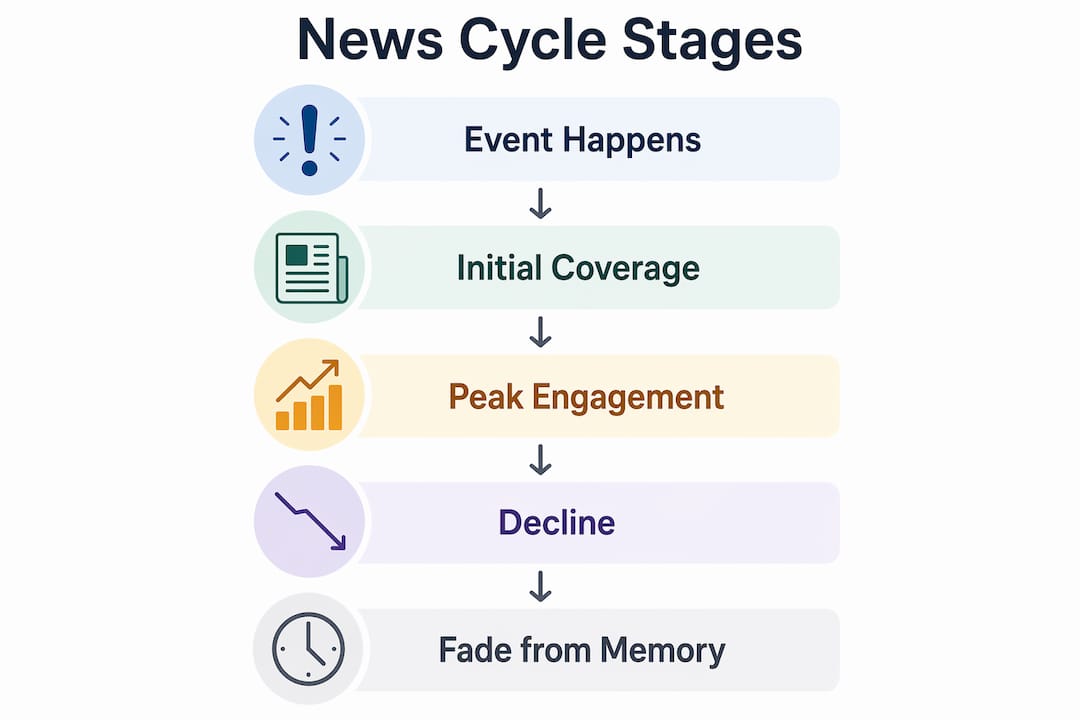
Viral news stories follow a predictable lifecycle: approximately 2.5 days at peak engagement before fading from collective attention. By day seven, most events have vanished from public discourse entirely. This means the news cycle turns over roughly 100–120 times per year. Each cycle triggers the same cognitive and emotional responses in audiences, creating what analysts describe as perpetual informational whiplash.
Emotional and tribal engagement accelerates this further. Stories that confirm existing beliefs or provoke moral outrage spread faster than neutral information. Platforms like X and Facebook are structured to reward outrage-driven engagement, which means the most emotionally charged version of any story travels furthest and fastest.
| Cognitive factor | Effect on news speed |
|---|---|
| Availability bias | Makes heavily covered stories feel more important, driving further coverage |
| Confirmation bias | Audiences share stories that reinforce existing views, accelerating spread |
| Negativity bias | Bad news travels faster than good news across all platforms |
| Social proof | High share counts signal importance, prompting further engagement |
Pro Tip: When a story feels overwhelmingly important, check whether that feeling comes from the story’s actual significance or from the sheer volume of coverage it has received. The two are not the same thing.
Understanding why opinion pieces go viral requires understanding these biases. Opinion content that triggers availability or confirmation bias spreads faster than factual reporting, which is why commentary often outpaces news in the social media environment.
Traditional vs modern news cycles: what has changed?
Traditional news operated on a finite model. A newspaper had 32 pages. A television news bulletin ran for 30 minutes. Editorial decisions were made by a small group of journalists who selected, verified, and contextualised stories before publication. The audience received a curated, bounded product.
Modern digital news operates on an infinite model. There is no page limit, no broadcast end time, and no single editorial gatekeeper. The feed never stops. This structural difference is the root cause of news cycle compression. When there is always space for another story, the pressure to fill that space never relents.
Public trust in news media fell to 37% globally in 2026, a record low. That decline coincides with a 5% drop in traffic to traditional news websites and apps since 2023. Audiences are not simply moving to new platforms. They are losing confidence in the institutions that once set the news agenda.
The weakening of direct publisher-to-audience relationships compounds this. Social-first news consumption means readers encounter stories through algorithmic feeds rather than by visiting a specific outlet. Brand recall drops. Habitual engagement with a single trusted source becomes rare, particularly among younger audiences. A reader may consume ten stories from ten different outlets in a single scroll without registering the source of any of them.
Legacy media faces a structural bind. Matching the speed of social platforms requires abandoning the editorial rigour that once justified audience trust. Maintaining that rigour means losing the speed race. Most outlets are attempting both simultaneously, with mixed results.
What are the societal and political consequences?
Faster news cycles produce measurable effects on public discourse and political behaviour. The most direct is emotional whiplash. When audiences cycle through outrage, sympathy, alarm, and indifference at the pace of a social feed, the emotional responses become shallower and less connected to the underlying events.
Political messaging has adapted to this environment. Campaigns and governments now time announcements to dominate a single news cycle rather than build sustained public understanding. A policy announcement made on a Monday is designed to generate maximum coverage by Wednesday, when the next story will displace it. Depth of public understanding is not the goal. Saturation of a 48-hour window is.
The risks of misinformation multiply in a compressed cycle. Corrections travel slower than initial claims. A false report published at 9am can reach millions before a correction is issued at 3pm. By then, the story has already shaped opinion. The rapid dissemination of political commentary without adequate verification is one of the defining challenges of the current media environment.
The implications for democratic processes are serious:
- Superficial coverage of complex policy reduces informed public participation
- Manufactured outrage displaces substantive political debate
- Short attention cycles make long-term issues like climate policy or pension reform structurally harder to sustain in public discourse
- Misinformation embedded in fast cycles is rarely corrected with equivalent reach
Key takeaways
News cycles accelerate because digital platforms, commercial incentives, and cognitive biases all push in the same direction: faster, louder, and shallower.
| Point | Details |
|---|---|
| Social media dominates news | 54% of global audiences use social or video platforms weekly for news, surpassing TV. |
| Commercial logic drives speed | Conflict and urgency generate more ad revenue, making rapid output a deliberate strategy. |
| Cognitive bias amplifies cycles | Availability and negativity bias cause audiences to engage faster with emotionally charged stories. |
| Viral stories last 2.5 days | News events peak and fade within days, cycling roughly 100–120 times per year. |
| Trust in legacy media is falling | Global trust in news dropped to 37% in 2026, weakening the institutions that once slowed cycles. |
The uncomfortable truth about how we consume news
I have been watching news cycles for a long time, and the pattern that strikes me most is not the speed. It is the predictability. Every major story follows the same arc: initial shock, peak outrage, counter-narrative, fatigue, replacement. The faces and topics change. The structure does not.
What concerns me more than the acceleration itself is the way it has reshaped what audiences expect from news. Speed has become a proxy for credibility. If a story is everywhere, it must matter. That assumption is precisely what commercial news producers exploit. The rage-bait economy did not emerge because journalists became worse. It emerged because the incentive structure stopped rewarding them for being better.
The practical response is not to disengage from news. Disengagement leaves the field to those who are least interested in accuracy. The response is to slow your own consumption deliberately. Read the second-day coverage. Seek out the outlet that waited to verify before publishing. Treat the first 24 hours of any major story as provisional. That discipline is harder than it sounds in a feed designed to make every story feel urgent.
I also think the comparison between traditional and modern news cycles is often too nostalgic. Legacy media was never perfectly trustworthy or free from commercial pressure. What it had was a structural limit on volume. That limit forced prioritisation. The infinite feed removed that limit, and we are still working out what replaces it.
— John
Stay ahead of the news cycle with Whitebunnywabbit
Understanding how news cycles work is the first step to consuming them without being consumed by them. Whitebunnywabbit publishes regular political commentary, media analysis, and current affairs coverage designed for readers who want context alongside speed. Whether you are tracking a fast-moving political story or trying to build a more considered view of the media environment, the Whitebunnywabbit news archive covers the stories that matter with the depth they deserve. For readers who want to go further, the media literacy resources on the education page offer structured frameworks for understanding how modern news works and why it moves the way it does.
FAQ
Why do news cycles accelerate faster now than before?
Social media algorithms prioritise engagement over editorial importance, compressing the time between an event and its replacement in public attention. The commercial incentive to publish first and publish often has replaced the traditional editorial model of verify first, publish second.
How long does a typical news story stay in the public eye?
Viral news events peak at roughly 2.5 days before fading, with most stories disappearing from collective memory by day seven. This means the news cycle turns over approximately 100–120 times per year.
What role does social media play in speeding up news?
Social media is now the top global news source, used by 54% of audiences weekly. Its algorithmic feeds amplify emotionally charged content, which travels faster and further than neutral reporting.
Does faster news mean less accurate news?
Speed and accuracy are structurally in tension. Publishers using AI and content farms to maintain output volume prioritise pace over verification, and corrections rarely reach the same audience size as the original claim.
How can I protect myself from news cycle manipulation?
Wait at least 48 hours before forming firm opinions on breaking stories, seek second-day coverage from outlets with strong verification records, and build a personalised news feed that includes sources with different editorial speeds and perspectives.
Leave a Reply