
Headlines are the single most powerful editorial tool in modern media. Approximately 80% of digital news consumers read only the headline and never open the article. That figure alone explains how headlines shape opinion at scale, often before a single fact is verified or a full sentence of context is read. Understanding the mechanics behind this influence is not optional for anyone who consumes news. It is the foundation of genuine media literacy.
How do headlines shape opinion so effectively?
Headlines function as independent frames, not summaries. Stylistic strategies in headlines including metaphor, alliteration, and epistemic verbs actively construct the emotional and cognitive context of a story before the reader encounters a single fact. This is what researchers call the framing effect: the way information is presented determines how it is interpreted, regardless of the underlying content.
Three core psychological mechanisms drive this process:
- Framing: A headline describing a protest as a “riot” versus a “demonstration” produces measurably different attitudes in readers, even when the article beneath is identical.
- Emotional triggers: Fear and outrage are the most commonly amplified emotions. 20–25% of analysed news articles contained headlines with emotionally heightened language exceeding that found in the article body, with fear being the dominant category.
- Negativity bias: Human brains are wired to prioritise threatening information. Sensational headlines exploit this by triggering faster attention and stronger memory encoding than neutral ones.
Memory is where the impact of headlines becomes most insidious. When you read a headline and later forget the source, the claim itself often persists. This is why repeated exposure to a framed headline can shift beliefs even among sceptical readers.
Pro Tip: When a headline produces a strong emotional reaction in you, treat that reaction as a signal to pause rather than share. Emotional intensity in a headline is frequently a design choice, not a reflection of the story’s actual significance.

Sensational vs neutral headlines: which is more dangerous?
The intuitive answer is that sensational headlines are more dangerous. The research tells a more complicated story.
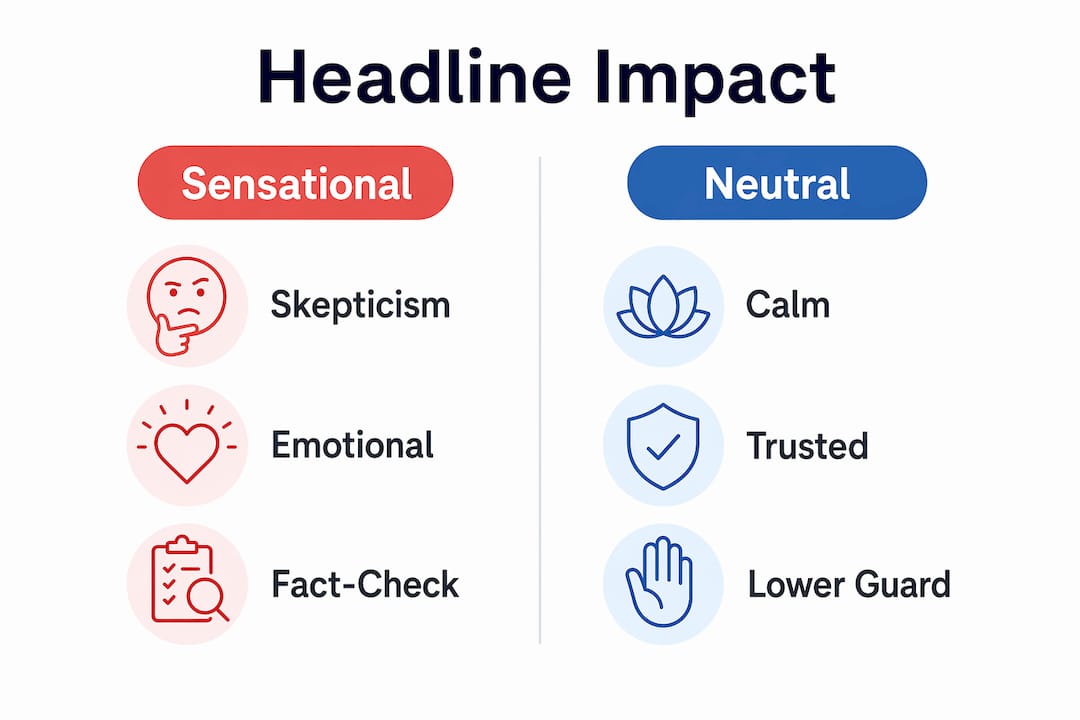
Sensational headlines can trigger initial scepticism in readers, particularly around fake news. Words like “Shocking” or “Explosive” serve as mental discounting cues. Readers recognise the manipulation and briefly resist. However, that initial doubt fades over time while the core claim lodges in memory. The result is that sensational headlines can build belief gradually, even in readers who initially dismissed them.
Neutral headlines carry a different risk. They appear factual and measured, which lowers the reader’s critical guard. Neutral-sounding fake news is frequently more deceptive than sensational fake news precisely because it does not trigger the scepticism reflex. A calm, authoritative tone signals credibility, whether or not the content deserves it.
| Feature | Sensational headline | Neutral headline |
|---|---|---|
| Initial reader reaction | Scepticism, doubt | Trust, acceptance |
| Long-term belief effect | Gradual belief retention | Immediate belief acceptance |
| Fake news risk | Lower initial acceptance | Higher deception risk |
| Fact-checking intention | Higher | Lower |
| Emotional charge | High | Low |
Pro Tip: Do not assume a calm, measured headline is more trustworthy. Neutral framing is a stylistic choice too. Check the source’s track record, not just the headline’s tone.
The broader lesson from this comparison is that clickbait dominates news partly because both emotional and restrained framing serve different manipulation functions. Neither style is automatically honest.
What does the evidence say about headlines changing beliefs?
The most striking empirical evidence comes from a 2026 national survey experiment. Brief exposure to protest and race-themed headlines reduced public approval of police use-of-force by approximately 7 percentage points. No images, no full articles, no commentary. Just headlines. That shift represents a measurable change in attitude toward a major public institution, produced by a handful of words.
This finding matters because it demonstrates that headline framing operates without requiring the reader to engage with any supporting argument. The frame itself does the persuasive work. When those frames are repeated across multiple outlets and social media feeds, the cumulative effect on public attitudes compounds significantly.
The relationship between headlines and public opinion is not one-directional, though. Research using vector autoregression shows that public sentiment influences news coverage direction as frequently as coverage shapes public opinion. Editors and journalists respond to what audiences are already thinking, which means the framing of headlines is partly a reflection of existing opinion, not purely a cause of new opinion. This bidirectional dynamic makes the system harder to reform and easier to exploit.
How to critically evaluate headlines in daily media consumption
Recognising manipulation is a learnable skill. The following steps give you a practical framework for evaluating any headline you encounter.
- Identify the epistemic verb. Epistemic framing via verbs like “believe” versus “know” fundamentally changes how a claim reads. “Scientists believe X” signals uncertainty. “Scientists know X” signals established fact. Editors choose these words deliberately. Notice which one is used.
- Name the emotional register. Ask yourself whether the headline is designed to produce fear, outrage, hope, or disgust. If you can name the intended emotion, you have already created critical distance from it.
- Check for stylistic devices. Alliteration, metaphor, and loaded nouns are rhetorical tools. “Crime wave” is a metaphor. “Border chaos” is a loaded noun phrase. Neither is neutral description.
- Read the article before sharing. This sounds obvious. Most people do not do it. The 80% headline-only readership figure confirms this is the norm, not the exception.
- Cross-reference with a second source. A single headline from a single outlet is not a complete picture. Compare framing across two outlets with different editorial positions to see what each is emphasising and omitting.
- Use fact-checking resources. Sites such as Full Fact, FactCheck.org, and Snopes exist specifically to evaluate headline claims. Consulting them takes under two minutes and dramatically reduces misinformation acceptance.
Learning to consume commentary without an echo chamber is the practical application of these steps. It requires deliberate effort, but it becomes habitual with practice.
What are the broader societal consequences of headline-driven opinion?
Headlines function as the gatekeepers of public discourse. The stories that receive prominent, emotionally charged headlines enter the public conversation. The stories that receive bland or no headlines do not. This gatekeeping role means that editorial decisions about headline framing are simultaneously decisions about which issues the public thinks about and how they think about them.
Repeated framing of the same issue in the same emotional register constructs a skewed social reality over time. If every headline about immigration uses crisis language, the public begins to perceive immigration as inherently a crisis, regardless of the underlying data. This is the agenda-setting function of media, and headlines are its sharpest instrument. Understanding media echo chambers is inseparable from understanding how repeated headline framing narrows the range of perspectives people encounter.
Social media has accelerated this process considerably. A headline shared on X or Facebook travels without its article, without its context, and without its corrections. The framing reaches millions of people in its rawest, most emotionally primed form. The tension between attracting clicks and maintaining factual integrity is not new, but the speed and scale at which misleading frames now spread has made it a defining challenge for public trust in 2026.
Key takeaways
Headlines shape public opinion by setting emotional and cognitive frames that persist in memory long after the source is forgotten, making media literacy the most practical defence available to readers.
| Point | Details |
|---|---|
| Headlines as primary frames | 80% of readers consume only headlines, making framing the dominant influence on perception. |
| Sensationalism has delayed effects | Initial scepticism fades; sensational claims build belief over time even in doubting readers. |
| Neutral headlines carry hidden risk | Calm framing lowers critical guard and makes deceptive content harder to detect. |
| Empirical opinion shifts are real | Protest and race-themed headlines reduced police approval by 7 points in a controlled experiment. |
| Media literacy is a learnable skill | Identifying epistemic verbs, emotional registers, and stylistic devices reduces manipulation risk. |
Why I think we are underestimating the headline problem
I have spent years reading political news across outlets from the BBC and The Guardian to smaller independent blogs, and the pattern I keep returning to is this: the most damaging headline framing is rarely the obviously outrageous kind. It is the quietly loaded kind. The headline that uses “claims” instead of “says.” The one that frames a policy as “controversial” before you have read a word of the detail. The one that describes a protest as “unrest” rather than “demonstration.”
These choices feel small. They are not. They accumulate into a worldview. And because they do not trigger the scepticism reflex that a “SHOCKING BOMBSHELL” headline does, they slip past critical thinking almost entirely.
What I advocate for is not cynicism about all media. That leads to paralysis and the equally dangerous conclusion that nothing can be trusted. The goal is calibrated scepticism: reading headlines as editorial choices rather than neutral descriptions, and asking who made that choice and why. That shift in reading posture changes everything. It turns passive consumption into active engagement, which is exactly what editorial debate online requires.
The most important thing you can do right now is share this framework with someone who does not yet have it.
— John
Explore more at Whitebunnywabbit
Whitebunnywabbit covers the political stories and media dynamics that shape how we all see the world. If this article has prompted you to think differently about the headlines you read each day, there is considerably more to explore. The Whitebunnywabbit education resources offer practical guidance on media literacy, critical thinking, and navigating the modern news environment with greater confidence. From analysis of government policy to breakdowns of how news narratives are constructed, Whitebunnywabbit is the place to keep asking the questions that most readers never think to ask.
FAQ
Do headlines influence opinion even without reading the article?
Yes. Research shows 80% of readers consume only the headline, meaning the frame set by those words is the entirety of the information most people receive.
Are sensational headlines always more manipulative than neutral ones?
Not always. Sensational headlines can trigger scepticism and fact-checking behaviour, whereas neutral-sounding headlines often lower critical guard and make deceptive content harder to detect.
What is epistemic framing in headlines?
Epistemic framing refers to the use of verbs like “believe” versus “know” to signal whether a claim is opinion or established fact. This linguistic choice profoundly affects how readers perceive the credibility of a story.
Can a single headline measurably change public opinion?
Yes. A 2026 survey experiment found that brief exposure to protest and race-themed headlines reduced police approval by approximately 7 percentage points, with no additional context provided to participants.
How can I protect myself from headline manipulation?
Identify the emotional register of a headline, check for loaded language and epistemic verbs, read the full article before sharing, and cross-reference claims using fact-checking resources such as Full Fact or Snopes.
Leave a Reply