
News literacy is the ability to critically evaluate sources, formats, and intent when reading or watching news. Most people skip it entirely. The common news consumption mistakes that do the most damage in 2026 are over-reliance on AI tools, falling for sensational headlines, ignoring source verification, living inside echo chambers, and misreading journalistic formats. Research from the BBC and MIT Media Lab shows these errors are not rare lapses. They are habits baked into how most people engage with news every day. Fixing them does not require hours of extra reading. It requires a few deliberate changes to how you approach the news you already consume.
1. Trusting AI tools to verify news for you
AI verification tools are the fastest-growing news consumption error of 2026. They feel authoritative, they respond instantly, and they sound confident. The problem is that 51% of AI-generated news summaries contain significant factual errors, with 20% including fabricated quotes or incorrect dates. That is not a minor accuracy gap. That is a coin-flip on whether the summary you just read reflects reality.
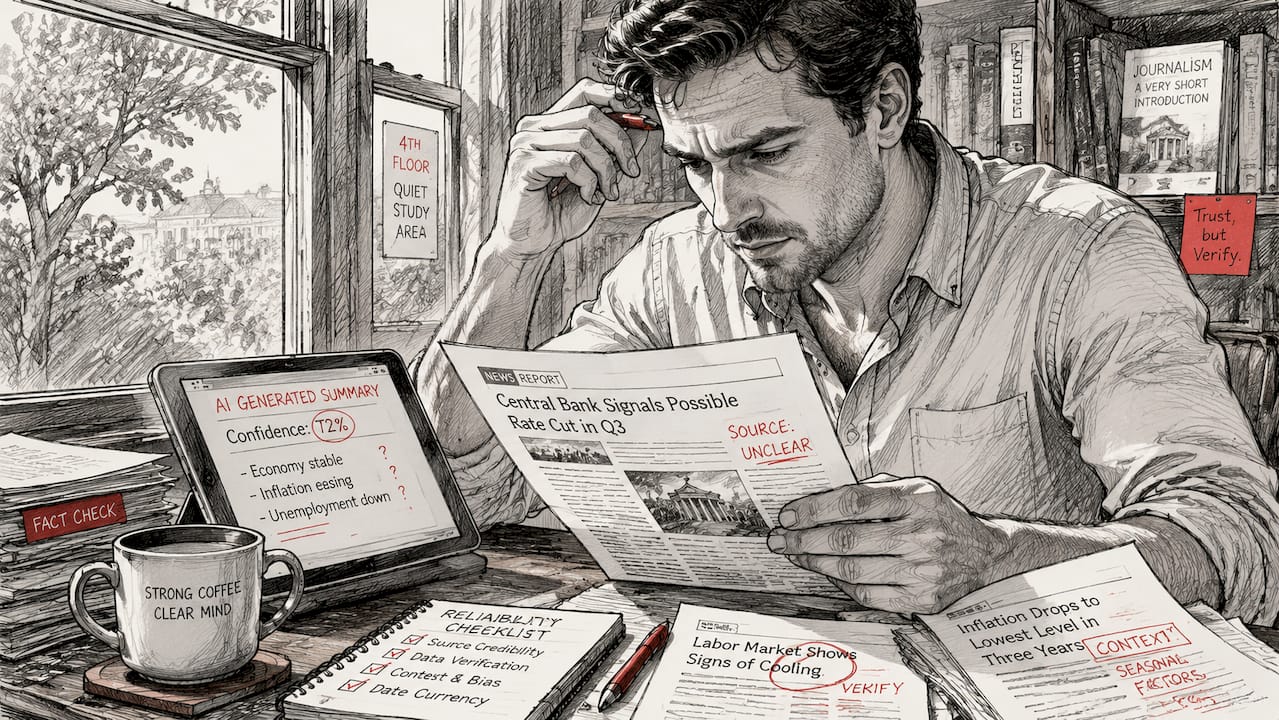
The deeper problem is cognitive. An MIT study found that after four weeks using AI for news verification, participants’ ability to identify misinformation without AI dropped by 15 percentage points. The brain offloads the work to the tool and stops practising the skill independently. AI verification tools improve short-term detection but erode long-term critical thinking.
Treat AI-generated summaries as rough notes, not finished facts. Every claim, date, and quote needs checking against the original source.
- Never accept an AI summary as the final word on a news story.
- Search for the original article, press release, or official statement.
- If a quote appears in an AI summary, verify it exists in the source text.
- Use AI to find leads, not to confirm them.
Pro Tip: When ChatGPT or a similar tool gives you a news summary, paste the key claim into a search engine and find the primary source before sharing or acting on it.
2. Clicking on fear-based headlines without questioning them
Sensational headlines are not an accident. They are a deliberate design choice. Fear-based and negative headlines generate a 2.3% higher click-through rate than neutral ones. Publishers know this and write accordingly. The result is a news environment that systematically overstates threat, crisis, and conflict.
This creates what researchers call the “rage economy.” Outrage-driven content keeps readers engaged longer, but it also produces psychological exhaustion and distorted risk perception. You end up believing the world is more dangerous and chaotic than it actually is. Understanding why outrage drives engagement on social media helps you recognise when a headline is designed to provoke rather than inform.
“The news is not a mirror of the world. It is a selection of the world, shaped by what generates the most attention.”
Practical ways to push back against this pattern:
- Pause before clicking on any headline that triggers a strong emotional reaction.
- Read the full article before forming an opinion, not just the headline and first paragraph.
- Set a daily news time limit. Thirty minutes of focused reading beats three hours of anxious scrolling.
- Seek out solutions-focused journalism alongside crisis coverage.
For a deeper look at how clickbait dominates news and what drives it, Whitebunnywabbit has covered the full picture in detail.
3. Relying on a single source for any story
Single-source news reading is one of the most common news reading pitfalls, and it is also one of the easiest to fix. No single outlet covers every angle of a story. Every publication has an editorial line, an ownership structure, and an audience it is writing for. Reading only one source means you are reading one interpretation.
Media literacy experts recommend lateral reading as the most effective counter. Lateral reading means opening multiple tabs and checking what other credible sources say about the same story before accepting any version as accurate. It takes two minutes and dramatically reduces the risk of accepting a misleading framing.
Follow these steps when verifying a news story:
- Search the story headline across at least three different outlets.
- Check the publication’s ownership and editorial history using a site like MediaBias/FactCheck.
- Look for named sources and direct quotes. Anonymous attributions deserve extra scrutiny.
- Cross-reference statistics with the original study or report they come from.
- Use fact-checking organisations such as Full Fact or FactCheck.org for contested claims.
Pro Tip: Before sharing any news story, spend 90 seconds checking whether a trusted fact-checker has already reviewed the claim. Full Fact publishes daily fact-checks on UK news.
For guidance on how news stories are verified by professional journalists, the process is more rigorous than most readers assume.
4. Confusing opinion with factual reporting
Opinion pieces, think pieces, and news reports look almost identical on most websites. That visual similarity is one of the most underappreciated news consumption errors. A columnist arguing a position and a reporter describing verified events are doing fundamentally different jobs. Treating them as equivalent distorts your understanding of what actually happened.
The 24-hour news cycle accelerates this confusion. Speed-driven “churnalism” means stories are often republished without fresh verification, and vague attributions like “sources say” or “it is understood that” fill the gaps. These phrases signal that a claim has not been confirmed on the record. Healthy scepticism of vague attributions is a core news literacy skill. Whitebunnywabbit’s guide on how a think piece differs from news breaks this distinction down clearly.
Watch for these signals when reading:
- A byline labelled “opinion,” “comment,” or “analysis” signals interpretation, not straight reporting.
- Named sources with direct quotes indicate stronger verification than anonymous attributions.
- Corrections published at the bottom of an article are a sign of editorial integrity, not weakness.
- Visual elements matter too. Low-angle photography makes subjects appear powerful; high-angle shots make them appear diminished. Images shape perception before you read a single word.
5. Living inside an echo chamber without realising it
Echo chambers are the most invisible of all bad news habits. They form gradually, through algorithm-driven personalised feeds on platforms like Facebook, X, and Google News. Each click teaches the algorithm what you prefer. Over time, personalised feeds create closed loops that amplify your existing views and filter out contradictory perspectives. You do not notice the absence of what you are not seeing.
The psychological effect is misinformation reinforcement. When every source you encounter agrees with your existing beliefs, those beliefs feel more certain than the evidence warrants. Understanding what a media echo chamber actually does to your perception is the first step to breaking out of one.
| Diverse news consumption | Echo chamber consumption |
|---|---|
| Multiple outlets across the political spectrum | One or two ideologically aligned outlets |
| Exposes you to contested evidence | Reinforces existing conclusions |
| Builds tolerance for complexity | Increases certainty and reduces nuance |
| Reduces susceptibility to misinformation | Amplifies misinformation within the loop |
| Improves independent critical thinking | Weakens ability to evaluate opposing claims |
Breaking out of an echo chamber does not mean reading sources you find unreliable. It means deliberately adding one or two outlets with different editorial perspectives to your regular reading. Whitebunnywabbit’s guide on how to consume commentary without an echo chamber offers a practical framework for doing exactly that.
6. Ignoring how breaking news coverage distorts early reporting
Breaking news is the most error-prone format in journalism. The first reports of any major event are almost always incomplete, sometimes wrong, and frequently updated within hours. Treating breaking news as settled fact is a news consumption error with real consequences. It locks in a version of events that the full reporting will later contradict.
Speed-driven reporting creates specific patterns of error: misidentified suspects, incorrect casualty figures, and misattributed statements. These errors spread faster than corrections because the initial story gets shared widely before the update appears. A review of breaking news coverage across key sectors shows how consistently early reports require significant revision. Waiting 24 hours before forming a firm opinion on a breaking story is not passivity. It is good epistemic hygiene.
Key takeaways
Avoiding news consumption errors requires consistent habits, not occasional fact-checks. The most damaging mistakes share a common cause: passive reading that accepts information at face value rather than questioning its source, format, and intent.
| Point | Details |
|---|---|
| AI summaries need verification | 51% contain significant errors; always check claims against the original source. |
| Negative headlines exploit emotion | Fear-based headlines get more clicks but distort your perception of risk and reality. |
| Lateral reading beats single-source reading | Check three or more outlets and use fact-checkers like Full Fact for contested claims. |
| Opinion and news are not the same | Look for byline labels, named sources, and direct quotes to distinguish reporting from commentary. |
| Echo chambers form without your awareness | Deliberately add outlets with different perspectives to break algorithm-driven closed loops. |
What I have learned from getting this wrong
I spent a long time trusting AI tools more than I should have. The speed was addictive. You ask a question, you get a confident answer, and you move on. The MIT research on cognitive offloading confirmed what I had already started to notice in myself: the more I leaned on AI for news verification, the less sharp my own judgement became. I stopped questioning things I would previously have questioned automatically.
The outrage problem took longer to recognise. I did not think I was being manipulated by headlines. I thought I was just staying informed. The shift came when I started tracking how I felt after reading the news versus how accurate my understanding of events turned out to be. The correlation was poor. High emotional engagement did not mean high accuracy. Often it meant the opposite.
The fix that made the most difference was simple: I started reading more slowly and sharing less quickly. Lateral reading became a reflex rather than a chore. Treating corrections as a sign of trustworthiness rather than incompetence changed which outlets I returned to. None of this requires special tools or hours of extra effort. It requires deciding that accuracy matters more than speed.
— John
Improve your news habits with Whitebunnywabbit
Whitebunnywabbit covers politics, international affairs, and current events with a focus on analysis over reaction. If you want to build better news habits, the education resources on the site offer practical guidance on media literacy, source evaluation, and critical reading. Whether you are trying to spot misinformation faster or build a more balanced news diet, the Whitebunnywabbit homepage is a good place to start. The goal is not to read more news. It is to read it better.
FAQ
What are the most common news consumption mistakes?
The most common errors are over-relying on AI tools for verification, accepting sensational headlines at face value, reading only one source, confusing opinion with factual reporting, and consuming news inside an echo chamber.
How does AI cause news reading errors?
AI-generated summaries contain significant factual errors in more than half of cases, including fabricated quotes and incorrect dates. Regular reliance on AI for verification also weakens your ability to spot misinformation independently.
What is lateral reading and why does it matter?
Lateral reading means opening multiple tabs to check what different credible sources say about the same story. Media literacy experts recommend it as the most effective method for assessing source credibility and avoiding misinformation.
How can I tell opinion from factual news reporting?
Look for byline labels such as “opinion” or “comment,” check whether sources are named and quoted directly, and be sceptical of vague attributions like “sources say.” These signals reliably distinguish interpretation from verified reporting.
Do echo chambers really affect how accurately I understand news?
Yes. Algorithm-driven personalised feeds reinforce existing beliefs and filter out contradictory evidence, which increases certainty without improving accuracy. Deliberately reading outlets with different editorial perspectives breaks this pattern.
Leave a Reply