

Media watchdogs are defined as organisations and journalists that monitor powerful actors, expose misconduct, and hold institutions accountable to the public. The role of media watchdogs spans politics, science, and the media industry itself, making them one of the most consequential forces in democratic society. Actors range from investigative journalists and press councils to fact-checking bodies and verification platforms such as the Journalism Trust Initiative. Understanding how these mechanisms work, who operates them, and what impact they have is no longer optional for anyone who cares about where their information comes from.
How do media watchdogs promote transparency and accountability?
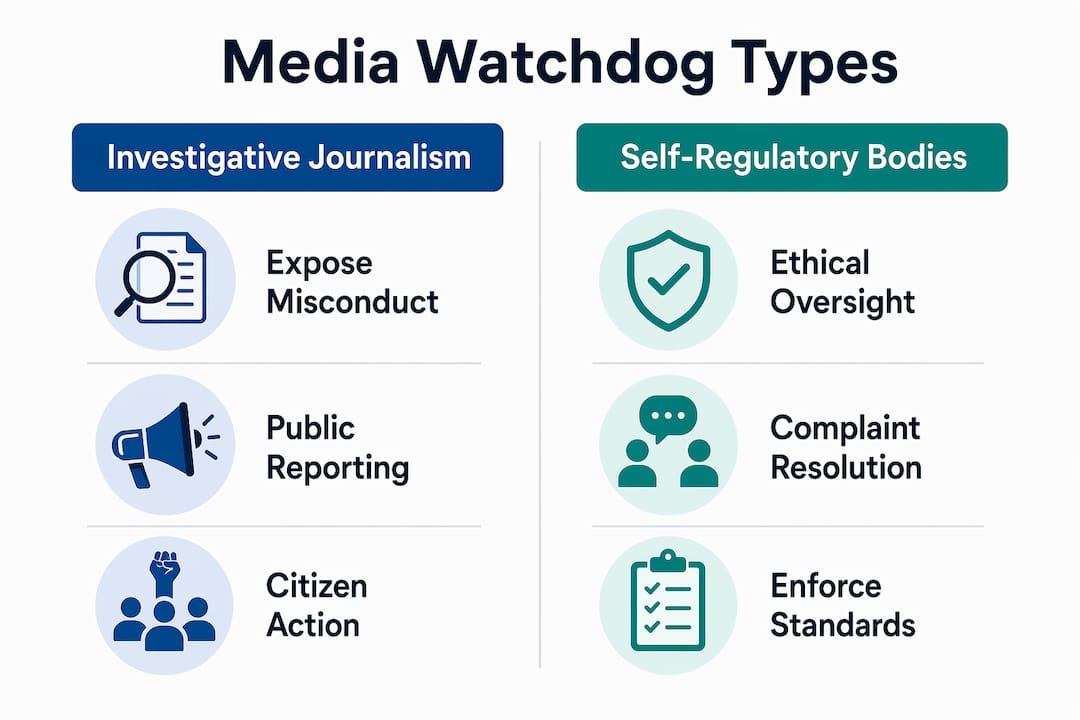
Watchdog journalism focuses on monitoring powerful actors and sounding alarms on misconduct to enable citizen action. The function of media oversight is not passive. It requires active investigation, structured complaint handling, and the publication of findings that regulators and the public can act upon.
The process typically follows a recognisable sequence:
- Identification — Journalists or watchdog bodies detect a potential breach through tip-offs, data analysis, or systematic monitoring of public records.
- Investigation — Reporters gather evidence, cross-reference sources, and verify claims before publication.
- Publication — Findings are released publicly, raising visibility and reputational costs for wrongdoers.
- Regulatory response — Authorities or self-regulatory bodies review published findings and decide whether formal action is warranted.
- Remedy — Corrections, sanctions, or policy changes follow where misconduct is confirmed.
Self-regulatory bodies add a formal layer to this process. Albanian media self-regulation, for instance, requires outlets to respond within seven days and mandates that decisions be published, making accountability measurable rather than rhetorical. That operational specificity is what separates credible watchdog systems from symbolic ones.
Pro Tip: When assessing whether a watchdog body has real teeth, look for three things: mandatory response deadlines, publicly available rulings, and stated consequences for non-compliance. Rhetoric without remedy is not accountability.

Media coverage also acts as a pipeline to institutional enforcement. Information translation is the critical step: media must frame scrutiny in terms that regulators can convert into enforcement action, particularly in markets where oversight bodies are under-resourced or politically compromised.
Who are media watchdogs? types and actors explained
The watchdog ecosystem is far broader than the image of a lone investigative reporter. Science watchdog journalism alone involves multiple specialised actors monitoring knowledge production, communication, and the use of scientific findings. That breadth reflects a wider truth: accountability is no longer concentrated in traditional newsrooms.
The main categories of watchdog actor include:
- Investigative journalists — Traditional reporters at outlets such as the Guardian or ProPublica who pursue long-form exposés on political and corporate misconduct.
- Infrastructural watchdog platforms — Digital tools and databases that aggregate public records, court filings, and financial disclosures to surface patterns of wrongdoing.
- Translational intermediaries — Specialists who convert complex technical or scientific findings into accessible public reporting, bridging expert knowledge and citizen understanding.
- Corrective verification organisations — Fact-checkers such as Full Fact in the United Kingdom who identify and correct misinformation in published media.
- Attention-based watchdogs — Social media monitors and advocacy groups that amplify overlooked stories and apply reputational pressure on powerful actors.
The table below compares the two most commonly confused watchdog categories:
| Feature | Investigative Journalism | Media Self-Regulatory Bodies |
|---|---|---|
| Primary function | Expose misconduct through reporting | Handle complaints and enforce ethical codes |
| Independence | Editorial independence from government | Non-governmental, industry-led |
| Output | Published articles and investigations | Rulings, reprimands, and published decisions |
| Enforcement power | Reputational and public pressure | Formal reprimands, corrections, and sanctions |
| Example | The Guardian, ProPublica | Danish Press Council, Malaysian Media Council |
The emerging roles in science watchdog journalism demonstrate that accountability is no longer limited to traditional newsrooms. It is spread among multi-disciplinary actors operating across the digital environment, each with distinct methods and targets.
How do media watchdogs impact governance and public trust?
Media coverage acts as an external oversight mechanism that uncovers hidden misconduct, particularly when formal regulators miss or ignore issues. This function is especially significant in emerging markets where regulatory gaps are wide and enforcement capacity is limited.
The synergy between media investigation and regulatory action is well established. When a watchdog report raises visibility around a specific breach, it increases the reputational cost for the wrongdoer and prompts higher-level scrutiny from authorities who might otherwise have remained inactive. Media attention does not replace regulation. It catalyses it.
“Deliberative journalism extends watchdog functions by promoting public reasoning and citizen engagement, not only exposing wrongdoing but encouraging debate on prevention.” — Deliberative Journalism and Democratic Engagement
This deliberative dimension matters. Watchdog journalism that stops at exposure misses half its potential. The most effective outlets frame findings in ways that invite public deliberation about systemic causes and solutions, not just individual wrongdoing. That is how media accountability roles translate into lasting democratic change.
Transparency frameworks reinforce this impact. The Journalism Trust Initiative sets standards for media accountability covering ownership disclosure, revenue transparency, editorial governance, and external accountability mechanisms. JTI-compliant outlets are advised to implement ombudspersons, media councils, or statutory regulators. These structural requirements push audiences to evaluate media based on institutional openness, not just story content.
Pro Tip: When reading a watchdog report, check whether the outlet discloses its funding sources and editorial governance. JTI-aligned outlets publish this information openly. Opacity about ownership is a warning sign, regardless of how compelling the story appears.
You can explore how editorial debate online connects to these accountability frameworks in more detail, particularly when assessing how citizen engagement amplifies watchdog findings.
How does media self-regulation function as a watchdog mechanism?
Media self-regulation is the process by which the press governs its own ethical conduct through non-governmental bodies, complaint mechanisms, and published codes of practice. It operates independently from state enforcement, which is what distinguishes it from statutory regulation and preserves press freedom.
The Malaysian Media Council, established in 2025, is one of the clearest recent examples. The MMC implements online complaint tools, issues reprimands for ethical breaches, and promotes media freedom within a professional framework. Its independence from government enforcement is deliberate. The goal is accountability without political control.
Effective self-regulatory bodies share several operational features:
- Clear, accessible complaint pathways for members of the public
- Defined response deadlines that prevent indefinite delay
- Mandatory publication of rulings to maintain public transparency
- Protections for journalists against harassment and undue pressure
- Ethical codes covering accuracy, privacy, and conflicts of interest
Denmark’s Press Council provides a well-established model. Its guidelines balance citizen rights including privacy and personal integrity, with the preservation of media independence. Complaint procedures apply across platforms, meaning digital publications face the same ethical scrutiny as print outlets.
The table below summarises key operational features across two self-regulatory models:
| Feature | Malaysian Media Council | Danish Press Council |
|---|---|---|
| Established | 2025 | 1964 |
| Complaint mechanism | Online portal | Written submission |
| Response requirement | Defined deadlines | Structured review process |
| Scope | Print and digital media | Print and digital media |
| Independence | Non-governmental | Non-governmental |
Watchdog bodies with operational transparency and enforceability have proven credibility over purely rhetorical systems. The difference between a credible self-regulator and a toothless one is almost always found in the mechanics, not the mission statement.
Key takeaways
Media watchdogs are most effective when operational transparency, enforceable remedies, and structural independence work together across investigative journalism, self-regulatory bodies, and verification organisations.
| Point | Details |
|---|---|
| Core watchdog function | Monitor powerful actors, expose misconduct, and enable citizen and regulatory action. |
| Ecosystem diversity | Watchdog roles span investigative journalists, fact-checkers, press councils, and digital platforms. |
| Governance impact | Media coverage catalyses regulatory enforcement, especially where formal oversight is weak. |
| Self-regulation credibility | Bodies with mandatory deadlines, published rulings, and real consequences outperform rhetorical systems. |
| Transparency frameworks | JTI standards push structural openness on ownership, funding, and editorial governance. |
Why the watchdog debate is more urgent than it looks
I have spent years reading watchdog reports, press council rulings, and accountability frameworks, and the pattern I keep returning to is this: the gap between what watchdog institutions say they do and what they actually enforce is wider than most people realise.
The Malaysian Media Council and Denmark’s Press Council are genuine attempts to build accountability with teeth. But for every body with published deadlines and enforceable rulings, there are a dozen that produce eloquent mission statements and little else. Comparing rhetoric with actual remedy mechanics is the only honest way to assess whether a watchdog institution is worth your trust.
The science watchdog ecosystem is where I find the most interesting developments right now. The emergence of translational intermediaries and corrective verification organisations shows that accountability has genuinely decentralised. Full Fact in the United Kingdom and similar bodies are doing work that traditional newsrooms either cannot or will not do. That is a structural shift, not a trend.
The uncomfortable challenge for readers is that media literacy now requires understanding who is doing the watching, not just what they are reporting. Digital harassment of journalists and coordinated misinformation campaigns are direct attacks on the watchdog function. When you see a credible investigative outlet being discredited through social media pressure, ask who benefits from that discrediting.
My advice: treat watchdog reports as starting points, not verdicts. Cross-reference findings against the outlet’s JTI compliance, funding disclosures, and complaint history. The intellectual dark web debate is a useful reminder that not every actor claiming the watchdog mantle is operating in the public interest.
— John
Stay informed with Whitebunnywabbit
Whitebunnywabbit covers the stories behind the stories, from political accountability to media scrutiny and the forces shaping public discourse. If the role of media watchdogs matters to you, the platform’s ongoing commentary on governance, press freedom, and institutional accountability is worth your time.
Whitebunnywabbit’s education resources offer deeper context on media oversight, accountability frameworks, and the political forces that shape what gets reported and what gets buried. For those who want to go further, the main platform brings together analysis, opinion, and current affairs commentary that treats its readers as informed adults. Accountability starts with knowing where to look.
FAQ
What is the role of media watchdogs in democracy?
Media watchdogs monitor powerful actors, expose misconduct, and enable citizen action, making them a core institution of democratic accountability. Deliberative journalism research confirms their function extends beyond exposure to fostering public reasoning about systemic causes.
How do media watchdogs differ from self-regulatory bodies?
Investigative journalists expose misconduct through published reporting, while self-regulatory bodies such as the Malaysian Media Council and Denmark’s Press Council handle complaints and enforce ethical codes within the industry. Both serve media accountability roles but operate through different mechanisms.
How do you know if a media watchdog is credible?
Credible watchdog bodies publish rulings openly, enforce mandatory response deadlines, and impose real consequences for breaches rather than issuing non-binding advice. The Journalism Trust Initiative standard provides a useful checklist for evaluating structural transparency.
What is the journalism trust initiative?
The Journalism Trust Initiative is a standards framework that requires media outlets to disclose ownership, revenue sources, and editorial governance, and to implement external accountability mechanisms such as ombudspersons or press councils. It enables audiences to evaluate media on structural openness, not just content quality.
Why does media watchdog journalism matter in 2026?
Digital misinformation, regulatory gaps in emerging markets, and coordinated attacks on press credibility make independent media scrutiny more consequential than at any previous point. Verification organisations, fact-checkers, and investigative platforms now form a distributed accountability ecosystem that no single institution could replicate alone.
Leave a Reply