
Anonymous sources are defined as individuals who provide information to journalists on the condition that their identity is withheld from public disclosure. The role of anonymous sources in journalism is to surface critical information that would otherwise remain hidden, particularly in political reporting, whistleblowing, and investigations into institutional wrongdoing. Organisations such as NPR, the Canadian Association of Journalists (CAJ), and Journalism Authority have each developed editorial frameworks that govern when and how confidential sources may be used. These frameworks exist because anonymous sourcing is not a shortcut. It is a regulated practice with significant ethical weight, and understanding it is non-negotiable for anyone working in or studying modern media.
How do news organisations verify and manage anonymous sources?
Verification is the foundation of responsible anonymous sourcing. The standard industry term for this process is source authentication, and it operates through a layered set of internal controls rather than a single check.
The CAJ requires that the identity of any anonymous source be fully known to senior editorial staff before publication. Anonymity applies to the public, not to the newsroom. This distinction matters enormously. A source who is unknown internally is not an anonymous source in the professional sense. That source is simply unverified, and publishing their claims is irresponsible.

Journalism Authority reinforces this standard by requiring that source identity be revealed to senior editors confidentially, with independent corroboration of the information before it goes to print. Corroboration means a second source, a document, or on-the-record evidence that supports the claim. A single anonymous account of a controversial allegation is not sufficient.
NPR frames anonymous sourcing as an editorial ethical decision requiring documented internal escalation and organisational approval. Their 2026 podcast episode on political reporting makes clear that unnamed sources are the exception, not the routine. Reporters must seek approval before granting anonymity, not after.
The AP applies a similar standard. Claim confirmation at AP requires multi-source verification for sensitive stories, meaning no single anonymous account carries a story on its own. This systematic approach reduces the risk of publishing misinformation dressed up as insider knowledge.
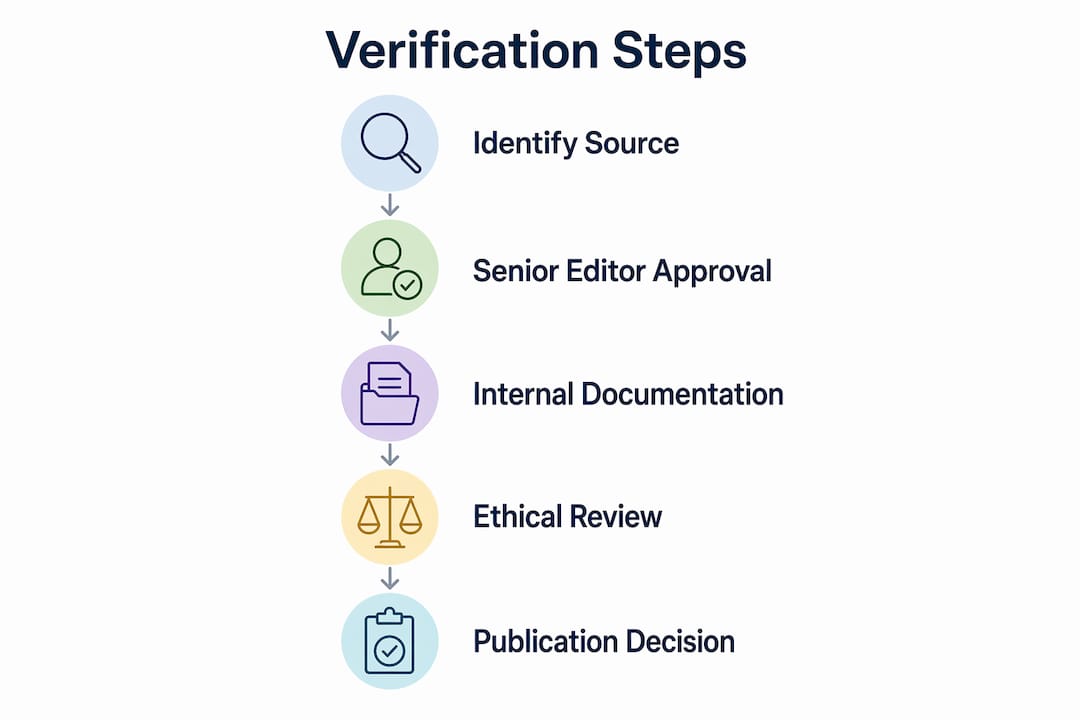
Here is how a robust editorial verification workflow typically operates:
- Reporter identifies the source and assesses whether they have direct, firsthand knowledge of the information being shared.
- Reporter seeks editorial approval before agreeing to anonymity, documenting the source’s identity and the justification for confidentiality.
- Senior editors review the source’s identity and the nature of the information, applying the proportionality test: does the public benefit outweigh the transparency cost?
- Independent corroboration is obtained through a second source, documentary evidence, or on-the-record confirmation of key facts.
- Legal staff may be briefed where publication carries legal risk, with source identity held under privilege.
- Publication proceeds only after all steps are satisfied, with the level of anonymity granted clearly defined in the sourcing agreement.
Pro Tip: Never agree to anonymity terms in the field before consulting your editor. The agreement defines what is protected, and that negotiation belongs in the newsroom, not in a car park.
What ethical challenges and risks arise from using anonymous sources?
Anonymous sourcing introduces a credibility-accountability tradeoff that no editorial policy fully eliminates. The CAJ identifies this tension directly: anonymity reduces the public’s ability to judge source reliability, and it may encourage sources to make irresponsible or exaggerated statements they would never attach their name to.
The risks are real and documented:
- Manipulation by sources. A government official who speaks anonymously faces no public accountability for misleading a journalist. The reporter carries the reputational risk alone.
- Verification traps. When editors lack sufficient knowledge of a source’s expertise or firsthand access, they cannot adequately assess the claim. Publishing in this state risks spreading misinformation.
- Fabrication risk. Falsifying anonymous sources) is a documented failure mode in journalism, from Jayson Blair at the New York Times to Stephen Glass at The New Republic. The absence of a named source makes fabrication easier to conceal.
- Reader trust erosion. Repeated reliance on unnamed sources, particularly in political reporting, trains audiences to be sceptical of all sourcing. That scepticism does not always discriminate between responsible and irresponsible use.
“Anonymous sources create transparency challenges which require editorial oversight and clear justification to protect credibility.” — Canadian Association of Journalists
The proportionality principle is the ethical anchor here. The public interest served by publishing the information must be proportional to the transparency cost of withholding the source’s identity. A story about a government minister’s undisclosed financial conflict of interest clears that bar. A story about a celebrity’s private behaviour almost certainly does not.
The impact of anonymous sources on public discourse extends beyond individual stories. When anonymous sourcing becomes routine rather than exceptional, it shifts the entire information environment toward opacity. Readers lose the ability to trace claims back to accountable individuals, and the media loses the moral authority to demand transparency from the institutions it covers.
How does anonymous sourcing compare to other attribution methods?
Journalists work with four distinct levels of source attribution, each carrying different implications for transparency and verification.
| Attribution Level | What It Means | Verification Status | Transparency to Reader |
|---|---|---|---|
| On the record | Source named and quoted directly | Highest | Full |
| Background | Information used but source not named | Moderate | Partial |
| Deep background | Information used, no attribution at all | Moderate | None |
| Anonymous | Source identity withheld from public, known internally | Requires corroboration | Minimal |
On-the-record sourcing is the professional standard. NPR strongly prefers named sources and treats anonymous sourcing as an exception requiring editorial justification. This preference is not merely procedural. Named sources are accountable for what they say, which raises the quality of the information and gives readers a basis for independent judgement.
Background sourcing sits between on-the-record and anonymous. A source speaking on background allows the journalist to use the information without naming them, often framed as “a senior official said.” This is common in diplomatic and political reporting, where sources need to speak candidly without triggering official repercussions.
Anonymous sourcing, by contrast, involves a formal agreement. Anonymity agreements are negotiated arrangements that define precisely what is withheld from the public and what is preserved for internal editorial evaluation. The negotiation matters because “anonymous” is not a binary condition. A source might agree to be described by their department, their seniority, or their professional role, each of which gives readers varying degrees of context.
Pro Tip: When negotiating anonymity, always specify the description that will appear in print. “A government source” and “a senior Treasury official” carry very different levels of reader transparency. Push for the most specific description the source will accept.
Journalist-initiated anonymity occurs when a reporter judges that a source faces genuine risk if named. Source-driven anonymity occurs when a source requests confidentiality as a condition of speaking. Both are legitimate, but source-driven requests require more scrutiny. A source who insists on anonymity without a clear reason may be seeking to avoid accountability rather than protect themselves from harm.
How can journalists responsibly apply anonymous sourcing in practice?
Responsible use of confidential sources requires discipline at every stage, from the first conversation to the final edit. The benefits of anonymous sources are real, but they are only realised when the process is rigorous.
Here are the core steps for ethical application:
- Assess the source’s firsthand knowledge. The SPJ and Journalism Authority both require that sources have direct knowledge of the information they provide. Hearsay or inference does not qualify for anonymous sourcing protection.
- Negotiate the anonymity agreement precisely. Define what is protected: identity only, or also the source’s role, department, or relationship to the story. The CAJ’s guidance makes clear that anonymity agreements must specify what is withheld and what remains available for internal editorial review.
- Obtain senior editorial approval before publication. This is non-negotiable under the CAJ, NPR, and Journalism Authority standards. Approval must be documented.
- Corroborate independently. Do not publish a claim that rests solely on one anonymous account. Seek a second source, a document, or on-the-record confirmation of the core facts.
- Disclose the sourcing method to readers. Readers deserve to know that a source is unnamed and, where possible, why. Phrases such as “a senior official who was not authorised to speak publicly” give readers meaningful context without compromising identity.
The importance of anonymous sources is most visible in stories that could not exist without them: whistleblower accounts of institutional corruption, insider testimony about policy decisions made behind closed doors, and source protection in authoritarian contexts where speaking publicly carries physical risk. These are the cases that justify the practice. They are also the cases that demand the most rigorous application of the steps above.
Key takeaways
Anonymous sourcing is a regulated editorial practice, not a convenience, and its credibility depends entirely on internal verification, senior approval, and independent corroboration.
| Point | Details |
|---|---|
| Internal identity is mandatory | Senior editors must know the source’s identity before publication, even when the public does not. |
| Corroboration is non-negotiable | A single anonymous account is insufficient; independent evidence or a second source is required. |
| Anonymity agreements must be specific | Define precisely what is withheld from the public and what remains available for editorial review. |
| Proportionality governs ethical use | The public interest served must outweigh the transparency cost of withholding the source’s identity. |
| On-the-record sourcing remains the standard | Anonymous sourcing is the exception; organisations like NPR require editorial approval for every instance. |
Why anonymous sourcing deserves more scrutiny, not less
I have spent years reading political journalism, and the pattern I keep returning to is this: anonymous sourcing is most abused precisely when it appears most justified. The bigger the story, the more pressure there is to publish quickly, and the more likely it is that verification steps get compressed or skipped entirely.
The credibility-accountability tradeoff the CAJ describes is not an abstract ethical problem. It is a practical one that plays out in every newsroom that covers power. When a senior official speaks anonymously, they are often doing so because they want a story published without bearing the consequences of having published it. The journalist becomes the instrument of someone else’s agenda. That is not always wrong. Sometimes the public genuinely needs the information. But it requires the journalist to be clear-eyed about whose interests are being served.
What I find missing from most discussions of this topic is the reader’s perspective. Audiences are not passive recipients of sourcing decisions. When trust in news erodes, anonymous sourcing is one of the contributing factors. Readers who cannot evaluate a source cannot evaluate a claim. That is a structural problem, and editorial policies alone do not solve it. Transparency about the sourcing process itself, not just the story, is where the next evolution of responsible journalism needs to go.
— John
Explore journalism ethics at Whitebunnywabbit
Whitebunnywabbit covers the mechanics and ethics of modern journalism with the same directness you have just read. If you are a journalist, media scholar, or engaged citizen who wants to go deeper on sourcing standards, editorial accountability, and the evolving relationship between the press and the public, the Whitebunnywabbit education section is a practical starting point. You will find guides on embedded journalism, the psychology of opinion pieces, and the forces shaping how news reaches you. For broader context on how digital platforms shape the information you receive, the analysis at Whitebunnywabbit connects these editorial questions to the wider media environment.
FAQ
What is the role of anonymous sources in journalism?
Anonymous sources provide information that named sources cannot or will not disclose publicly, enabling journalists to report on institutional wrongdoing, policy decisions, and whistleblower accounts. Their role is to expand the information available to the public while editorial safeguards protect both the source and the story’s credibility.
How do journalists verify anonymous sources?
Journalists are required to know the source’s identity internally and obtain senior editorial approval before publication. Independent corroboration through a second source or documentary evidence is mandatory under standards set by the CAJ, NPR, and Journalism Authority.
What are the main ethical risks of using anonymous sources?
The primary risks include source manipulation, verification failures, fabrication, and reader trust erosion. The CAJ identifies the credibility-accountability tradeoff as the central ethical challenge, requiring proportional public interest justification for every instance of anonymous sourcing.
How does anonymous sourcing differ from off-the-record sourcing?
Off-the-record sourcing means the information cannot be published at all without the source’s consent, while anonymous sourcing means the information is published but the source’s identity is withheld from the public. Both require editorial discipline, but they operate under different rules.
When is anonymous sourcing ethically justified?
Anonymous sourcing is justified when the information serves a clear public interest, the source faces genuine risk if named, and the information cannot be obtained through named sources or documentary evidence. Proportionality between the transparency cost and the public benefit is the governing standard.
Leave a Reply