
A think piece is an analytical article that offers the author’s subjective interpretation and perspective on a topic, whereas a news article presents objective, verifiable facts to inform the public without bias or advocacy. Understanding how a think piece differs from news is not merely an academic exercise. It is a practical media literacy skill that shapes how you consume political commentary, journalism, and public debate. The Society of Professional Journalists and the American Press Institute both treat this separation as foundational to credible media. Confusing the two formats leads directly to misreading opinion as fact, which distorts your understanding of events.
How a think piece differs from news: purpose and intent
The core difference between a think piece and a news article is intent. News aims to inform without advocacy, while a think piece seeks to persuade or challenge the reader’s existing views. A news report on a parliamentary vote tells you who voted, what passed, and what the legislation contains. A think piece on the same vote argues why the result matters, what it reveals about political culture, and what should happen next.

News articles operate under strict accuracy and defamation standards enforced by editorial codes. The American Press Institute defines news as content that serves the public’s need to know, grounded in independently verified information. Think pieces, by contrast, carry the author’s byline as a signal that what follows is interpretation, not record.
The practical consequences of this distinction are significant:
- News shapes the shared factual record that citizens use to make decisions.
- Think pieces conduct the arguments on top of that factual record.
- A news article that advocates for a position has crossed an editorial line.
- A think piece that presents only facts without interpretation has failed its own format.
Pro Tip: When you read a political article, ask yourself one question before anything else: is the author telling me what happened, or telling me what it means? That single question separates news from opinion every time.
Understanding why opinion pieces generate stronger emotional responses than straight news reports also helps explain why the two formats serve different functions in public discourse.
How language and tone signal the difference
Language is the most reliable surface-level indicator of format. News uses neutral, formal language; think pieces frequently deploy emotive language, subjective modifiers, and rhetorical questions to move the reader toward a conclusion. This distinction is not stylistic preference. It reflects the fundamentally different relationship each format has with the reader.
Consider two sentences covering the same event:
“The government’s reckless decision to cut welfare spending will devastate the most vulnerable communities in Britain.”
That is think piece language. The words “reckless” and “devastate” are value judgements, not facts. A news article covering the same story would read: “The government announced a reduction in welfare spending of £2 billion, affecting an estimated 400,000 claimants.” No adjective, no prediction, no advocacy.
Specific language cues that identify a think piece include:
- Subjective modifiers: “reckless,” “courageous,” “misguided,” “overdue”
- Rhetorical questions: “But what does this really mean for ordinary families?”
- First-person voice: “I believe,” “In my view,” “My argument is”
- Calls to action: “We must,” “It is time to,” “The government should”
News articles avoid all of these by design. The emotional and rhetorical language in opinion content is not a flaw. It is the mechanism by which think pieces do their work. Recognising this prevents you from treating a persuasive argument as a neutral account. For a deeper look at how language choices shape reader perception, Whitebunnywabbit’s piece on why clickbait dominates news covers the psychology behind charged phrasing in detail.
News, analysis, and think pieces: what separates all three
Most readers treat journalism as a binary: either it is news or it is opinion. Journalists actually distinguish three modes: straight reporting, analysis, and opinion or think pieces. Understanding the middle category, analysis, is what makes the full picture clear.
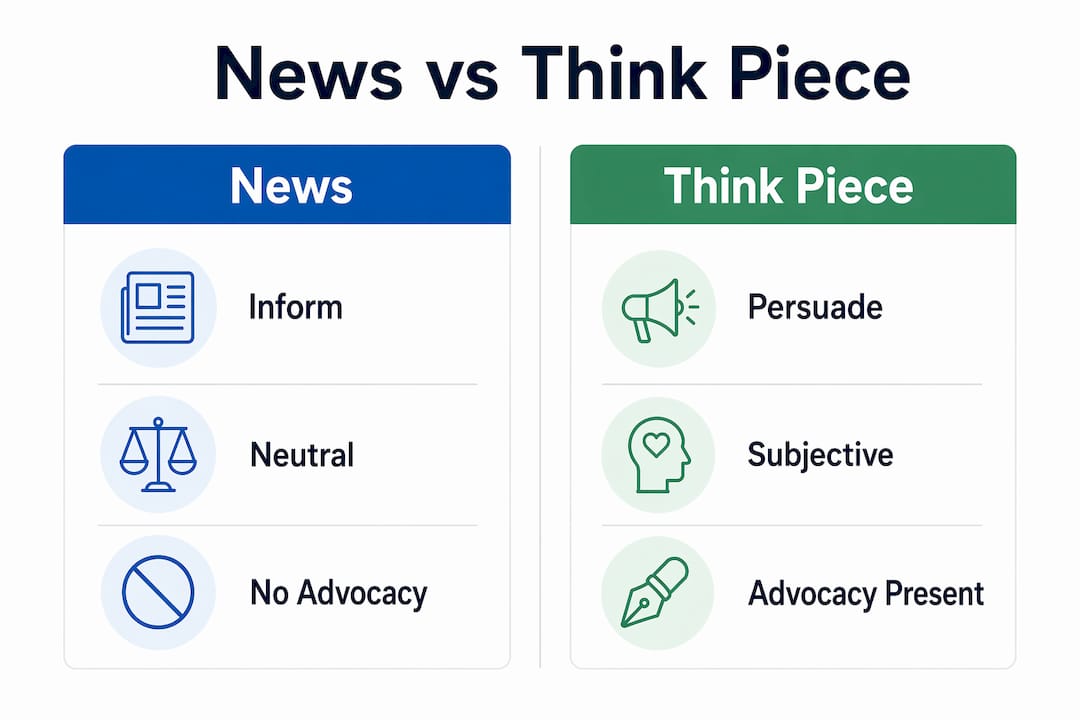
| Format | Primary purpose | Author’s voice | Advocacy present? |
|---|---|---|---|
| News report | Inform with verified facts | Absent | No |
| Analysis piece | Interpret significance | Restrained | No |
| Think piece | Argue or provoke | Prominent | Yes |
Straight news reports what happened. An analysis piece, such as a “what this means” explainer in The Guardian or The Economist, interprets the significance of events using reportorial methods but stops short of advocating for a position. A think piece goes further. It explicitly argues, interprets through a declared viewpoint, and invites the reader to adopt a conclusion.
Think pieces also follow a distinct narrative structure. Effective long-form think pieces guide readers through complexity using a clear tension or tradeoff at the centre of the argument, followed by methodology, examples, and recommendations. This is why a well-written think piece feels like a sustained argument rather than a collection of facts. News reports, by contrast, follow the inverted pyramid: the most important information appears first, and detail tapers toward the end.
Pro Tip: If you are trying to identify the format of an unfamiliar article, scroll to the end. A think piece typically closes with a recommendation or a call to reconsider. A news report closes with background context or a final quote.
Understanding how to engage editorial debate online also requires knowing which format you are responding to, since the standards of evidence and argument differ sharply between news and opinion.
Legal and ethical distinctions you should know
The legal framework separating news from think pieces is more consequential than most readers realise. News content must adhere to neutrality and factual verifiability to avoid defamation claims. A journalist who publishes a false statement of fact in a news article faces significant legal exposure. The standard is strict because the format presents itself as objective record.
Think pieces operate under a different legal doctrine. Opinion privilege protects commentary based on disclosed facts, meaning a writer who clearly signals that they are offering interpretation rather than reporting is afforded greater legal latitude. This is why publications separate opinion content structurally, labelling it explicitly and placing it in dedicated sections away from the news pages.
The ethical implications follow the same logic:
- A news journalist who allows personal views to colour their reporting has violated editorial standards, regardless of whether the views are correct.
- A think piece writer who presents opinion as fact has misled the reader and potentially exposed the publication to legal risk.
- Readers who cannot distinguish the two are vulnerable to treating advocacy as evidence.
- Publications that blur the line deliberately, presenting opinion in news format, undermine public trust in media as a whole.
Opinion is separately labelled and structurally separated from news in credible publications precisely because the legal and ethical stakes of conflation are high. This is not bureaucratic tidiness. It is the architecture of trustworthy journalism.
How to identify a think piece versus a news article
Developing the habit of format identification takes practice, but the signals are consistent. Readers can use tone, purpose, and structural clues to differentiate formats reliably once they know what to look for.
Start with these checks when you encounter an unfamiliar article:
- Check the byline section. Publications such as The Times, The Guardian, and the BBC label opinion and analysis content explicitly. If the article appears under “Comment,” “Opinion,” or “Analysis,” the format is declared.
- Read the opening sentence. News leads with the most important fact. Think pieces typically open with a claim, a provocation, or a scene-setting anecdote designed to frame an argument.
- Count the adjectives. A high density of evaluative adjectives (“disastrous,” “bold,” “cynical”) signals opinion content. News prose is deliberately flat.
- Look for evidence referencing. News articles cite named sources, official documents, and verifiable data. Think pieces may reference the same sources but use them to support an argument rather than simply report them.
- Identify the closing move. As noted above, think pieces close with a recommendation or a challenge to the reader. News closes with context.
A common pitfall is assuming that a well-researched article must be news. Think pieces actively seek to persuade or stir reaction, and the best ones are densely evidenced. Evidence in a think piece serves the argument. Evidence in a news article serves the record. That distinction in function is what separates the two, not the presence or absence of research.
Confusion between opinion and reporting weakens public discourse and misleads readers. Treating a think piece as a news report means accepting an argument as a fact, which is precisely the kind of error that erodes informed political participation.
Key takeaways
A think piece and a news article serve fundamentally different purposes: one builds the factual record, the other argues on top of it.
| Point | Details |
|---|---|
| Intent is the core distinction | News informs without advocacy; think pieces persuade or challenge the reader’s views. |
| Language signals format | Subjective modifiers, rhetorical questions, and first-person voice identify think pieces reliably. |
| Three formats exist, not two | Straight news, analysis, and think pieces each occupy a distinct position in journalism. |
| Legal protections differ | News faces strict defamation standards; think pieces benefit from opinion privilege when facts are disclosed. |
| Identification is a learnable skill | Checking bylines, opening sentences, adjective density, and closing moves distinguishes formats consistently. |
Why this distinction matters more than most people think
I have been reading and writing political commentary long enough to know that the confusion between news and opinion is not accidental in every case. Some publications exploit it deliberately, presenting advocacy in the visual and structural language of news to lend it unearned authority. That is a manipulation worth naming.
What I find more interesting, though, is how often readers want the confusion. A think piece that confirms your existing view feels like evidence. A news report that contradicts it feels like bias. That psychological pull is real, and it is why media literacy cannot stop at format identification. You also have to interrogate your own response to the content.
The most useful habit I have developed is reading think pieces from writers I disagree with. Not to be persuaded, necessarily, but to understand the argument on its own terms before deciding whether it holds. A think piece that makes a strong argument deserves engagement, not dismissal. A news report that you dislike deserves scrutiny of its sourcing, not rejection of its format. These are different critical moves, and conflating the formats makes both harder to perform well.
The separation of news and opinion is not a technicality. It is the structural condition that makes honest public debate possible. When that line collapses, what you are left with is not journalism. It is propaganda with better production values.
— John
Explore more at Whitebunnywabbit
Whitebunnywabbit covers the full spectrum of political commentary, news analysis, and media criticism, giving you the context to read both formats with sharper eyes.
Whether you are a student building media literacy skills or a regular reader trying to cut through the noise, the education resources at Whitebunnywabbit offer structured guidance on how journalism works, how opinion functions, and how to tell the difference between the two in practice. The site’s commentary on current affairs is written with that distinction firmly in mind, so you always know what you are reading and why. Visit Whitebunnywabbit to explore the full archive of news, analysis, and political think pieces.
FAQ
What is a think piece in journalism?
A think piece is an analytical, perspective-driven article that offers the author’s interpretation, argument, or viewpoint on a topic rather than a neutral account of events. It is distinct from news reporting by design and intent.
What is the main difference between a think piece and a news article?
The main difference is purpose: news informs the public using verified, neutral facts, while a think piece argues, interprets, or provokes using the author’s declared viewpoint. Language, structure, and legal standards all follow from that core distinction.
How can I tell if an article is a think piece or a news report?
Check the publication’s labelling, the opening sentence, the density of evaluative adjectives, and the closing paragraph. Think pieces open with a claim or provocation and close with a recommendation; news reports open with the key fact and close with background context.
Are think pieces less reliable than news articles?
Not less reliable, but differently accountable. Think pieces are assessed by the quality of their argument and the accuracy of the facts they cite; news articles are assessed by neutrality and verifiability. A well-evidenced think piece from a credible author is a legitimate contribution to public debate.
Why do publications separate opinion from news?
Publications separate opinion from news for both legal and ethical reasons. News faces strict defamation standards, while opinion content benefits from opinion privilege. Structural separation signals to readers which standards apply and protects the credibility of both formats.
Leave a Reply