
Consuming commentary without an echo chamber means actively seeking out sources that challenge your existing views, rather than passively absorbing whatever an algorithm decides you should see. The media literacy term for this practice is intentional information diversification, and it is the foundation of genuine critical thinking in media. Research shows that 61% of individuals remain trapped in single-perspective information feeds, yet only 6 to 8% inhabit true partisan echo chambers. That gap matters: most people are not radicalised, but they are narrowed. This guide gives you the specific tools, habits, and frameworks to widen that view deliberately.
How to consume commentary without echo chambers: choosing your sources
The first step to avoid an echo chamber is not finding more sources. It is finding better ones. Credible commentary outlets share three traits: they separate news reporting from opinion clearly, they publish corrections openly, and their journalists are named and accountable. Outlets like Reuters, the BBC, Associated Press, and Al Jazeera English meet this standard consistently. Opinion sections at the Financial Times, The Atlantic, and Foreign Affairs offer ideologically varied analysis grounded in evidence rather than outrage.
Balance matters as much as quality. A diet of only British broadsheets misses how the same story reads in Lagos, Delhi, or São Paulo. Pairing domestic sources with international wire services and sector-specific analysis gives you three distinct lenses on any single event. Experts recommend curating 8 to 12 sources as the optimal range: enough for genuine diversity, few enough to read properly. Beyond that number, quality of engagement drops sharply.

Avoid outlets that rely on emotional framing as their primary hook. Social engagement metrics are unreliable proxies for news importance. A headline generating 50,000 shares is not necessarily covering something significant. It is more likely triggering an emotional response. Quiet, factual reporting on complex policy rarely trends, but it is almost always more useful than viral commentary. Understanding why clickbait dominates news is itself a form of media literacy.
When assessing a new outlet, ask three questions before adding it to your regular rotation:
- Does it distinguish clearly between news and opinion?
- Does it cover stories that contradict its apparent editorial line?
- Does it cite primary sources, official data, or named experts rather than anonymous claims?
Pro Tip: Use Media Bias/Fact Check and AllSides to cross-reference the political lean of any outlet you are considering. Neither tool is perfect, but together they give you a working map of where a source sits on the spectrum.
What tools actually bypass algorithmic echo chambers?
Algorithmic personalisation is the structural cause of filter bubbles. Platforms like Facebook, X (formerly Twitter), and YouTube are designed to maximise engagement, which means they surface content that confirms your existing preferences. Clicking on content you disagree with does not reliably fix this. RSS feeds and browser extensions like News Feed Eradicator are more effective because they remove the algorithm from the equation entirely rather than trying to game it.
RSS readers such as Feedly, Inoreader, and NewsBlur let you subscribe directly to the output of specific outlets. You see every article published, in chronological order, without any ranking or personalisation layer. This is the closest digital equivalent of buying a physical newspaper: you get the full edition, not a curated selection based on your previous reading. Pairing an RSS reader with a structured daily briefing approach gives you both breadth and discipline.
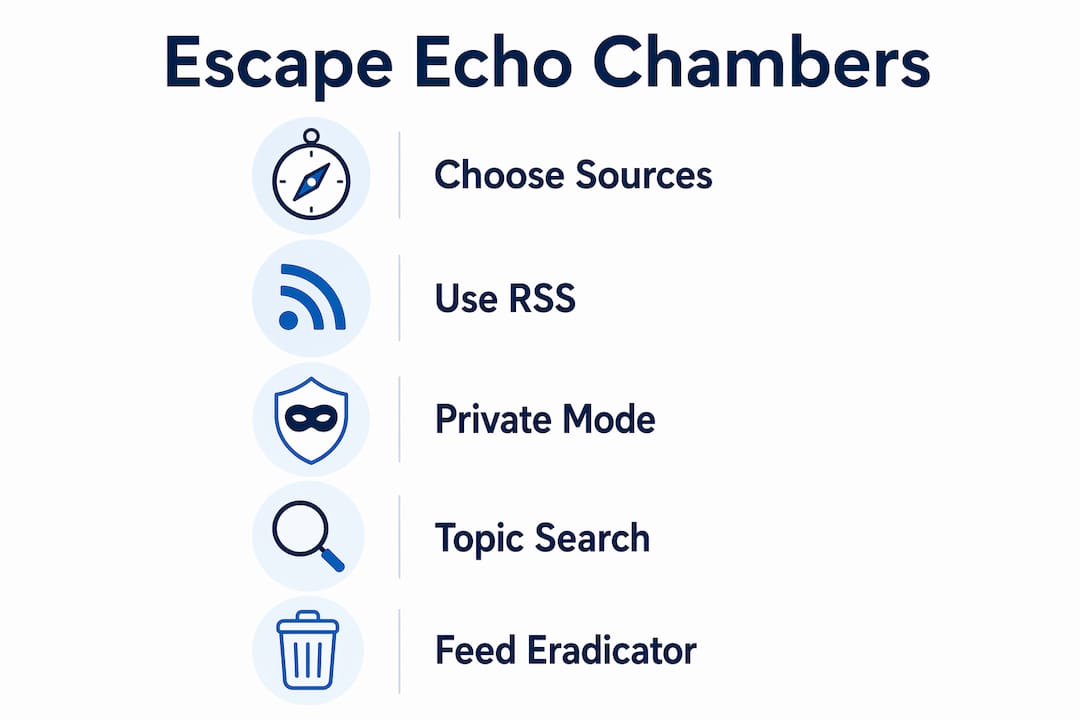
Incognito browsing and platform rotation also reduce algorithmic learning. When you browse in private mode, your session data is not stored, which limits the platform’s ability to build a preference profile. Rotating between platforms for different topics, using DuckDuckGo for searches rather than Google, and accessing news sites directly rather than through social feeds all reduce the amount of data feeding the personalisation engine.
| Method | How it works | Effectiveness against algorithms |
|---|---|---|
| Algorithmic social feed | Platform ranks content by predicted engagement | Reinforces existing preferences actively |
| RSS reader (Feedly, Inoreader) | Chronological, unfiltered output from chosen outlets | Removes algorithmic ranking entirely |
| News Feed Eradicator extension | Replaces social feed with blank screen or quote | Eliminates passive feed scrolling |
| Incognito browsing | Prevents session data being stored | Limits profile-building per session |
| Direct site visits | Bypasses platform referral tracking | Neutral; no algorithmic filtering |
Active topic searches beat passive feed scrolling every time. When you search for a specific subject rather than scrolling a feed, you are directing the inquiry rather than receiving it. This small shift in posture changes your relationship with information from receptive to investigative.
Pro Tip: Install the News Feed Eradicator extension on Chrome or Firefox. It replaces your social media feed with a blank page or an inspirational quote. You can still post, message, and search, but the passive scroll is gone. Most users report reading more long-form content within a week.
How do you build critical thinking habits for commentary?
Critical thinking in media has moved beyond simple fact-checking. Perceptual literacy now requires asking not just “Is this true?” but “What is this doing to my thinking?” That second question is harder and more revealing. It forces you to notice the emotional register of a piece, the framing choices the writer made, and the perspectives that are absent from the argument.
Intellectual humility is the psychological foundation of this practice. Psychologist Octavio Ortega Esteban’s research identifies intellectual humility as the primary defence against echo chambers. Tribalism becomes visible when you refuse to answer the question: “What evidence would change my mind?” If you cannot answer that honestly, you are not engaging with commentary. You are seeking confirmation. The antidote is the steel man technique: before dismissing an opposing argument, reconstruct it in its strongest possible form and engage with that version instead.
The Media and Information Literacy (MIL) framework, developed through UNESCO’s digital citizenship programmes, treats media literacy as a lifelong competency rather than a one-time skill. This framing is useful because it removes the pressure to achieve perfect objectivity and replaces it with a commitment to ongoing improvement. You do not need to consume commentary without any bias. You need to consume it with awareness of your bias.
Apply these questions to any piece of commentary before sharing or acting on it:
- What is the central claim, and is it supported by named evidence or primary sources?
- What emotion does this piece trigger in me, and is that emotion doing work the argument cannot?
- Whose perspective is centred, and whose is absent or minimised?
- What would a thoughtful person who disagrees with this conclusion say in response?
- Does the framing present a false binary, or does it acknowledge genuine complexity?
These are not rhetorical exercises. They are practical filters that slow the gap between reading and reacting, which is where most misinformation gains its foothold. Learning to engage with editorial debate online effectively is a skill that compounds over time.
What does a sustainable media consumption routine look like?
Sustainable exposure to diverse opinions requires a schedule, not willpower. Experts recommend 15 to 45 minutes daily for scanning your curated sources, split across two fixed windows rather than spread throughout the day. A morning scan of headlines and an evening read of two or three longer pieces gives you breadth without the anxiety of continuous exposure.
A structured routine looks like this:
- Set two fixed windows: 15 minutes in the morning for headlines, 20 to 30 minutes in the evening for longer analysis.
- Use a dedicated email address for newsletter subscriptions. A separate inbox prevents news from bleeding into work or personal correspondence and lets you batch-read on your own schedule.
- Prune your source list every month. Remove any outlet that consistently triggers anxiety without adding understanding. Stress is not the same as being informed.
- Rotate one source every quarter. Replace a familiar outlet with something from a different country, political tradition, or sector. This prevents your curated list from calcifying into its own echo chamber.
- Turn off push notifications for all news apps. Notifications are designed to interrupt, not inform. They train you to react rather than reflect.
Doom-scrolling is not a character flaw. It is a predictable response to an environment engineered to exploit your attention. The solution is structural: remove the conditions that enable it rather than relying on self-discipline alone. Pairing this routine with guidance on optimising news consumption for decision-making gives you a framework that scales with your needs.
Pro Tip: At the end of each week, ask yourself two questions: “What did I read this week that genuinely surprised me?” and “Did I encounter a strong argument I could not immediately counter?” If the answer to both is no, your source list needs pruning and diversifying.
Key takeaways
Consuming commentary without an echo chamber requires deliberate source selection, algorithmic resistance tools, and a weekly reflection habit that forces genuine exposure to opposing views.
| Point | Details |
|---|---|
| Curate 8 to 12 sources | Enough for genuine diversity, few enough to read with proper attention and engagement. |
| Use RSS readers over social feeds | Tools like Feedly and Inoreader deliver unfiltered, chronological content free from algorithmic ranking. |
| Apply perceptual literacy questions | Ask what a piece does to your thinking, not just whether its facts are accurate. |
| Schedule fixed consumption windows | Two daily windows of 15 to 30 minutes each prevent doom-scrolling and reduce news anxiety. |
| Practise intellectual humility | Ask what evidence would change your mind. If you cannot answer, you are seeking confirmation, not understanding. |
Why escaping echo chambers is harder than it looks
I have been reading political commentary seriously for over a decade, and the honest truth is that the echo chamber problem is not primarily a technology problem. It is a comfort problem. Algorithms amplify what we already prefer, yes. But we preferred it before the algorithm existed. The feed is a mirror, not a manufacturer.
What I have found actually works is treating your source list like a portfolio. You would not put all your savings into one asset class, and you should not put all your attention into one editorial tradition. The Intellectual Dark Web, whatever its flaws, demonstrated that challenging established beliefs has genuine value even when the challengers are imperfect. The same principle applies to your reading habits.
The psychological benefit of active consumption over passive scrolling is real and underrated. When you choose what to read rather than receiving what you are served, your relationship with the information changes. You become a reader rather than an audience. That shift in posture, from passive to active, is where digital citizenship literacy explains 54.1% of the variance in misinformation resistance. The skill is not knowing more facts. It is engaging differently with the facts you encounter.
Pick one strategy from this article and apply it this week. Not all of them. One. Add an RSS reader, or install News Feed Eradicator, or set up a dedicated newsletter inbox. The compounding effect of small, structural changes to your media habits is far greater than any single act of willpower.
— John
Explore more at Whitebunnywabbit
Whitebunnywabbit covers political commentary, international affairs, and media analysis for readers who want more than a single editorial line. If this article has prompted you to rethink your media habits, the news and analysis section is a good place to continue. For readers who want to go deeper on the skills behind critical consumption, the education resources cover media literacy, source evaluation, and structured approaches to understanding bias in commentary. The goal at Whitebunnywabbit is the same as yours: to read widely, think carefully, and resist the pull of comfortable consensus.
FAQ
What is an echo chamber in media consumption?
An echo chamber is an information environment where a person encounters only views that reinforce their existing beliefs, typically shaped by algorithmic personalisation on social platforms. Research shows that 61% of individuals remain in single-perspective feeds, though fewer than 8% inhabit true partisan echo chambers.
How do RSS readers help you avoid filter bubbles?
RSS readers like Feedly and Inoreader deliver content in chronological order directly from your chosen outlets, bypassing the algorithmic ranking that social platforms use to prioritise emotionally engaging content. This gives you an unfiltered view of what outlets are actually publishing.
How many news sources should you follow for a balanced diet?
Experts recommend between 8 and 12 sources, combining international wire services, domestic outlets, and sector-specific analysis. Fewer than eight limits genuine diversity; more than twelve reduces the depth of engagement with any single source.
What is perceptual literacy and why does it matter?
Perceptual literacy is the practice of asking what a piece of content is doing to your thinking, beyond verifying whether its facts are accurate. It is a response to AI-generated content and emotionally engineered commentary that can be factually accurate but still systematically misleading in its framing.
Can intellectual humility actually reduce bias in how you read commentary?
Yes. Psychologist Octavio Ortega Esteban’s research identifies intellectual humility as the primary defence against echo chambers, specifically the habit of asking what evidence would change your mind. Without that question, reading commentary becomes confirmation-seeking rather than genuine inquiry.
Leave a Reply