

Most people scroll past the comments section. That is a mistake. The role of social media commentary in shaping how we interpret political messages, news stories, and social issues is far more significant than most readers appreciate. A landmark 2026 study involving over 11,000 respondents across five European countries found that online comments shift audience interpretation of content, even when people hold firm prior opinions. What sits beneath a post is not decoration. It is a second narrative, running in parallel, quietly rewriting what readers think they just saw.
Table of Contents
- Key takeaways
- How social media commentary shapes political interpretation
- Commentary, engagement, and community value
- AI’s growing influence on commentary quality
- Mental health and the broader social picture
- Engaging responsibly with commentary
- My take on comments as a force in public life
- Explore more at Whitebunnywabbit
- FAQ
Key takeaways
| Point | Details |
|---|---|
| Comments reframe content | User commentary alters how audiences interpret political posts, even when opinions appear fixed. |
| Engaged commenters drive loyalty | Active comment writers can be up to 48 times more engaged than passive readers. |
| AI changes the equation | AI-assisted commentary raises participation but risks eroding authenticity if not carefully designed. |
| Moderation shapes discourse quality | Platforms and newsrooms that moderate actively produce more constructive and loyal communities. |
| Mental health effects are design-driven | Social media’s psychological impact stems largely from engagement-first platform mechanics, not content alone. |
How social media commentary shapes political interpretation
The University of Exeter research published in 2026 is worth sitting with for a moment. Researchers did not find that comments change people’s opinions outright. What they found is subtler and more troubling. Comments change how people interpret the content itself. A post that reads as neutral without context can read as sexist or misleading once the surrounding commentary frames it that way.
This matters enormously for political communication. In polarised environments, the comment thread is not a reaction to the message. It is part of the message. Readers absorb both simultaneously, and the social signals from other users, whether supportive or critical, act as cues that calibrate understanding.
The research highlighted several specific mechanisms at work:
- Counter-argument comments help readers recognise misinformation by providing visible corrective context, even when readers are not actively seeking correction
- Highlighting problematic framing through replies increases the likelihood that audiences notice sexist or misleading content they might otherwise have accepted
- No single strategy works universally. The effect depends on the reader’s pre-existing views, the platform, and the type of content in question
- AI-generated comments were shown to function similarly to human comments in influencing interpretation, raising serious questions about synthetic manipulation of public discourse
“Public discourse seen on social media is deeply shaped by platform governance and moderation policies, not a pure reflection of public sentiment.” — University of Exeter
This is the crux of the importance of online commentary. It is not just about what people say. It is about the interpretive environment those comments create. When you read a news story on social media accompanied by 200 angry replies, you are not reading the story in isolation. You are reading it inside a curated emotional frame.
Commentary, engagement, and community value
Beyond politics, the role of user comments in sustaining digital communities is increasingly well understood by publishers and platforms. For years, many newsrooms disabled comment sections entirely, citing toxicity and the labour costs of moderation. That decision is now being revisited at scale.

The reason is commercial as much as editorial. Loyal comment writers can be up to 48 times more engaged than non-commenting readers, and engaged commenters are statistically more likely to subscribe and renew. The significance of social media dialogue is not abstract. It translates directly into retention, revenue, and community resilience.
Consider how this plays out in practice:
- The Times, The Washington Post, and the Financial Times have all reinvested in moderated comment sections after periods of closure, recognising that active moderation and journalist participation produce more meaningful conversation and deeper audience loyalty
- Platforms that nurture commentary build communities where readers feel heard. That sense of participation converts casual visitors into regulars, and regulars into subscribers
- Even critical commenters promote site loyalty and subscription renewals, shifting the perception of comment sections from a liability into a genuine community asset
- Moderation costs remain the central challenge. Human moderation at scale is expensive, and automated systems frequently misclassify nuanced political debate as harmful content
Pro Tip: If you manage a publication or community platform, consider assigning a journalist or editor to actively participate in comment threads at least once per week. Visible editorial presence dramatically improves comment quality and reader trust.
The social media feedback impact of well-managed commentary reaches further than most organisations realise. When comment sections work well, they do not just host conversation. They become the reason people return.
AI’s growing influence on commentary quality
The impact of social media discussion is increasingly mediated by artificial intelligence, and the results are genuinely mixed. A 2026 experimental study measuring consumer perception found that AI-assisted commenters are identified as using AI tools by other users in roughly 39 to 44 per cent of cases when AI feedback features are employed. That detection rate is neither high enough to eliminate concern nor low enough to dismiss.
The benefits of AI integration into commentary are real:
- Lower barriers to participation. Users who struggle with written expression can use AI assistance to contribute more confidently, broadening who gets to join the conversation
- Idea generation. AI tools help users articulate complex thoughts they might otherwise abandon, increasing the depth of contributions
- Inclusivity. For non-native speakers or people with certain cognitive differences, AI assistance can make commentary genuinely accessible
The risks are equally real.
“Empirical evidence indicates AI supports idea generation but can undermine authenticity if not contextually tailored.” — Scientific Reports
Generic, AI-polished comments tend to read smoothly but say very little. When a comment section fills with well-structured but interchangeable observations, the social texture of genuine dialogue disappears. Readers sense it. Trust erodes. The social media commentary effects of widespread AI use include a kind of conversational flattening that makes discourse feel performative rather than real.
Effective AI integration in commentary requires design that prioritises contextual sensitivity, authorial authenticity, and transparency with other users. Platforms that disclose when AI tools are in use, and that train systems to preserve individual voice rather than standardise it, will produce healthier comment ecosystems.
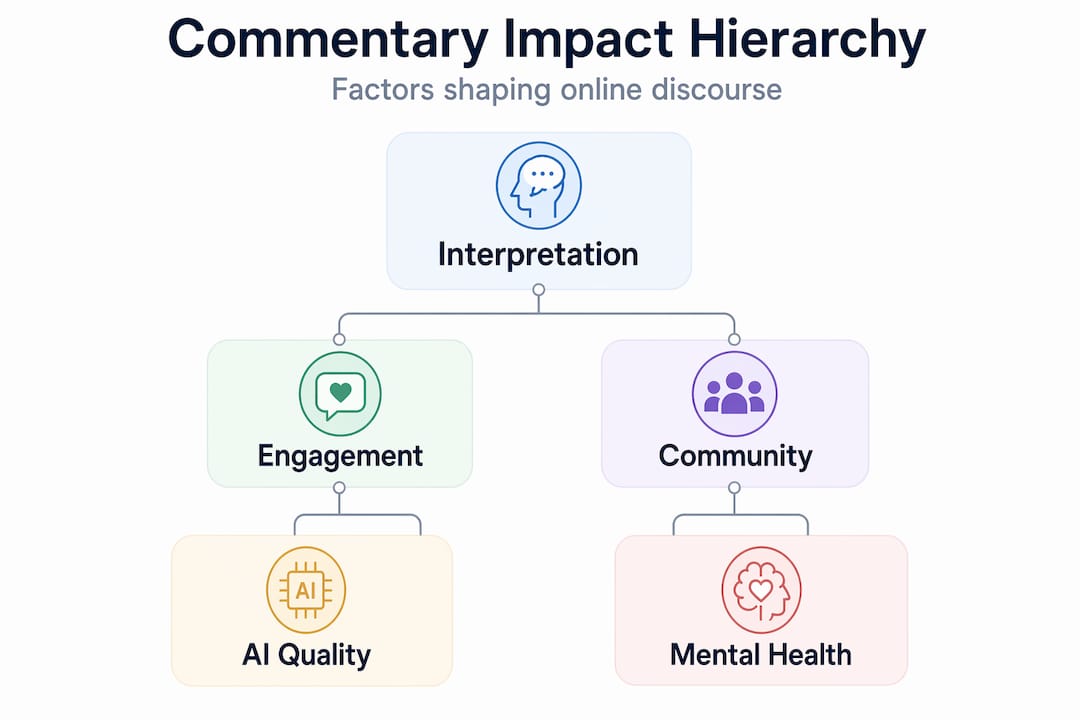
Mental health and the broader social picture
The mental health implications of social media commentary are impossible to separate from the platform mechanics that govern how commentary spreads. Social media platforms are built to optimise for engagement rather than user well-being, creating dopamine feedback loops that keep users scrolling, reacting, and replying beyond what is healthy.
The social media commentary effects on mental health and social cohesion are usefully summarised in the table below:
| Aspect | Potential benefit | Potential harm |
|---|---|---|
| Community formation | Belonging, solidarity, shared identity | Echo chambers, exclusion of contrary views |
| Public discourse | Exposure to diverse perspectives | Amplification of misinformation and extremism |
| Creative expression | Encouragement, feedback, creative collaboration | Harassment, public shaming, chilling of speech |
| Information access | Rapid dissemination of important news | Viral spread of false or misleading content |
| Political engagement | Civic participation, grassroots organising | Manipulation, synthetic influence campaigns |
Misinformation enforcement matters enormously here. Research analysing Twitter’s vaccine-related discourse found that removal of COVID-19 policy enforcement led directly to increased anti-vaccine content volume and amplified ideological clustering. What platforms choose to moderate or ignore does not merely reflect public sentiment. It actively constructs it.
The impact on mental health is not uniformly negative. Commentary sections that foster belonging and creative participation genuinely support user well-being. The problem is not social media itself. It is the engagement-first design philosophy that treats user attention as the primary resource to harvest.
Pro Tip: When reading heated commentary threads, pause before replying. Research consistently shows that a brief delay reduces reactive responses and produces more constructive contributions, better for you and the conversation.
Engaging responsibly with commentary
Understanding how commentary shapes social media is only useful if it translates into better habits. For individuals and organisations alike, the social media opinions influence that flows through comment sections requires conscious navigation rather than passive absorption.
Several practical principles apply:
- Treat the comment section as a framing device, not a fact-checker. Comments reveal how other users are interpreting content. They do not verify it. Distinguish between social consensus signals and actual evidence before updating your view
- Recognise platform effects. The news and commentary you encounter on any platform has already been filtered by recommendation algorithms designed to maximise your time on site, not to represent a balanced sample of opinion
- Participate constructively. The quality of any comment section is shaped by the quality of contributions it receives. Specificity, civility, and genuine curiosity produce better threads than hot takes
- Support moderation. Reporting harmful or misleading content is not censorship. It is community maintenance. Platforms with stronger moderation practices produce more valuable discourse for everyone
Pro Tip: Before sharing a post based on the reactions in the comment section, read the original source material independently. Commentary can create a vivid but distorted impression of what a piece actually argues.
The future of online commentary will be shaped by how platforms, publishers, and users respond to the pressure points identified above. AI moderation tools will improve. The line between human and AI-generated commentary will blur further. And the significance of social media dialogue in political and social life will only intensify.
My take on comments as a force in public life
I have been reading and writing about social media and political communication for long enough to remember when comment sections were treated as the embarrassing footnotes of serious journalism. That view was always wrong, and the evidence now confirms it.
What I have come to believe is that comments are not a failure of rational discourse. They are what rational discourse actually looks like at scale, messy, partial, emotionally inflected, and shaped by the social environment as much as by the content itself. The mistake is holding comment sections to a standard we do not apply to conversations in any other context.
What worries me more is the AI dimension. The risk is not that AI comments will be undetectable. It is that even partially detectable artificial commentary will normalise a kind of managed consensus, where the range of visible opinion is subtly narrowed by whoever controls the tools. That is a much more sophisticated problem than simple misinformation, and most platforms are nowhere near equipped to address it.
My practical advice is this: use comment sections actively and sceptically. Read them as social data, not as verdicts. The platform dynamics that shape what you see in any comment thread are real, and understanding them is part of being an informed reader in 2026.
— John
Explore more at Whitebunnywabbit
If the role of social media commentary in shaping political and public discourse is something you follow closely, Whitebunnywabbit offers a focused space for exactly this kind of analysis.
At Whitebunnywabbit, you will find opinion pieces, news commentary, and political analysis from a platform that treats its readers as people capable of forming their own views. From detailed breakdowns of how commentary functions in political narratives to educational resources covering social media dynamics and media literacy, the site is built for readers who want more than headlines. Spend five minutes on the site and you will understand why the comment thread beneath any political post deserves as much attention as the post itself.
FAQ
How does social media commentary affect political opinion?
Online comments alter how audiences interpret political content, even among people with firm prior views. A 2026 study across five European countries found this effect operates through the interpretive framing that comments create around a post, not through direct persuasion.
Are comment sections worth reinstating for news publishers?
Evidence suggests yes. Active commenters can be up to 48 times more engaged than non-commenting readers, and well-moderated comment sections increase subscriber retention. The business case for thoughtful reinstatement is strong.
Does AI-generated commentary undermine trust?
Partially. Around 39 to 44 per cent of AI-assisted comments are detected by other users, which creates a trust gap. AI tools that preserve individual voice and operate transparently produce less friction than those that generate generic, indistinguishable content.
What is the link between commentary and misinformation?
When content moderation policies are weakened, research shows that harmful content volumes increase and ideological clustering intensifies. Commentary sections without active moderation amplify misinformation rather than correcting it.
How should individuals protect their mental health in comment sections?
Platform design prioritises engagement over well-being, so deliberate limits on reactive behaviour matter. Pausing before replying, setting time boundaries, and distinguishing between community participation and passive consumption all reduce the negative mental health impact of social media commentary.
Leave a Reply