

Well-meaning advocates fail communities every day. Not through malice, but through haste: they arrive with megaphones before they’ve listened, launch campaigns before they’ve built trust, and measure success by reach rather than by whether the people they claim to amplify actually feel heard. To genuinely support marginalized community voices requires something more demanding than good intentions. It demands preparation, ethical rigour, and a willingness to follow community leadership rather than impose it. This guide offers the practical frameworks you need to do that work properly.
Table of Contents
- Key takeaways
- Support marginalized community voices through preparation
- Ethical participation and amplification methods
- Digital challenges in amplifying community voices
- Safety and ethical storytelling
- Verifying impact and sustaining empowerment
- My honest take on doing this well
- Explore resources for ethical advocacy
- FAQ
Key takeaways
| Point | Details |
|---|---|
| Preparation precedes participation | Map community diversity, vulnerabilities, and access needs before designing any engagement programme. |
| Consent is ongoing, not a signature | Treat consent as a living process with rights to review, edit, and withdraw at any stage. |
| Closing the feedback loop matters | Communities must see how their input influences decisions, or participation becomes extractive. |
| Digital tools require critical judgement | Algorithmic distortion and the digital divide can undermine justice goals if platforms are chosen carelessly. |
| Impact needs qualitative verification | Meaningful empowerment cannot be measured by attendance numbers alone; qualitative indicators and community ownership are the real test. |
Support marginalized community voices through preparation
Before you hold a single meeting or publish a single story, you need to understand who you are engaging with and what they actually need from you. This is not optional groundwork. UNDP advises that accessible meeting times, childcare provision, and inclusive communication must be prioritised over one-size-fits-all engagement, because inclusion is fundamentally a logistics problem before it becomes anything else.
Start by building a detailed picture of the communities involved. Consider:
- Who makes up each group, including sub-populations often excluded from even progressive spaces, such as disabled people, non-literate members, undocumented residents, or those with caring responsibilities.
- What barriers they face in terms of time, transport, language, digital access, and psychological safety.
- What existing power dynamics exist within the community itself, and how your external presence may shift those.
- What organisational clarity you can offer: who is asking for participation, why, what will happen to contributions, and who retains control.
Participatory territorial reading is one of the most underused techniques available to advocates. Rather than conducting surveys from the outside, you walk the physical and social geography of a community with its members, mapping it through their eyes. You learn which streets feel unsafe for women after dark, which community centre is trusted and which is associated with a hostile institution, and where informal networks of mutual aid already exist. This kind of mapping shapes everything that follows.
Pro Tip: When planning engagement sessions, run a differential access audit before setting dates. Ask yourself who is structurally excluded by the time, location, or format you have chosen, then redesign around the answer rather than the convenience.
Trust is not granted because you have good politics. It is built through consistent, transparent behaviour over time. That means showing up when you say you will, being honest about the limits of your power, and never overpromising what participation will deliver.
Ethical participation and amplification methods
Once you have done the preparatory work, the question becomes how to engage in ways that genuinely empower rather than extract. E-participation alone does not empower unless contributions visibly influence decisions and the process is designed with and for the affected communities. Participation that produces no visible change is not empowerment. It is data collection with extra steps.
The following framework helps you keep engagement meaningful at every stage:
- Co-design the process. Rather than presenting a ready-made engagement model, invite community members to help design how participation will work. UNESCO’s toolkit emphasises adapting tools to context rather than copying templates, because methods that work in one setting can be alienating or even harmful in another.
- Build in narrative control. The person sharing a story must retain the right to shape how it is told, to whom, and in what form. Ethical amplification means enabling people to author their own narratives, not harvesting testimony for your campaign.
- Screen for tokenism actively. Ask yourself whether the community members you are featuring are genuinely influencing outcomes or functioning as proof-of-diversity for an institutional audience. Tokenism is not neutral. It erodes trust and reproduces the marginalisation it claims to oppose.
- Apply the amplification criteria. Before publishing or sharing, assess whether the contribution meets three conditions: there is genuine gain for the contributor, distortion is low, and the positive effect outweighs the risk of backlash. Amplification must meet these conditions to further justice; otherwise it risks causing harm.
- Plan feedback explicitly. Tell participants what will happen to their contributions, by when, and how they will be informed of the outcomes. Then follow through.
Pro Tip: Record the explicit purpose of each contribution at the time of collection. When you return to use it months later in a different context, that record tells you whether the original consent still applies.
Digital challenges in amplifying community voices
Digital tools create extraordinary possibilities for advocates who want to amplify community voices. They also carry serious risks that are frequently underestimated. Digital activism success depends on societal readiness, economic access, political will, and technological infrastructure working in combination. Remove any one of those pillars and the digital channel may actively deepen inequality.

| Challenge | What it means in practice |
|---|---|
| Digital divide | Many marginalised people lack reliable device access, broadband, or digital literacy, making online-first approaches exclusionary. |
| Algorithmic distortion | Social media platforms amplify content according to engagement metrics, not justice criteria, which can reshape or drown community messages. |
| Context collapse | A story shared in a trusted community space can reach hostile audiences when redistributed online, exposing contributors to harm. |
| Feedback loop failure | Without closing the loop on how input was used, digital participation feels performative and breeds disengagement. |
The practical responses to these challenges include:
- Offering analogue and digital pathways in parallel so that access barriers do not determine who gets heard.
- Selecting platforms based on where the community already feels comfortable and safe, not where you have the largest following.
- Briefing contributors on how their content may travel once it leaves your control, including worst-case scenarios.
- Selecting channels and frames carefully, using heuristics about likely audience reception rather than defaulting to whatever platform is trending.
The feedback loop question is particularly important for advocates who want to engage with marginalized communities over the long term. If people contribute and never hear what happened as a result, they stop contributing. That silence is not apathy. It is a rational response to an experience of not being taken seriously.
Safety and ethical storytelling
The most powerful stories are often the most dangerous ones to tell. Any advocate who wants to support underrepresented populations through storytelling must treat safety not as a box to tick but as a continuous responsibility.
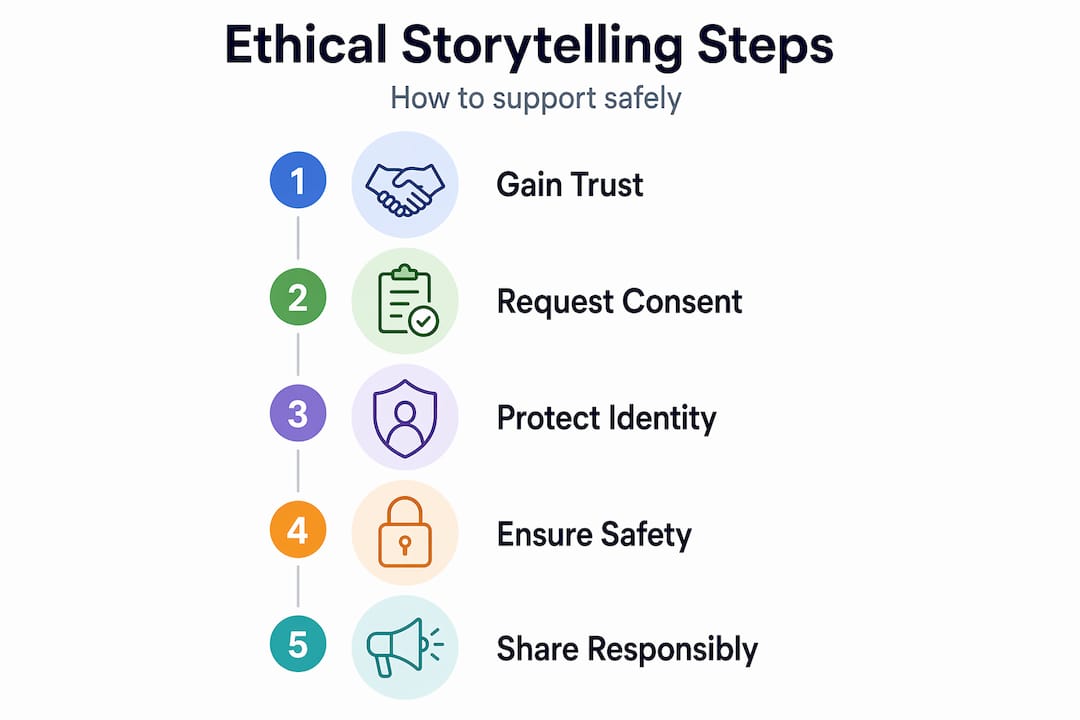
Consent is a process with rights to review, edit, and withdraw before publication. That means obtaining initial agreement is only the beginning. You need mechanisms for contributors to see drafts, request changes, and change their minds entirely, without social or professional consequence.
Collaborative story framing is one of the most useful practices available here. Rather than deciding how a story will be told and then seeking sign-off, you sit with the contributor and work out together what context is needed, what can safely be shared, and what must stay private. This is slower. It is also vastly more ethical and produces better journalism.
“The difference between amplification and extraction is not intent. It is whether the person whose story is being shared retains meaningful control over how it reaches the world.”
Identity protection requires more rigour than many advocates realise. Voice masking alone is often insufficient to protect identity in high-risk situations. Structural operational anonymity, including using different speakers, altering identifying details, and carefully controlling metadata, is necessary when contributors face genuine risk of retaliation. The latest reporting guidance on protecting vulnerable sources covers several of these techniques in detail.
Psychological safety is equally non-negotiable. Sharing difficult personal narratives can be retraumatising. Build in debriefs, offer signposting to support services, and never pressure contributors to include more than they have volunteered.
Verifying impact and sustaining empowerment
Good intentions are not a substitute for measurable outcomes. If you are serious about helping to foster equitable representation, you need to evaluate whether your work is actually achieving that.
- Move beyond attendance metrics. The number of people who showed up tells you very little. Ask instead: did participants report feeling genuinely heard? Did their contributions change the document, policy, or narrative in question? Use qualitative indicators alongside any quantitative data.
- Assess community leadership retention. The clearest sign of genuine empowerment is whether the community retains autonomous leadership over its own narrative after your involvement. If every story still routes through you, something has gone wrong.
- Build constant feedback mechanisms. Short regular check-ins are more valuable than annual evaluations. Create channels through which community members can tell you, honestly and without risk, when something is not working.
- Recognise when amplification causes harm. Closing the feedback loop builds trust and empowerment, but it also means listening when communities tell you an approach is backfiring. Be prepared to pause, withdraw content, or change tactics based on that feedback.
- Adjust dynamically. No plan survives contact with reality unchanged. Build review points into your timeline from the start so that adaptation is expected rather than treated as failure.
Building community advocacy networks that last requires this kind of honest self-evaluation. The communities you work with will remember whether your involvement left them stronger or simply more visible.
My honest take on doing this well
I’ve watched campaigns built with the best possible politics fall apart because the advocates involved confused amplification with solidarity. Visibility without power is not liberation. I’ve seen people from marginalised communities used as case studies in funding bids, their stories reshaped to fit a theory of change they had no part in writing, and then discarded when the funding cycle ended.
What I’ve learned from watching both failures and genuine successes is that the difference usually comes down to whether the community is in the room when decisions are made, not just when stories are collected. The ethical framework matters. The consent processes matter. But what matters most is whether you genuinely believe the community knows best about its own life, and whether your actions consistently reflect that belief.
The discomfort of slowing down, of ceding control, of accepting that your role is to support rather than lead, is precisely the work. It is not a preliminary obstacle to the real campaign. It is the campaign.
Commit to ongoing learning. Treat every piece of feedback as evidence and update your approach accordingly. This is not a fixed methodology you master once. It is a practice you refine throughout your working life.
— John
Explore resources for ethical advocacy
At Whitebunnywabbit, the commitment is to provide politically engaged readers with analysis and resources that respect the complexity of real advocacy work. If you are looking to deepen your practice around promoting inclusivity initiatives and building genuine community power, the site has been tracking these debates closely.

Whether you are navigating the ethics of digital storytelling, looking for frameworks to empower marginalized groups, or trying to make sense of how movements are using media responsibly, Whitebunnywabbit brings together commentary and resources to support that work. For those focused on building knowledge and skills, the educational resources section offers context and grounding for advocates at every stage of their practice.
FAQ
What does it mean to support marginalized community voices?
Supporting marginalised community voices means creating conditions where those communities can articulate their own needs, shape their own narratives, and see their contributions influence real decisions. It goes well beyond sharing stories on their behalf.
How do you avoid tokenism when advocating for marginalised groups?
Tokenism occurs when community members are included for appearance rather than influence. Avoid it by ensuring participants co-design processes, retain narrative control, and see their input reflected in outcomes rather than simply in promotional materials.
Why is consent an ongoing process in ethical storytelling?
Because circumstances change. A contributor may feel safe sharing a story at the time of collection and unsafe six months later when the political context has shifted. Ongoing consent protects against that vulnerability and keeps power with the storyteller.
What are the biggest risks of using social media to amplify community voices?
Algorithmic distortion, context collapse, and the digital divide are the three most significant risks. Platforms optimise for engagement, not justice, meaning community messages can be reshaped, misappropriated, or silenced based on opaque platform logic rather than community intent.
How do you measure whether community empowerment efforts are working?
Look beyond attendance and reach. Ask whether community members report feeling genuinely heard, whether their contributions changed decisions, and whether they retain leadership over their own narratives without your ongoing mediation.
Leave a Reply