
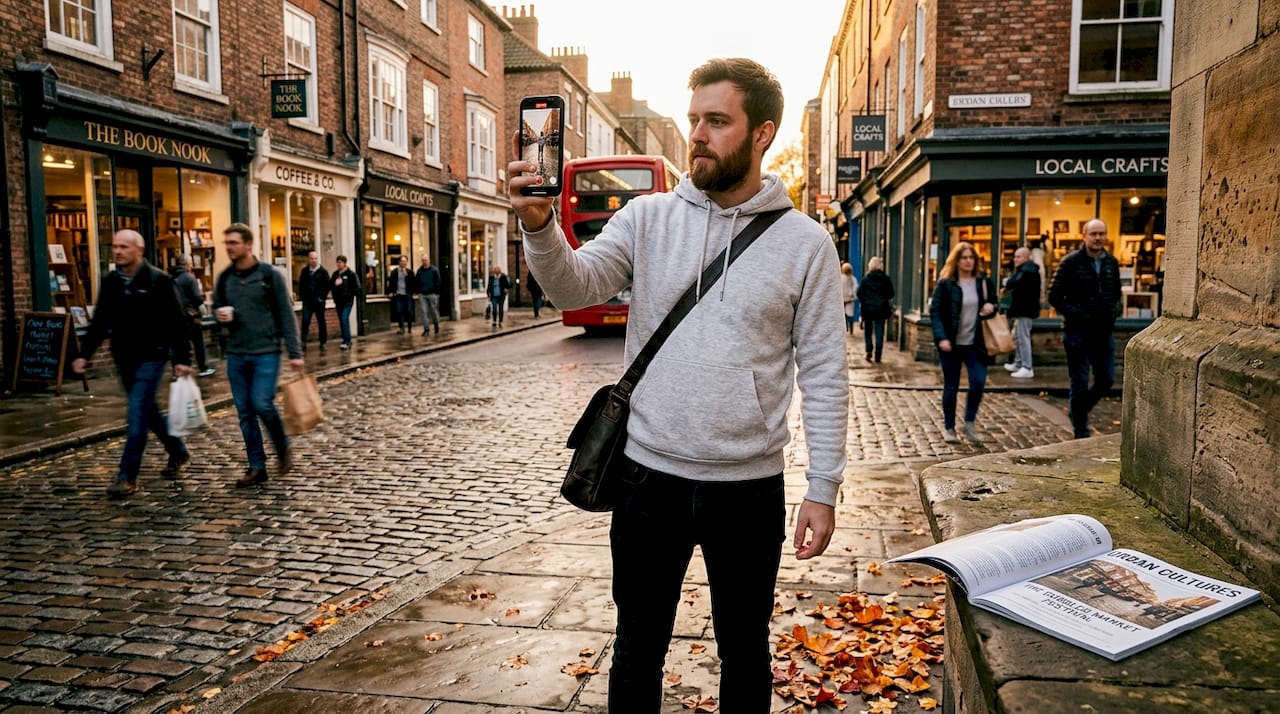
Citizen journalism is not a threat to professional newsrooms. It is, arguably, their most important supplement. What is citizen journalism, exactly? At its core, it is the act of ordinary people collecting, reporting, and sharing news, often in real time, without formal training or institutional backing. The smartphone in your pocket has made every witness a potential reporter. Yet most people still misunderstand what this means for how we consume news, who gets to tell stories, and why some of the most consequential reporting of the past two decades has come not from a newsroom, but from a bystander with a phone.
Table of Contents
- Key takeaways
- What is citizen journalism, exactly?
- Why citizen journalism matters
- How citizen journalism works in practice
- Citizen journalism vs traditional journalism
- Notable examples of citizen journalism
- My perspective on where this is all heading
- Explore more at Whitebunnywabbit
- FAQ
Key takeaways
| Point | Details |
|---|---|
| Citizen journalism defined | Ordinary people report and share news outside mainstream media, often using digital tools. |
| Gatewatching, not gatekeeping | Citizen journalists monitor and compile information rather than controlling what gets published. |
| Fills critical coverage gaps | Communities and stories ignored by mainstream outlets gain a voice through participatory reporting. |
| Technology shapes credibility | GNSS data and blockchain verification are improving the authenticity of citizen-produced content. |
| Misinformation is a real risk | Without editorial oversight, trust depends heavily on transparency and media literacy. |
What is citizen journalism, exactly?
The citizen journalism definition most scholars agree on is this: the collection, reporting, analysis, and dissemination of news and information by members of the general public, rather than professional journalists employed by media organisations. You may also see it called participatory journalism, grassroots journalism, or networked journalism. These terms are largely interchangeable, though each carries slightly different emphasis.
What sets it apart from simply posting on social media is intent and function. Citizen journalism is defined by community involvement and reporting, the use of accessible digital tools, and operation outside the structures of mainstream media. A tweet about your commute is not citizen journalism. A video you filmed of a protest that gets verified and broadcast nationally is.
Key characteristics of citizen journalism include:
- Accessibility: No formal qualifications are required. Anyone with a device and an internet connection can participate.
- Real-time reporting: Events are often captured and shared as they unfold, before professional crews arrive.
- Community focus: Stories frequently centre on local issues, marginalised groups, or events that mainstream outlets overlook.
- Digital platforms: Blogs, social media, YouTube, and podcasts are the primary distribution channels.
Historically, citizen journalism emerged partly because of the limits and biases embedded in mainstream media coverage. As mobile technology and broadband access spread through the early 2000s, the barriers to publishing dropped to near zero. The result was an explosion of what researchers call the “produser” model, where the audience acts as both producer and consumer of news content.
One concept worth understanding here is the shift from gatekeeping to gatewatching. Traditional journalists act as gatekeepers, deciding what information reaches the public. Citizen journalists act as gatewatchers, monitoring multiple information streams, compiling what they find, and presenting it to their audiences. It is a fundamentally different relationship with information.
Pro Tip: If you want to assess whether something qualifies as citizen journalism, ask two questions: Is the person reporting outside a professional media structure? And is the intent to inform others about events or issues? If yes to both, you are looking at citizen journalism.
Why citizen journalism matters
The importance of citizen journalism is most visible in the gaps it fills. Mainstream media, even at its best, cannot be everywhere. Budget cuts have gutted local newsrooms across the UK and beyond, leaving entire communities without dedicated coverage. Citizen journalists step into that void.
“The shift to citizen journalism empowers communities from subjects to authors, changing media’s fundamental structure and impact.” — Journalism University
The impact of citizen journalism on society operates on several levels:
- Local accountability: Town councils, planning decisions, and local policing are often scrutinised only because a resident decided to show up and report.
- Marginalised voices: Communities that professional media frequently misrepresent or ignore can tell their own stories on their own terms.
- Speed: During breaking events, citizen reports often surface minutes or hours before traditional outlets can deploy resources.
- Multi-perspective coverage: A single event covered by dozens of citizen journalists produces a richer, more contested account than a single correspondent’s dispatch.
The democratisation of news production is not merely a feel-good story, though. The same openness that makes citizen journalism powerful also makes it vulnerable. Misinformation is often driven not just by factual inaccuracy, but by narrow topic selection and writing style that mimics credibility. A citizen journalist with strong convictions and a large following can do real damage if they lack the editorial checks that professional newsrooms, at least in theory, apply.
Creator-led journalism is now described by former BBC News head Deborah Turness as the most disruptive shift the news industry has seen, driven by audiences demanding authenticity and personal connection. That demand is real and it is reshaping what news looks like. But demand for authenticity is not the same as a guarantee of accuracy.
How citizen journalism works in practice
Understanding how citizen journalism works means looking at both the tools people use and the emerging systems that help establish whether what they produce can be trusted.
The practical workflow for most citizen journalists follows a recognisable pattern:
- Witness or discover an event, issue, or story worth reporting.
- Document it using a smartphone, camera, or written notes.
- Publish via a blog, social media platform, YouTube channel, or community website.
- Engage with audience responses, corrections, and follow-up questions.
- Iterate by updating the story as new information emerges.
The platforms enabling this are well known: Twitter/X, Instagram, TikTok, Substack, WordPress, and YouTube are the primary vehicles. What is less well known is the technology now being developed to address citizen journalism’s credibility problem.
Research shows that integrating GNSS data and blockchain significantly increases the credibility and authenticity of citizen journalism content. GNSS provides precise geolocation for images and video, while blockchain creates an immutable timestamp, forming a digital chain of custody. A project called GeoNewsChain has demonstrated that smart contracts automate verification, improving both transparency and security without requiring human editorial intervention.

Here is a snapshot of the key tools and their roles:
| Tool | Function | Credibility impact |
|---|---|---|
| Smartphone camera | Captures photo and video evidence | High if metadata is preserved |
| GNSS geolocation | Verifies location of content capture | High, reduces fabrication risk |
| Blockchain timestamping | Creates immutable record of when content was created | High, prevents retroactive editing |
| Social media platforms | Distributes content rapidly to wide audiences | Variable, depends on platform moderation |
| Reverse image search | Checks whether images have been used previously | Medium, useful for basic verification |
Ethical challenges remain significant. Without editorial oversight, citizen journalists must make their own judgements about privacy, consent, and the potential harm their reporting could cause. Participatory transparency, the practice of openly sharing methods and motivations, is one of the most effective ways citizen journalists can build and maintain public trust.
Pro Tip: If you are reporting as a citizen journalist, always preserve the original metadata on your images and videos. Stripping metadata removes the very evidence that makes your content verifiable.
Citizen journalism vs traditional journalism
The citizen journalism vs traditional journalism debate is often framed as a competition. It is not. The two forms are better understood as occupying different but overlapping roles in the same information ecosystem.
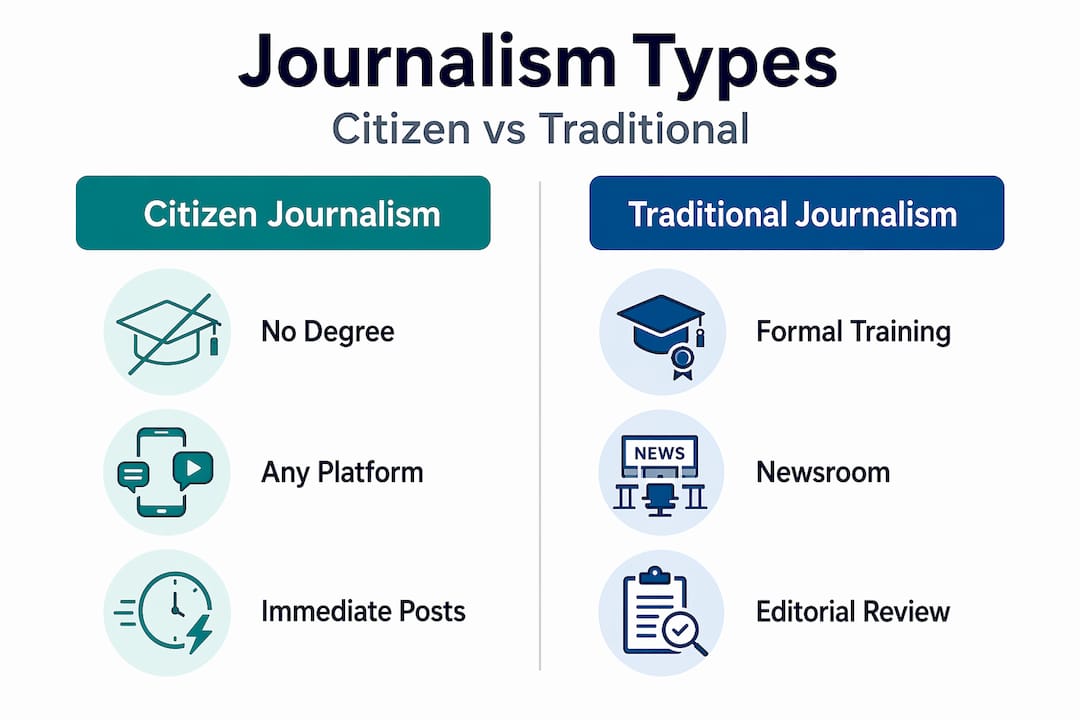
| Dimension | Citizen journalism | Traditional journalism |
|---|---|---|
| Training | None required | Formal education and editorial training |
| Editorial oversight | Minimal or none | Structured editorial process |
| Speed | Very fast | Slower due to verification steps |
| Reach | Variable, can go viral | Established, consistent audience |
| Accountability | Self-regulated | Legal and institutional accountability |
| Coverage focus | Local, niche, marginalised | Broad, national, institutional |
| Trust mechanisms | Transparency, community reputation | Editorial standards, brand credibility |
The benefits of citizen journalism are clearest where traditional journalism is weakest: local coverage, speed, and access to closed or dangerous environments. Professional journalists, by contrast, bring editorial rigour, legal protection, and institutional credibility that most citizen journalists simply do not have.
What the best media organisations have learnt is that citizen journalism complements professional journalism by filling critical local and marginalised coverage gaps. The BBC’s use of user-generated content during breaking news events, or The Guardian’s reader-submitted reporting, are both examples of professional outlets recognising that their audiences can be sources, not just consumers.
The impact on trust is nuanced. A 2025 meta-analysis found that people can generally discern true news from fact-checked false news, though they tend to err on the side of scepticism. That scepticism applies to citizen journalism too, which means the burden of building trust falls squarely on the individual reporter.
Notable examples of citizen journalism
Citizen journalists examples from the past two decades illustrate just how consequential this form of reporting has become. A few cases stand out.
The Arab Spring of 2010 to 2012 is perhaps the most cited example. In countries where state media controlled the narrative, ordinary citizens used social media to document protests, crackdowns, and political upheaval. Their footage reached global audiences and shaped international responses to events that professional journalists could not safely cover.
In the UK, local community Facebook groups and neighbourhood blogs have repeatedly broken stories about planning decisions, local crime patterns, and council misconduct before any regional newspaper picked them up. You can find examples of this kind of community-driven reporting across Whitebunnywabbit’s news coverage.
Other significant patterns include:
- Crisis documentation: Citizen journalists were among the first to share footage of the 2011 Tōhoku earthquake and tsunami in Japan, providing real-time information when official channels were overwhelmed.
- Social movements: The Black Lives Matter movement in the United States gained much of its early momentum from citizen-filmed footage of police encounters that mainstream media had not covered.
- Censored environments: In authoritarian states, citizen journalists often operate at personal risk to document events that state media suppresses entirely.
- Hyperlocal accountability: Residents reporting on local newspaper coverage gaps have driven investigations into issues from school funding to environmental violations.
The participatory nature of citizen journalism means audiences are not passive recipients. They respond, correct, share, and sometimes contribute additional evidence. That feedback loop is part of what makes it distinct from traditional broadcast journalism.
My perspective on where this is all heading
I have followed the evolution of citizen journalism closely, and the thing that strikes me most is how badly both sides of the debate have misread it. Traditionalists who dismissed it as amateur noise missed the fact that some of the most important footage of the past decade came from people who had never set foot in a journalism school. And enthusiasts who claimed it would replace professional media underestimated how much editorial infrastructure actually matters.
What I have come to believe is that citizen journalism’s real power is not in replacing anything. It is in forcing professional media to reckon with its own blind spots. When a community starts reporting on itself because no one else will, that is not a failure of technology. It is a failure of institutional journalism to serve the people it claims to represent.
The misinformation problem is real, but I think it is often overstated as an argument against citizen journalism specifically. Professional outlets have published misinformation too. The difference is accountability, and that is a solvable problem. Media literacy education, transparent reporting practices, and verification technology are all moving in the right direction.
What concerns me more is the concentration of citizen journalism on platforms owned by a handful of corporations. The freedom to report independently means very little if the distribution channel can remove your content without explanation. That tension between access and control is the defining challenge for citizen journalism in the years ahead.
— John
Explore more at Whitebunnywabbit
If this piece has sharpened your thinking about citizen journalism and the media, Whitebunnywabbit is worth bookmarking. The platform covers political analysis, current affairs, and social commentary with a direct, no-filler approach that suits readers who want substance over spin.

Whether you are tracking a developing story, looking to understand the forces shaping how news is made, or simply want a reliable place to read and think, Whitebunnywabbit’s coverage brings together the kind of commentary that treats its audience as intelligent adults. For those interested in going deeper on media literacy and journalism, the education resources section offers further reading worth your time.
FAQ
What is the citizen journalism definition?
Citizen journalism refers to the collection, reporting, and sharing of news by ordinary members of the public, outside professional media organisations, typically using digital tools such as smartphones and social media platforms.
How does citizen journalism differ from traditional journalism?
Traditional journalism operates within institutional structures with editorial oversight and formal training, while citizen journalism is self-directed, faster, and often focused on local or marginalised stories that professional outlets miss.
What is participatory journalism?
Participatory journalism is another term for citizen journalism, emphasising the active involvement of audiences in producing news rather than simply consuming it. It reflects the shift from passive reader to active contributor.
Can citizen journalism be trusted?
Research shows that audiences can generally distinguish true from false news, but trust in citizen journalism depends heavily on the reporter’s transparency about their methods and motivations. Verification tools such as blockchain and GNSS are improving credibility.
What are the main benefits of citizen journalism?
The core benefits include speed of reporting, coverage of underreported local and marginalised stories, and the democratisation of who gets to tell the news. It gives communities a direct voice in how their stories are told.
Leave a Reply