

Opinion journalism gets a bad reputation it hasn’t entirely earned. Most people assume it’s simply bias dressed up as reporting, or that it operates without standards. That misreading misses something significant. Understanding how opinion journalism works reveals a structured, ethically governed practice that plays a genuine role in democratic public life. This guide covers what opinion journalism actually is, how it’s produced, the ethics that govern it, and how to write it well. Whether you’re a student, an aspiring columnist, or simply a politically engaged reader, this is the explainer you’ve been looking for.
Table of Contents
- Key takeaways
- How opinion journalism works: definitions and distinctions
- The editorial process behind opinion pieces
- Ethics and disclosure in opinion writing
- Practical techniques for writing opinion pieces
- Why opinion journalism matters
- My take on opinion journalism today
- Explore more at Whitebunnywabbit
- FAQ
Key takeaways
| Point | Details |
|---|---|
| Opinion is structurally distinct | Opinion journalism presents explicit viewpoints, unlike neutral news reporting or contextual analysis. |
| Editorial workflows have rigour | Institutional opinion pieces go through topic selection, drafting, review, and editorial consensus before publication. |
| Ethics still apply | Clear labelling, conflict-of-interest disclosure, and factual accuracy are non-negotiable even in opinion writing. |
| Structure drives persuasion | Effective opinion pieces open with a hook, state a thesis early, address counterarguments, and close with purpose. |
| Tone matters as much as argument | Writing with measured reasoning rather than outrage connects better with readers who already disagree with you. |
How opinion journalism works: definitions and distinctions
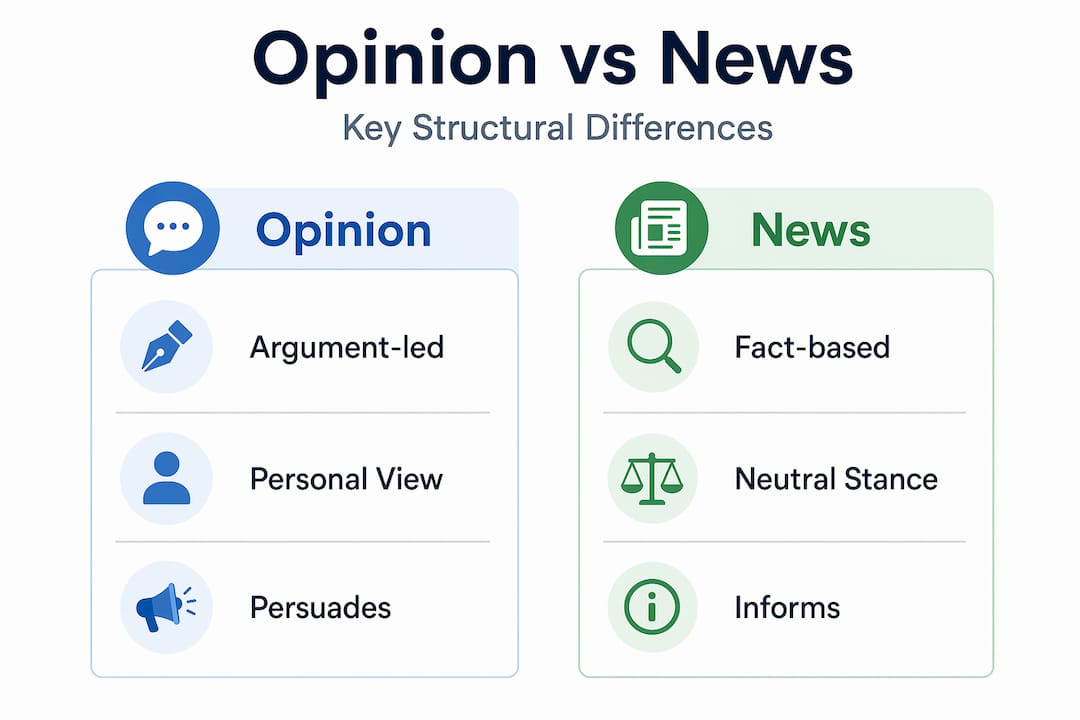
The most common mistake people make is treating opinion journalism as a catch-all for anything that isn’t straight news. It isn’t. Opinion journalism explicitly presents a point of view and is structurally distinct from news reporting, which aims to describe events without advocacy.
Many outlets add a third category to complicate things further. “News analysis” interprets context and explains significance but does not advocate for a position. A piece explaining why a government’s housing policy has failed economically is analysis. A piece arguing the government should resign over it is opinion. The distinction matters because each form carries different expectations for the reader.
Opinion journalism takes several common forms:
- Editorials: Written under the publication’s name, representing the collective institutional view. No individual byline.
- Op-eds: Opinion pieces submitted by external contributors or solicited from experts. Attributed to individuals.
- Columns: Regular opinion features written by staff or contracted writers, often with a defined focus or beat.
- Letters to the editor: Short reader responses, rarely over 200 words, that form part of the ongoing public dialogue.
- Criticism and reviews: Evaluative writing about culture, books, film, or policy, grounded in aesthetic or analytical judgement.
What unites all these forms is the presence of an explicit argument. Having a strong opinion alone is insufficient. Rigorous argumentation and credible support are what separate opinion journalism from a social media rant.
| Form | Authorship | Typical length | Purpose |
|---|---|---|---|
| Editorial | Publication (no byline) | 400–800 words | Institutional advocacy |
| Op-ed | Named individual | 400–1000 words | External perspective |
| Column | Named staff writer | 600–900 words | Regular commentary |
| Letter to editor | Reader | Under 200 words | Public response |
The editorial process behind opinion pieces
Knowing the workflow that produces opinion journalism is what separates readers who consume it critically from those who take it at face value. The process is more deliberate than most people realise.
For institutional editorials, the process typically follows these steps:
- Topic selection: The editorial board identifies issues of public significance, often tied to breaking news or policy developments.
- Internal deliberation: Board members debate positions, consider evidence, and reach a consensus view.
- Drafting: A staff writer or board member drafts the piece based on the agreed position.
- Review and revision: The draft circulates for fact-checking, legal review where relevant, and editorial refinement.
- Publication: The piece runs under the publication’s masthead, not an individual byline.
Op-eds and columns follow a lighter process, but still involve editorial oversight. A submitted op-ed will be assessed for factual claims, clarity, and whether it adds something genuinely new to the conversation. Columns written by staff writers typically go through a section editor before publication.
One structural safeguard that deserves more attention is the newsroom firewall. Beat reporters do not participate in editorial decisions on their beats. A political correspondent who covers Parliament does not sit on the editorial board deciding what position the paper takes on parliamentary reform. This separation of authority is what keeps advocacy from contaminating reporting.

Letters to the editor form part of opinion content’s lifecycle, enabling public engagement and accountability. When a publication publishes a strong editorial and then runs dissenting letters the following week, that’s the system working as intended.
Pro Tip: If you’re submitting an op-ed to a publication, read its recent opinion pieces carefully. Editors want pieces that extend an existing conversation, not ones that ignore what the publication has already said on the topic.
Ethics and disclosure in opinion writing
Opinion journalism carries a common misconception: that because it’s advocacy, normal journalistic standards don’t apply. That’s wrong, and dangerously so.
Clear labelling of opinion and commentary is a core requirement under SPJ (Society of Professional Journalists) ethics. Readers must be able to distinguish news from opinion from sponsored content. When that distinction blurs, public trust in the entire publication erodes.
Specific ethical obligations in opinion journalism include:
- Conflict-of-interest disclosure: If you’re writing about an industry in which you have financial interests, that must be declared. FTC endorsement rules mandate clear labelling of sponsored opinion content.
- Factual accuracy: Opinion protection does not cover false factual claims. You can argue that a policy is misguided. You cannot fabricate statistics to support that argument.
- Expertise boundaries: Writing confidently about areas outside your knowledge is one of the fastest ways to lose credibility. Stick to what you genuinely understand.
- Intellectual honesty: Acknowledging the strongest version of the opposing argument, rather than a weakened caricature, is both an ethical obligation and a persuasive strategy.
“Opinion journalism’s power comes precisely from its credibility. The moment readers suspect an opinion writer is hiding something or distorting facts, the argument collapses regardless of its underlying merit.”
That last point is worth sitting with. Opinion journalism that cherry-picks evidence or ignores inconvenient facts isn’t just ethically compromised. It’s also ineffective, because sophisticated readers notice.
Practical techniques for writing opinion pieces
Good opinion writing is a craft. The structure, tone, and evidence you choose determine whether your piece persuades or merely preaches.
The standard structure for an effective opinion piece works like this:
- Hook: Open with a specific scene, surprising fact, or provocative question. Not a vague generalisation.
- Thesis: State your argument clearly within the first two paragraphs. Readers shouldn’t have to guess what you think.
- Supporting arguments: Build your case with evidence, examples, and expert quotes. Op-eds typically run 400 to 1000 words, so every paragraph must earn its place.
- Counterargument: Address the strongest objection to your position. Dismissing it weakens you. Engaging it seriously strengthens you.
- Conclusion: End with purpose. A call to action, a reframing of the stakes, or a clear statement of what you want readers to think or do differently.
Strong opinion pieces combine logos, pathos, and ethos to persuade. Logos is your evidence and reasoning. Pathos is the emotional resonance of your argument. Ethos is your credibility as a writer. Neglect any one of these and the piece suffers.
On tone: write in plain, direct language. Avoid jargon unless you explain it. Use active voice. And choose your topics carefully. The best opinion pieces come from writers who have a genuine personal connection to the subject and something specific to say about it.
Pro Tip: Choose a topic that is timely but not so immediate that your piece will be irrelevant in 48 hours. The best op-eds speak to a current moment while making a point that holds beyond the news cycle.
Why opinion journalism matters
The importance of opinion journalism extends well beyond individual pieces. Opinion pieces serve as a platform for varied voices influencing public debate and challenging dominant narratives. That function is not decorative. It is structural to how democracies process disagreement.
When a newspaper editorial board argues for a particular policy position, it is not simply expressing preference. It is contributing to a public record of argument that politicians, citizens, and future historians can examine. When a columnist from a marginalised community writes about an experience the mainstream press has ignored, that piece can shift the frame of an entire debate.
Opinion journalism also creates accountability. A publication that takes a strong public stance on an issue is then obligated to report honestly on developments related to that issue. The editorial position becomes a standard against which the publication’s own coverage can be measured.
“The value of opinion journalism isn’t that it gives us the right answers. It’s that it insists on the questions being asked at all.”
The digital age has complicated this picture. The volume of opinion content has exploded, and the standards applied to it vary enormously. That makes media literacy more important than ever. Readers who understand how opinion journalism works are better equipped to assess the arguments they encounter, identify undisclosed conflicts of interest, and distinguish genuine advocacy from manufactured outrage.
My take on opinion journalism today
I’ve spent years reading, editing, and writing opinion journalism, and the thing that strikes me most is how rarely writers ask themselves a simple question: who am I actually trying to persuade?
Most opinion writing is aimed at people who already agree. That’s not persuasion. That’s performance. The pieces that actually shift minds are the ones written with what David French calls writing with regret, not outrage. They acknowledge the difficulty of the issue. They treat the opposing view with genuine respect. They make you feel the writer has thought hard about this, not just reacted.
The other thing I’ve learned is that expertise matters more than passion. I’ve seen writers with brilliant instincts destroy their credibility by straying into territory they don’t understand. Aligning arguments with your actual knowledge is what makes opinion writing credible rather than merely confident.
If you’re starting out, write about what you genuinely know. Write to change minds, not to confirm them. And read widely across opinion you disagree with. That’s where you’ll learn the most.
— John
Explore more at Whitebunnywabbit
If this guide has sharpened your interest in opinion journalism and media literacy, Whitebunnywabbit is worth bookmarking. The site publishes regular commentary and analysis on politics, policy, and current affairs, making it a useful reference point for anyone following public debate closely.

The education resources at Whitebunnywabbit are particularly useful for students and aspiring journalists looking to develop their understanding of how media works in practice. For ongoing political commentary, analysis, and opinion content that models the principles discussed in this article, the main Whitebunnywabbit platform is a good place to start. Explore it alongside what you’ve read here and you’ll find the theory and the practice sitting side by side.
FAQ
What is opinion journalism?
Opinion journalism is a form of journalism that explicitly presents a point of view, supported by argument and evidence, as distinct from neutral news reporting. Common formats include editorials, op-eds, columns, and letters to the editor.
How is opinion journalism different from news reporting?
News reporting aims to describe events without advocacy, while opinion journalism argues for a position. Many outlets also use a middle category called news analysis, which interprets context without explicitly advocating.
What ethical standards apply to opinion writing?
Opinion writers must clearly label their content, disclose conflicts of interest, and avoid false factual claims. SPJ guidelines and FTC rules both apply to opinion and commentary content.
How do you structure an opinion piece?
A strong opinion piece opens with a hook, states its thesis early, builds arguments with evidence, addresses counterarguments, and closes with a clear purpose or call to action. Most op-eds run between 400 and 1000 words.
Why does opinion journalism matter in a democracy?
Opinion journalism creates a public record of argument, challenges dominant narratives, and gives voice to perspectives the mainstream press might overlook. It plays a structural role in how democratic societies process disagreement and hold institutions to account.
Leave a Reply